Clear Sky Science · en
Trimester-aware yoga video recommendation using hybrid deep learning for pregnant woman
Why smarter prenatal yoga matters
Many expectant mothers turn to YouTube for prenatal yoga, hoping to ease back pain, reduce stress, and sleep better. But not every pose is safe at every stage of pregnancy, and most video platforms are not designed with pregnancy in mind. This study presents a new way to automatically recommend online yoga videos that match a woman’s trimester and health needs, aiming to keep both mother and baby safe while still delivering the physical and emotional benefits of yoga. 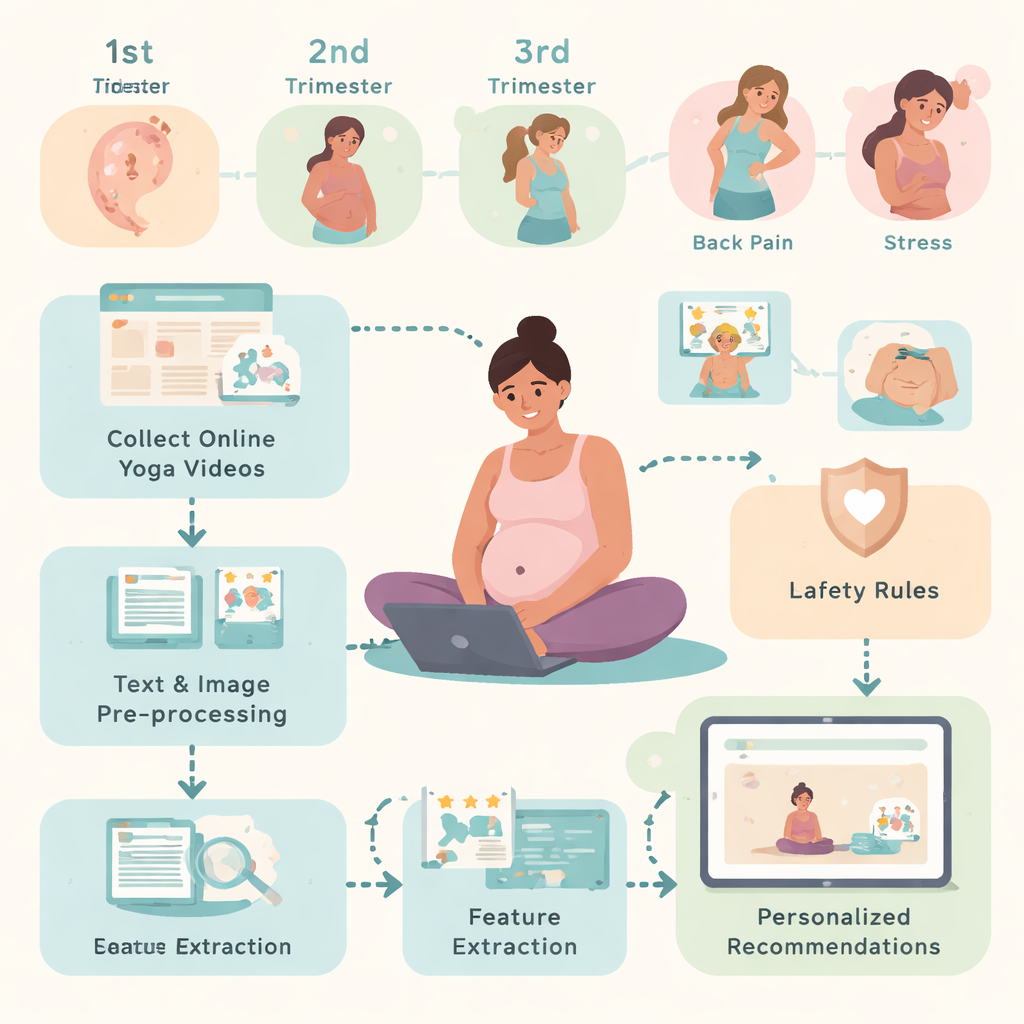
The challenge of safe yoga during pregnancy
Pregnancy puts unusual demands on the body and mind. Hormonal shifts, changes in posture, and growing pressure on internal organs can make even simple movements feel different and sometimes risky. Research shows that unmanaged stress and anxiety in mothers can affect fetal brain development and later behavior in children. Yoga is widely recognized for improving flexibility, strength, mood, and the body’s stress systems, making it a promising tool for prenatal care. Yet many online routines do not distinguish between trimesters, and some include poses—like deep twists or long periods lying flat on the back—that are not recommended for pregnant women. The authors argue that any digital yoga guide for pregnancy must put safety and context at the center, not treat it as an afterthought.
Turning messy online videos into useful guidance
The researchers assembled a specialized dataset of 200 prenatal yoga videos from YouTube and a professional platform, Yoga Download. Each video was carefully screened by prenatal experts to remove routines with unsafe positions and was labeled with trimester, difficulty level, and main benefits, such as stress relief or back pain support. From these videos, the team broke the footage into more than 35,000 individual frames and cleaned them using a sophisticated denoising filter so details of body posture remained sharp. They also processed the video titles, descriptions, and tags by stripping out filler words, splitting sentences into meaningful terms, and reducing them to their base forms. This dual cleanup—of text and images—laid the groundwork for an intelligent system that could “understand” what each video offers and for whom it is appropriate.
How the AI model learns what is safe
At the heart of the system is a hybrid deep learning model that looks at both words and visuals. For text, it uses a boosted version of a standard technique that scores how important each word or phrase is across all videos. For images, it relies on a powerful vision network called ResNet152 to turn each yoga pose frame into a detailed numerical fingerprint. These fingerprints are then combined and compared with a profile of the user that includes her trimester, health concerns, and preferred difficulty. A special similarity measure gives extra weight to safety in early pregnancy, where risks are higher, and relaxes slightly in later trimesters. On top of this, a graph-based neural network links together users, poses, videos, and health conditions, allowing safety rules—such as “avoid strong abdominal compression in the first trimester”—to spread throughout the recommendation system. 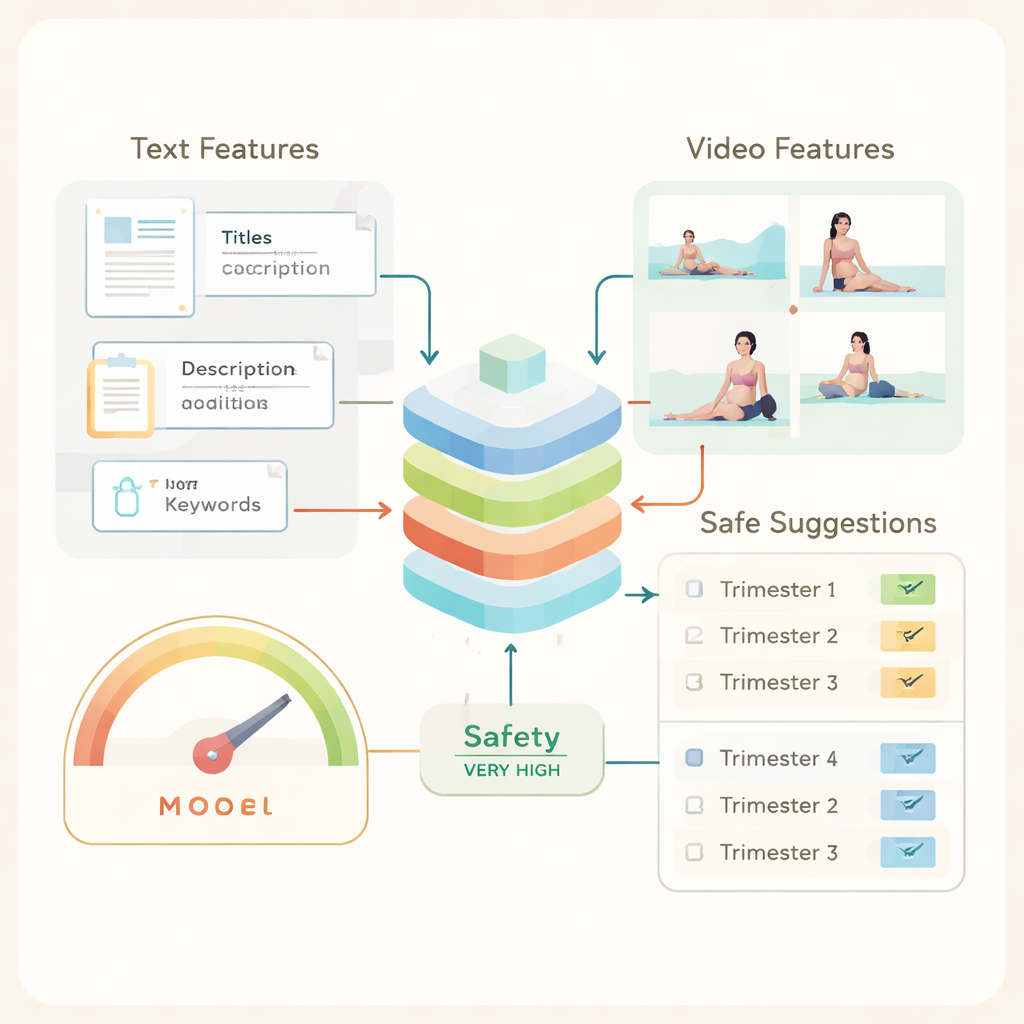
Testing accuracy and safety in the real world
To see whether their approach works, the authors compared it with several established deep learning and recommendation methods. They evaluated not only how often the model picked the right video, but also how highly it ranked the best options in a list of suggestions. Across multiple tests, including five rounds of cross-validation, the system reached about 98.3% accuracy and strong scores on precision, recall, and ranking quality. Importantly, it achieved over 97.5% compliance with trimester-specific safety rules, and nearly perfect safety in the first trimester. A panel of obstetricians and certified prenatal yoga instructors independently reviewed a sample of the recommendations and agreed with the system’s choices in more than 94% of cases, lending clinical credibility to the results.
What this means for pregnant women and beyond
For a layperson, the main message is that it may soon be possible to open a yoga app or video site, enter a few simple details about pregnancy stage and health, and receive a short list of routines that are not only helpful but also screened for safety. The study shows that by combining careful data cleaning, powerful pattern-recognition tools, and explicit safety rules, artificial intelligence can act more like a cautious prenatal instructor than a generic video recommender. While this work focuses on yoga in pregnancy, the same ideas could guide safe exercise suggestions for people with heart conditions, joint problems, or other medical needs—offering personalized support while keeping health risks firmly in check.
Citation: Bawistale, K., Rajendran, S. & Khalid, M. Trimester-aware yoga video recommendation using hybrid deep learning for pregnant woman. Sci Rep 16, 6229 (2026). https://doi.org/10.1038/s41598-026-37149-y
Keywords: prenatal yoga, pregnancy health, personalized recommendations, deep learning, safe exercise