Clear Sky Science · en
Possible favored great oxidation event scenario on exoplanets around M-stars with the example of TRAPPIST-1e
A Faster Road to Breathable Worlds
On Earth, it took billions of years for the atmosphere to become rich in oxygen, paving the way for animals and complex life. This study asks whether some distant planets might reach that life-friendly state much sooner. By focusing on TRAPPIST‑1e, a nearby Earth-sized world orbiting a small red star, the authors explore how starlight and atmospheric chemistry could speed up—or slow down—the rise of oxygen, and how future telescopes might actually spot such a transformation from afar.
From Earth’s Slow Turn to an Oxygen-Rich Sky
Earth’s “Great Oxidation Event” about 2.4 billion years ago marks the first time oxygen built up significantly in our air. Even though microbes that produced oxygen by photosynthesis appeared earlier, oxygen remained scarce for hundreds of millions of years. Geological clues in ancient rocks, along with computer models, show that this delay was tied to a delicate balance: oxygen had to be produced fast enough and removed slowly enough for the atmosphere to flip from oxygen-poor to oxygen-rich. A major culprit in removing oxygen was methane, a simple carbon-containing gas that reacts with oxygen in a chain of fast chemical steps.
How a Red Star Changes the Chemistry
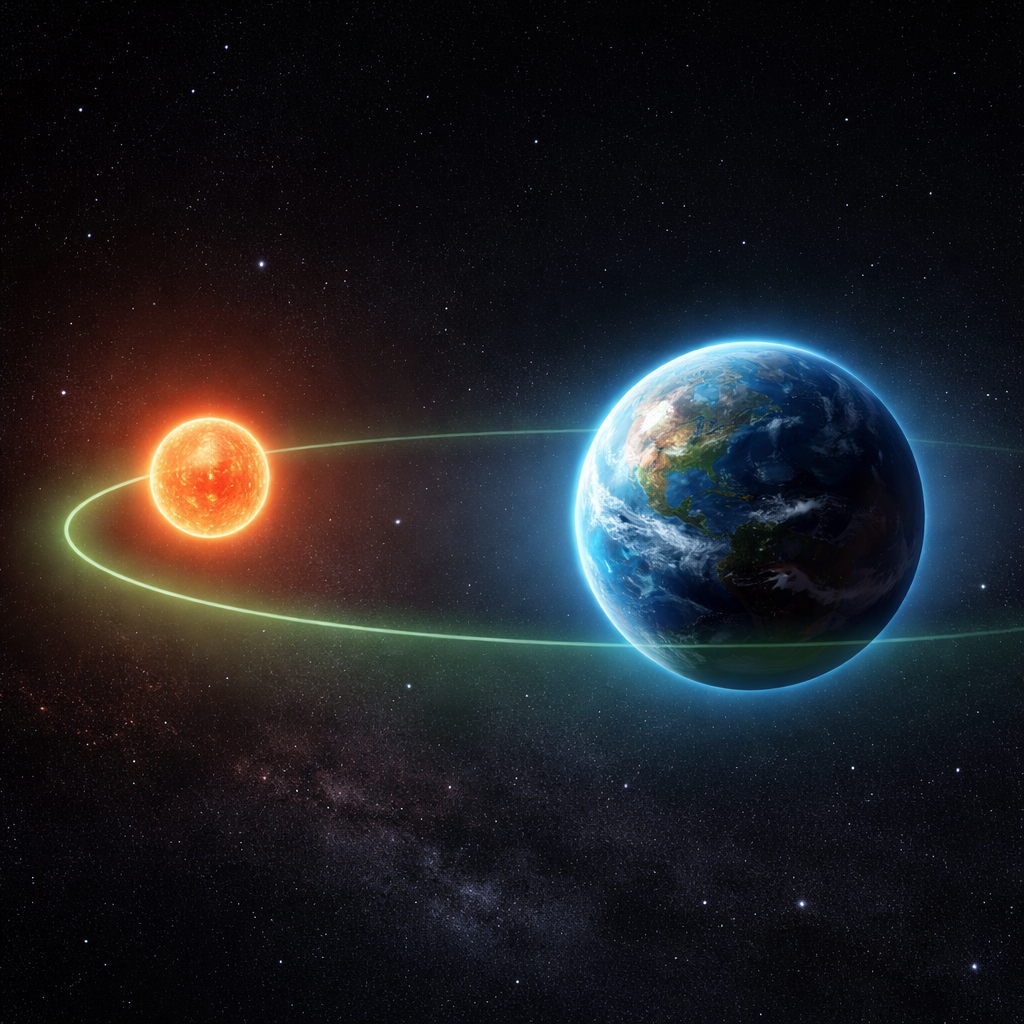
TRAPPIST‑1e orbits an M‑dwarf star—small, cool, and red compared with our Sun. Such stars emit light with a very different blend of colors, especially in ultraviolet (UV) wavelengths that drive atmospheric chemistry. Using a detailed climate and chemistry model, the authors treat TRAPPIST‑1e as an “early Earth in another system,” giving it similar gases but bathing it in TRAPPIST‑1’s light. They find that this red star’s UV output favors the formation of ozone, a molecule made of three oxygen atoms that forms a protective high‑altitude layer. On TRAPPIST‑1e, that ozone layer appears at much lower oxygen levels than it did on Earth, and it becomes thicker overall.
Ozone as Both Shield and Oxygen Booster
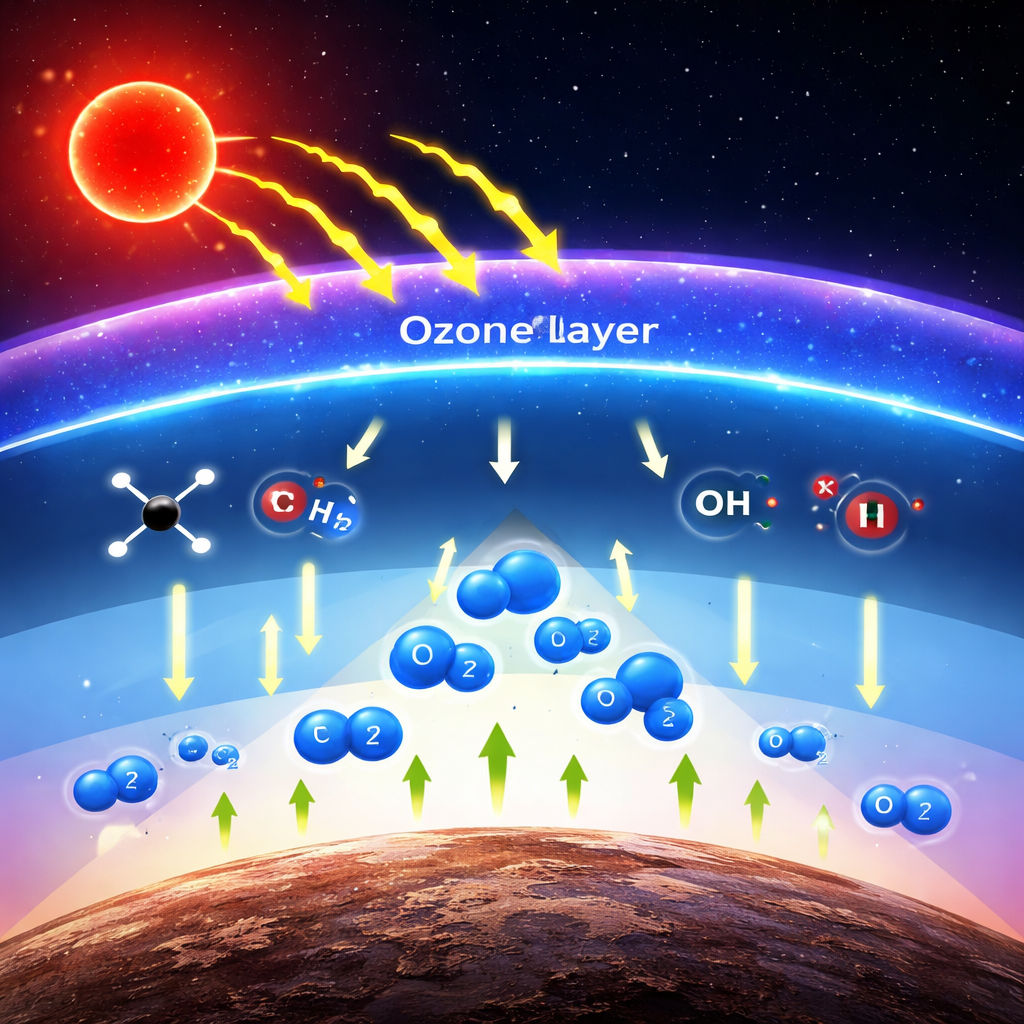
Ozone does more than block harmful UV rays—it reshapes how quickly oxygen is destroyed. On early Earth, methane reacted away with oxygen through a chain of reactions powered by highly reactive “radicals” such as OH. The new simulations show that on both Earth and TRAPPIST‑1e, many of these radicals are created when sunlight breaks apart hydrogen peroxide and other compounds at specific UV wavelengths. As ozone builds up, it absorbs that very same UV light, cutting off the main supply of radicals and slowing methane’s destruction of oxygen. This creates a feedback loop: more ozone means fewer radicals, which means less oxygen loss, which in turn allows oxygen—and therefore ozone—to climb even higher.
A Quicker Jump to an Oxygen-Rich World
Because TRAPPIST‑1’s spectrum boosts ozone so efficiently, this positive feedback kicks in at lower oxygen levels than on Earth. In the modeled scenario, if TRAPPIST‑1e hosts Earth‑like life that produces oxygen at similar rates, the planet’s atmosphere would “tip” into an oxygen-rich state up to about a billion years earlier than Earth’s did. The study also shows that even modest non‑biological oxygen sources—such as the slow loss of water to space early in the planet’s history—could be enough to trigger this runaway rise on TRAPPIST‑1e, even though the same flux would not have sufficed on Earth. In essence, around certain red stars, atmospheres may be naturally biased toward becoming oxidized.
Watching for Distant Oxygen with JWST
If TRAPPIST‑1e ever experienced such a rapid oxygenation, could we tell from here? The team uses their atmospheric models to simulate what the James Webb Space Telescope (JWST) would see as the planet passes in front of its star. Because ozone is more abundant in their TRAPPIST‑1e scenario than in an Earth‑like case, its spectral fingerprints—subtle dips in starlight at specific infrared wavelengths—stand out more strongly. They find that one ozone feature near 4.6 micrometers, observable with JWST’s NIRSpec instrument, could be detected with a few dozen repeated transits, far fewer than earlier estimates that relied on a weaker feature at 9.7 micrometers.
What This Means for Life Around Red Stars
For non‑specialists, the takeaway is that not all habitable planets are created equal. Around some red dwarf stars, the very color and strength of the starlight can make it easier for a world to build a thick ozone layer and retain oxygen, long before Earth managed the same feat. That could give complex, oxygen‑breathing life a head start on such planets. At the same time, strong ozone can be both protective and potentially harmful at the surface, and the true prospects for photosynthesis under red suns remain uncertain. Still, this work suggests that nearby systems like TRAPPIST‑1 offer promising targets in the search for distant worlds that may already have taken the crucial step toward an oxygen‑rich, life‑friendly atmosphere.
Citation: Jaziri, A.Y., Carrasco, N. & Charnay, B. Possible favored great oxidation event scenario on exoplanets around M-stars with the example of TRAPPIST-1e. Sci Rep 16, 6322 (2026). https://doi.org/10.1038/s41598-026-37144-3
Keywords: TRAPPIST-1e, ozone, Great Oxidation Event, M-dwarf stars, exoplanet atmospheres