Clear Sky Science · en
Generalized spatial two stage least squares analysis of foreign direct investment air pollution and green technology innovation in Chinese cities
Why foreign money and clean air matter to city life
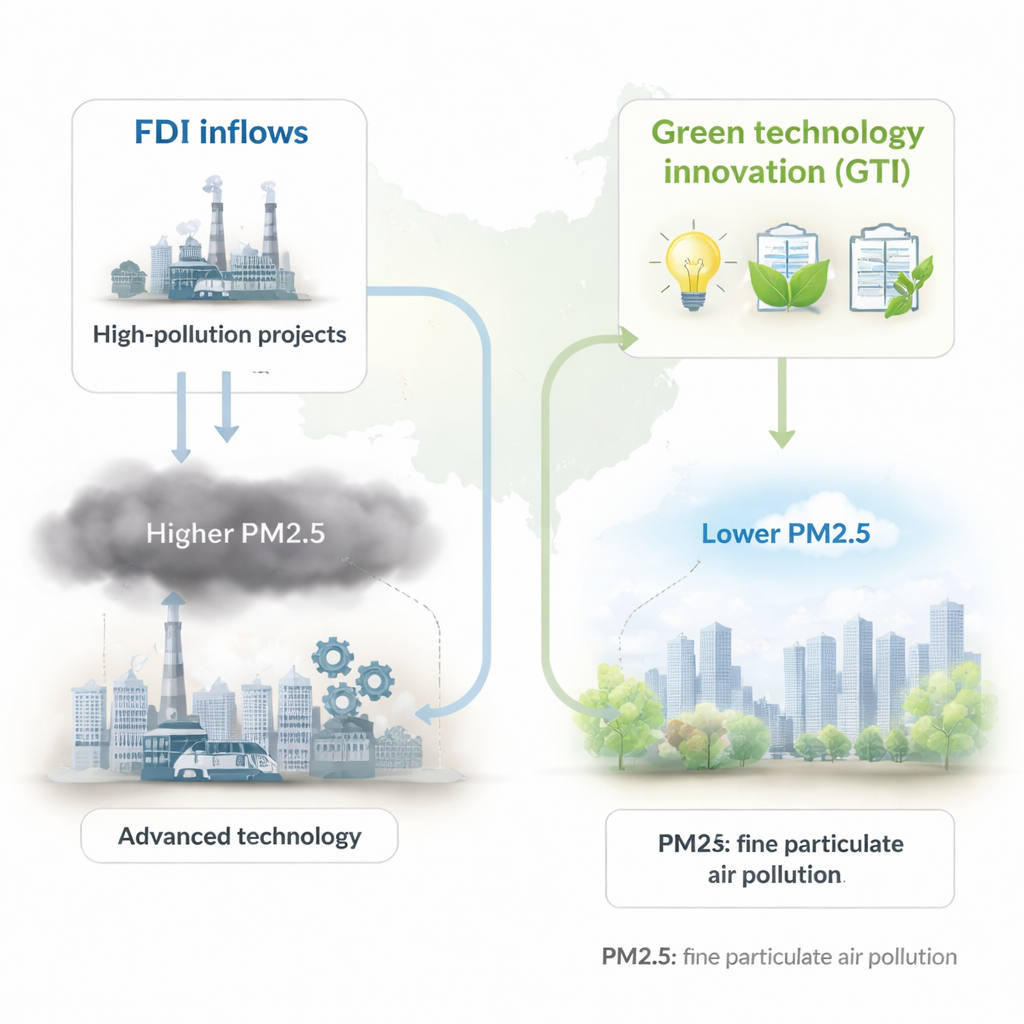
Across China and many other countries, city leaders face a tough question: can they welcome foreign investment, create jobs, and still breathe clean air? This study looks at 236 Chinese cities over more than a decade to see how foreign direct investment (FDI) and local green technology innovation (GTI) together shape fine particle pollution, known as PM2.5, which is closely linked to heart and lung disease. The authors do not just ask whether foreign money is good or bad for air quality; they ask when its impact can be softened or even partly offset by local advances in cleaner technology.
Dirty air, global capital, and the promise of green ideas
The starting point is a global reality: air pollution, especially PM2.5, remains stubbornly high in many fast‑growing cities, including major Chinese regions such as Beijing–Tianjin–Hebei and the Yangtze River Delta. At the same time, China has become one of the world’s largest recipients of foreign investment, bringing capital, factories, and management know‑how. Past research offers two competing stories. The “pollution haven” view argues that foreign firms shift dirty industries to countries with looser rules. The “pollution halo” view claims that foreign companies bring cleaner technology and better practices. The authors place their work within this debate and add a third piece of the puzzle: the strength of each city’s own green innovation system.
Following the pollution through space and time
To move beyond simple yes‑or‑no answers, the researchers assemble yearly data from 2008 to 2020 for 236 prefecture‑level cities. They measure air pollution using satellite‑based estimates of PM2.5, FDI as the share of foreign investment in local economic output, and GTI by counting green patent applications, which capture inventions aimed at saving energy or cutting emissions. Because dirty air drifts across city borders and today’s pollution is closely tied to yesterday’s emissions, they use a spatial–dynamic statistical model that tracks how PM2.5 spreads between neighboring cities and persists over time. This approach allows them to separate a city’s own choices from the influence of its neighbors.
When foreign factories worsen smog—and when they do less harm
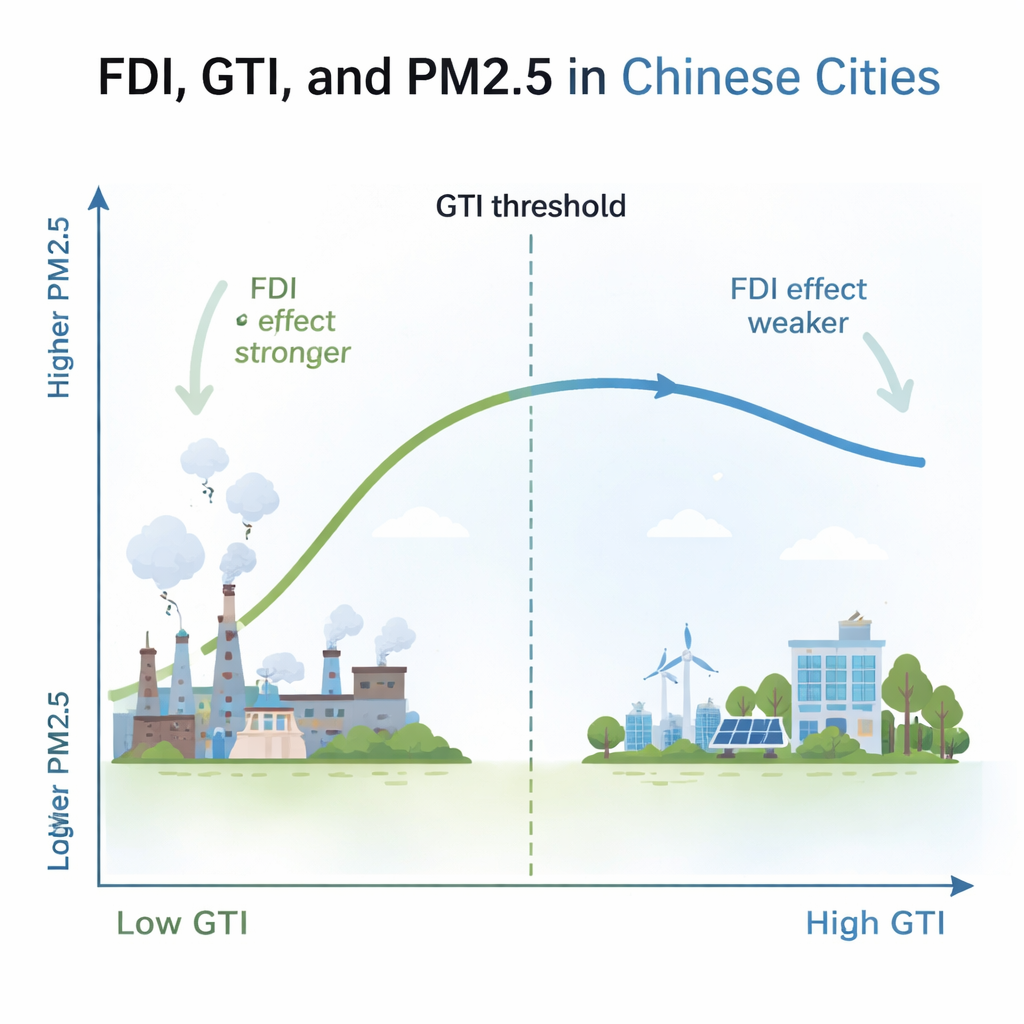
The results show that, on average, more FDI goes hand in hand with higher PM2.5, supporting the pollution‑haven story for current Chinese conditions. The relationship is not purely linear: at low levels of green capacity, extra foreign investment raises pollution more sharply, while at higher levels—and after technology upgrades and stricter rules—the damage grows more slowly and can begin to ease. Crucially, green technology innovation directly lowers PM2.5: cities with more green patents tend to have cleaner air. Even more important, GTI acts as a buffer. Where GTI is stronger, the same amount of FDI leads to a smaller increase in pollution. A threshold analysis finds a turning point in GTI: once a city passes this level, each new unit of foreign investment still tends to raise PM2.5, but by less than before, meaning local green capacity partly tames FDI’s environmental footprint.
Different regions, different paths
The study also uncovers strong regional contrasts. Eastern coastal cities, which typically have higher incomes, tighter environmental rules, and more advanced green industries, see a smaller pollution impact from FDI and a stronger cleaning effect from GTI. In many central and western cities, foreign projects are more likely to be energy‑intensive or heavy‑industry based, and local green innovation is less developed. In these places, FDI’s link to PM2.5 is stronger and GTI’s protective role is weaker. Across the map, the authors find clear clusters of high‑pollution and low‑pollution cities, confirming that smog often travels beyond local boundaries and that air‑quality policy must be coordinated regionally rather than city by city.
What this means for everyday air quality
For non‑specialists, the lesson is straightforward. Foreign investment by itself does not guarantee cleaner production and can worsen city air, especially where environmental rules are weak and green innovation is limited. Yet the study also offers a hopeful message: cities are not powerless. By building up their own green technology base—through research, patents, cleaner factories, and stricter standards—they can reduce the harm from incoming investment and push it toward cleaner projects. In practical terms, the healthiest cities of the future are likely to be those that both screen foreign projects for environmental performance and steadily raise their capacity to invent and adopt green technologies.
Citation: Wang, Y., Gao, X. & Li, H. Generalized spatial two stage least squares analysis of foreign direct investment air pollution and green technology innovation in Chinese cities. Sci Rep 16, 6328 (2026). https://doi.org/10.1038/s41598-026-37141-6
Keywords: foreign direct investment, PM2.5 air pollution, green technology innovation, Chinese cities, spatial econometrics