Clear Sky Science · en
A hidden route of exposure: adsorption of endocrine disrupting compounds and chemicals of emerging concern on tire rubber
Why tire dust matters for our health
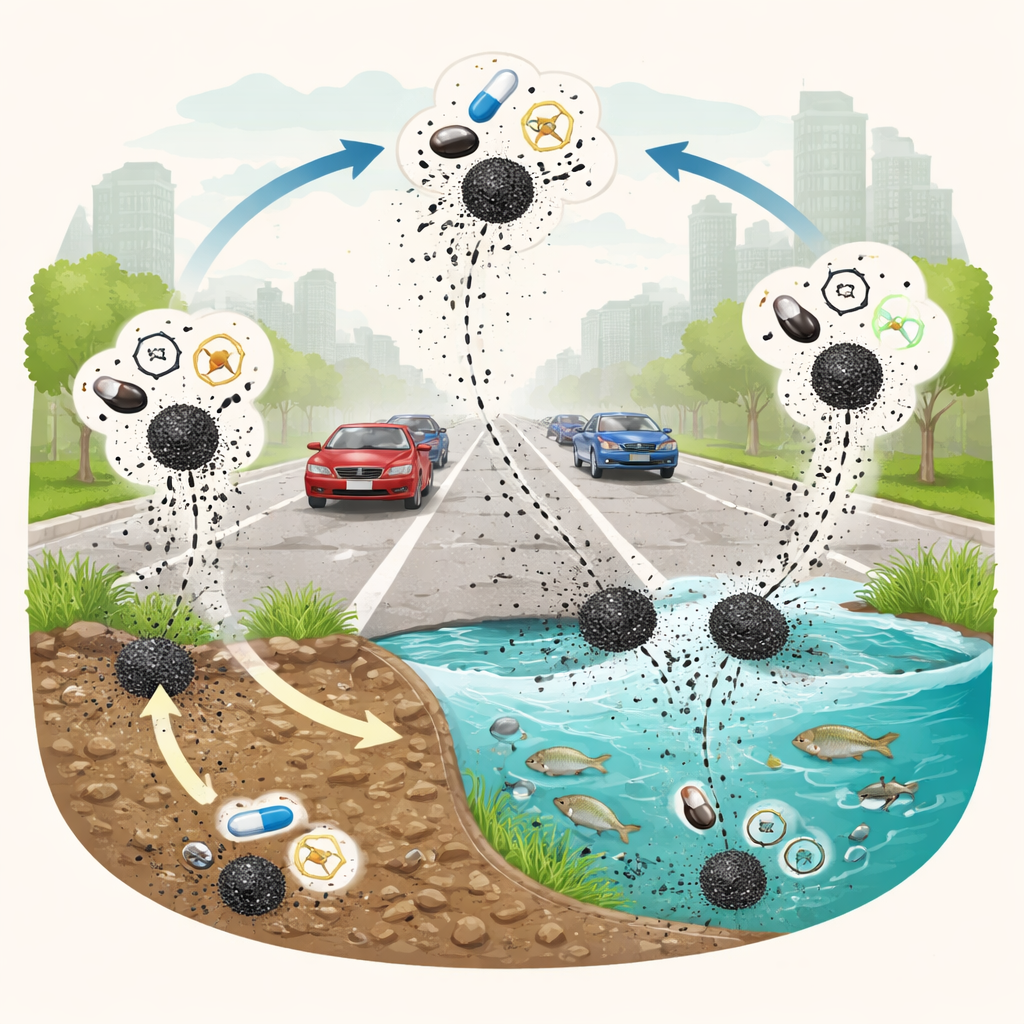
Every time we drive, tiny bits of tire rubber are scraped off and released into the air, onto roads, and into nearby soil and water. These tire wear particles are a major, but often overlooked, source of microplastics. This study shows that tire dust is more than just trash: it can act like a sponge for a wide variety of biologically active chemicals, including antibiotic residues, hormone-like compounds, and toxic by-products of combustion, potentially changing how long these substances persist in the environment and how people and wildlife are exposed to them.
From rolling tires to invisible particles
Modern tires are complex mixtures of natural and synthetic rubber, carbon black, silica, oils, metals, and many chemical additives. As tires roll and brake, microscopic fragments are worn away and spread along roads, blown into the air, or washed into drains and streams. Because these particles are small, rough, and chemically diverse, earlier research suggested they might be particularly good at trapping pollutants. The authors focused on this role of tire wear particles as “carriers” for chemicals of emerging concern, especially those that can interfere with hormones or drive antibiotic resistance.
Looking closely at tire particles
To understand what tire dust can hold onto, the researchers first ground a car tire into fine particles about the width of a human hair or smaller. They used laser-based Raman microscopy and infrared spectroscopy to examine the particles’ structure. These tests confirmed that the material is a patchwork of carbon-rich domains, rubber chains, and inorganic fillers such as silica and zinc oxide. This patchwork creates many different types of surfaces where pollutants can latch on—through oily (hydrophobic) contacts, electrostatic attractions, or chemical bonding.
Testing which chemicals stick, and how fast
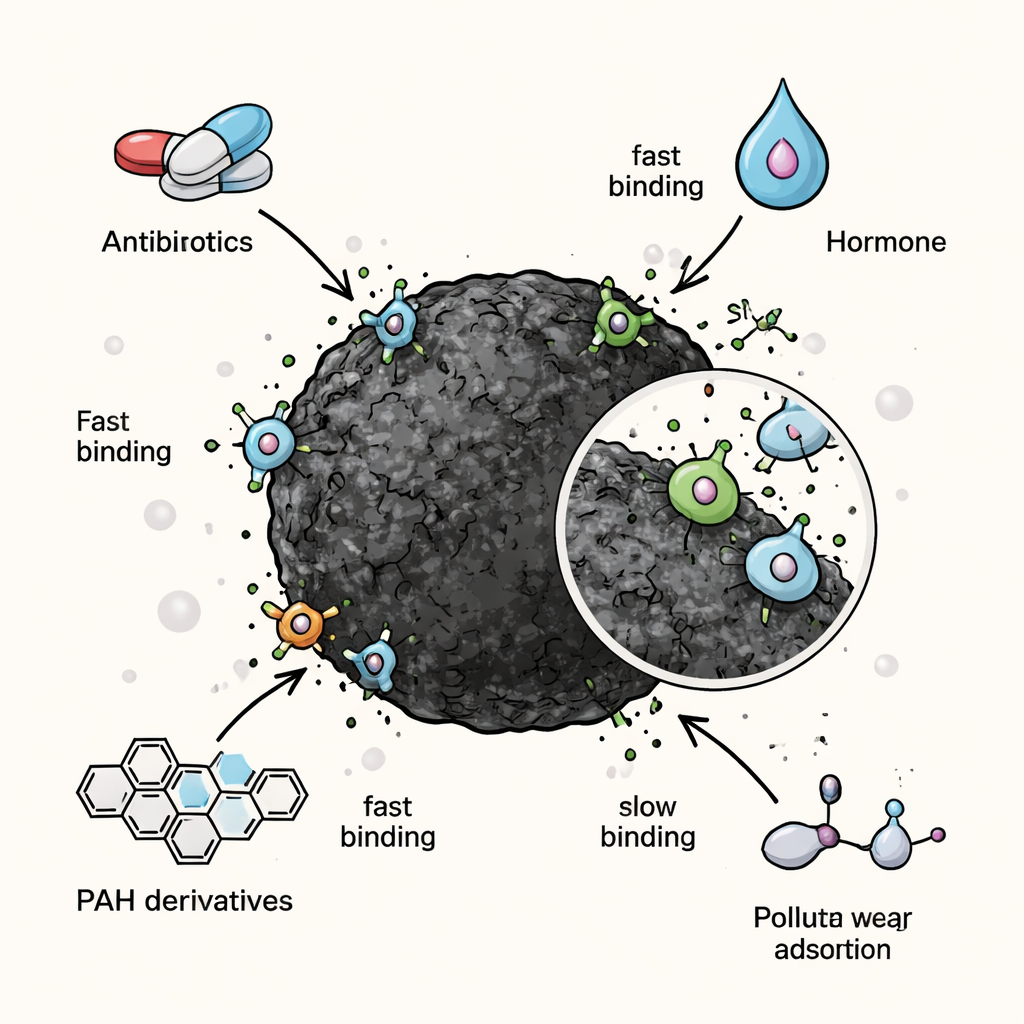
The team then exposed these tire particles to a mixture of environmental chemicals in water over periods from minutes up to 24 hours. The mixture included several antibiotics, a natural estrogen (estriol), a nicotine breakdown product called cotinine, and a family of combustion by-products known as hydroxylated polycyclic aromatic hydrocarbons (OH-PAHs), some of which are linked to cancer and DNA damage. Using sensitive liquid chromatography–mass spectrometry, they tracked how much of each compound disappeared from the water and ended up on the tire particles, and they used kinetic models to describe how quickly this happened.
A chemical sponge with clear favorites
The results revealed that tire wear particles act as strong but selective sponges. Cotinine showed the highest uptake, with particles holding close to 91 micrograms per gram of tire dust. Among the antibiotics, 5-hydroxypyrazinoic acid was most strongly retained, while others such as trimethoprim were removed less efficiently. Within the OH-PAHs, some forms of phenanthrene and pyrene metabolites were readily captured, whereas others showed only weak binding even if they interacted quickly at first. For most compounds, the data followed a so-called pseudo–second-order pattern, which in simple terms indicates that the rate of uptake is controlled by how strongly molecules interact with specific sites on the particle surface, rather than by simple diffusion alone.
What this means for everyday exposure
By showing that tire wear particles can strongly bind antibiotics, hormone-like substances, and toxic combustion products, this work highlights a hidden pathway by which people and ecosystems may encounter such chemicals. Tire dust is now known to be abundant in road dust, soils near traffic, and even in the fine particles we breathe in busy cities. If these particles carry tightly bound pollutants, they may prolong the chemicals’ lifetime and move them between air, soil, and water. The study concludes that tire wear particles are important multipollutant carriers and calls for real-world measurements—especially of airborne tire dust—to better understand how much they contribute to our overall chemical exposure.
Citation: Uchmanowicz, D., Badura, X., Styszko, K. et al. A hidden route of exposure: adsorption of endocrine disrupting compounds and chemicals of emerging concern on tire rubber. Sci Rep 16, 6584 (2026). https://doi.org/10.1038/s41598-026-37140-7
Keywords: tire wear particles, microplastics, endocrine disrupting chemicals, antibiotic pollution, hydroxylated PAHs