Clear Sky Science · en
Hybrid microlens-polymer dispersed liquid crystal substrate for synergistic light extraction from flexible OLEDs
Brighter, Bendable Screens
From smartphones you can fold to rollable TVs, the next wave of displays needs to be flexible, bright, and energy‑efficient. Organic light emitting diodes (OLEDs) already power many of today’s high‑end screens, but most of the light they produce never reaches your eyes. This study introduces a new see‑through backing film that helps flexible OLEDs shine more light outward without complex, costly manufacturing—pointing the way to thinner, longer‑lasting gadgets.
Why So Much Light Gets Trapped
Inside an OLED, electrical energy is turned into light with remarkable efficiency, but only about one fifth of that light escapes the device. The rest becomes trapped, bouncing around inside the many thin layers or leaking into the supporting substrate instead of heading out toward the viewer. This hidden loss forces displays to use more power to appear bright, draining batteries faster. Traditional tricks to free this trapped light—such as patterned glass surfaces and intricate microstructures—work well on rigid glass panels, but usually demand high temperatures, vacuum chambers, or multiple lithography steps that are poorly suited to large, flexible screens.
A Hybrid Film That Bends and Boosts Light
The researchers designed a hybrid substrate they call MIP, short for microlens‑imprinted polymer dispersed liquid crystal. In simple terms, it is a flexible plastic film that combines two light‑shaping elements: a smooth sheet filled with tiny droplets and a regularly patterned “egg‑crate” of microscopic lenses formed on its surface. The liquid crystal droplets inside act like countless miniature fog particles, gently scrambling the directions of light traveling through the film. Sitting on top, the microlens array bends this diffused light so more of it exits toward the outside instead of reflecting back in. Because the whole structure is made from a polymer matrix, it can flex and bend without cracking—an essential property for rollable and wearable displays. 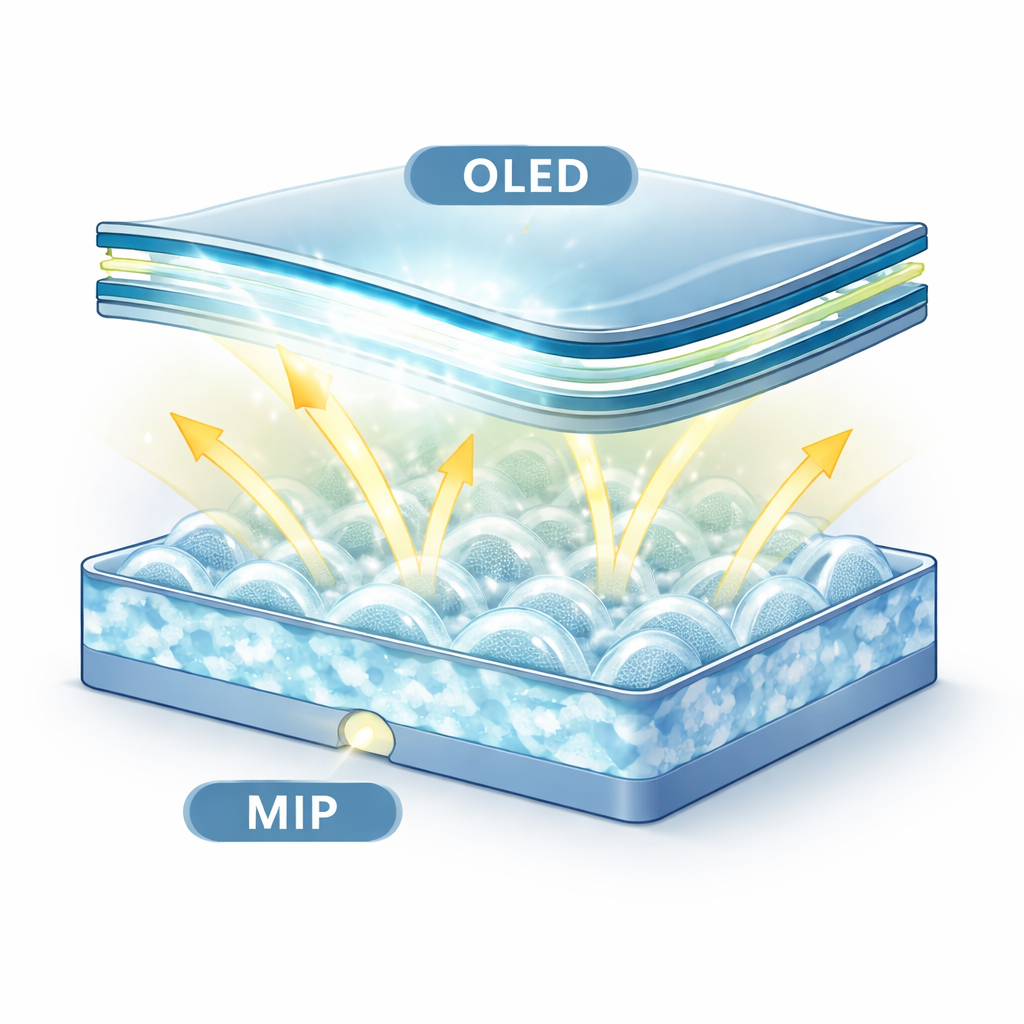
Simple, Scalable Manufacturing
Instead of relying on high‑tech chip‑making tools, the team used a straightforward room‑temperature process. They mixed a clear liquid crystal with a UV‑curable epoxy, spin‑coated this blend onto a reusable mold bearing the microlens pattern, and then hardened it with ultraviolet light. A thin, very flat top layer was added so that standard OLED stacks could be deposited on top without causing electrical shorts. Microscopy confirmed that the microlens pattern was copied cleanly into the flexible film, while optical tests showed that the film maintained good overall transparency but exhibited very high “haze”—a measure of how strongly it spreads light in many directions. This combination of high scattering inside and controlled bending at the surface is what allows the film to redirect otherwise trapped light.
How Well It Works in Practice
Computer ray‑tracing simulations first examined the effect of the microlens surface alone. Compared with a flat surface, the lens pattern sent roughly 60% more light out of the material and boosted brightness near straight‑on viewing angles by about 20%, without creating strong hot spots or dark zones. When the full hybrid film, including the droplet layer, was fabricated and used under real flexible OLED devices, the improvements closely matched these predictions. At typical operating voltages, OLEDs on the MIP film shone significantly brighter than those on bare glass, while drawing slightly less electrical current. Key performance metrics, such as current efficiency and external quantum efficiency, climbed by 15–21%. The film also remained mechanically robust: photographs of bent samples showed uniform green emission with little change in color across viewing angles, indicating that both the optical function and the mechanical flexibility are preserved. 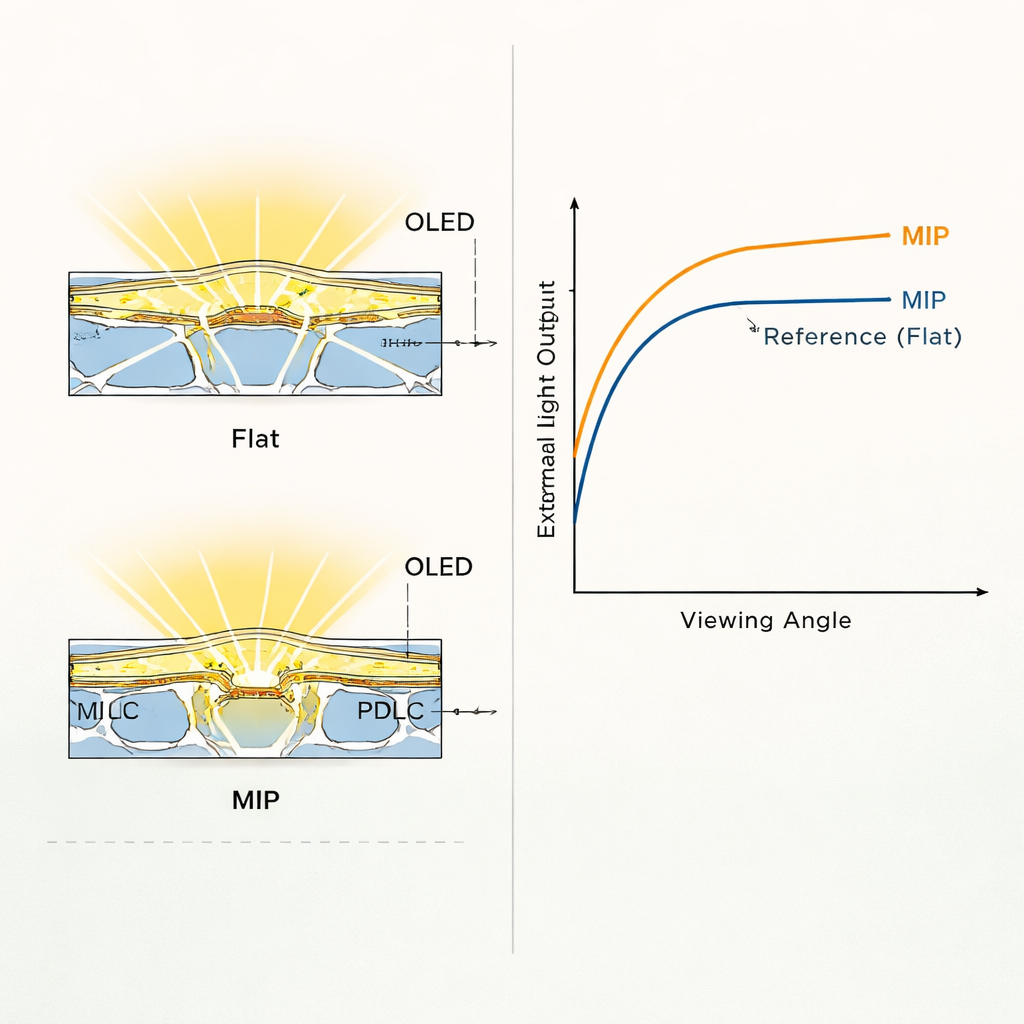
What This Means for Everyday Devices
For a non‑specialist, the bottom line is that this hybrid film helps flexible OLEDs waste less light, so screens can be brighter or run at lower power for the same brightness. The approach uses inexpensive materials and a simple, room‑temperature coating and curing sequence that can, in principle, be extended to roll‑to‑roll production. That makes it attractive not just for experimental lab devices, but for future mass‑produced phones, wearables, and automotive displays. More broadly, the work shows how carefully combining a regular surface pattern with a randomly structured interior can give precise control over light in thin, bendable components—an idea that could influence many next‑generation optical technologies.
Citation: Lim, S., Ahn, HS., Lee, W. et al. Hybrid microlens-polymer dispersed liquid crystal substrate for synergistic light extraction from flexible OLEDs. Sci Rep 16, 7627 (2026). https://doi.org/10.1038/s41598-026-37135-4
Keywords: flexible OLED displays, light extraction, microlens array, polymer dispersed liquid crystal, energy efficient screens