Clear Sky Science · en
ZenBand: a numerical solver of photonic crystals with a graphical user interface
Making Light Behave Like Electrons
Modern technologies from high-speed internet to quantum devices rely on guiding and shaping light with exquisite precision. Photonic crystals—materials with a tiny, repeating structure—can steer light almost as if it were electricity in a circuit. This paper introduces ZenBand, a free, open-source computer program that lets researchers and engineers explore and design such light‑guiding structures without expensive software or advanced programming skills.
Why Controlling Light Is So Powerful
Photonic crystals are like optical semiconductors: by arranging transparent materials in a regular pattern, they can block certain colors of light, bend beams sharply, or make light travel in narrow, loss‑free paths. These effects enable ultra-compact waveguides, reflective coatings, beam splitters, and even materials where light seems to refract “backwards.” Until now, exploring these designs often required costly commercial tools or specialized coding. ZenBand aims to lower that barrier by packaging a well-known numerical method—the plane wave expansion technique—into a user-friendly program written in Python.
A Workbench for Designing Optical Lattices
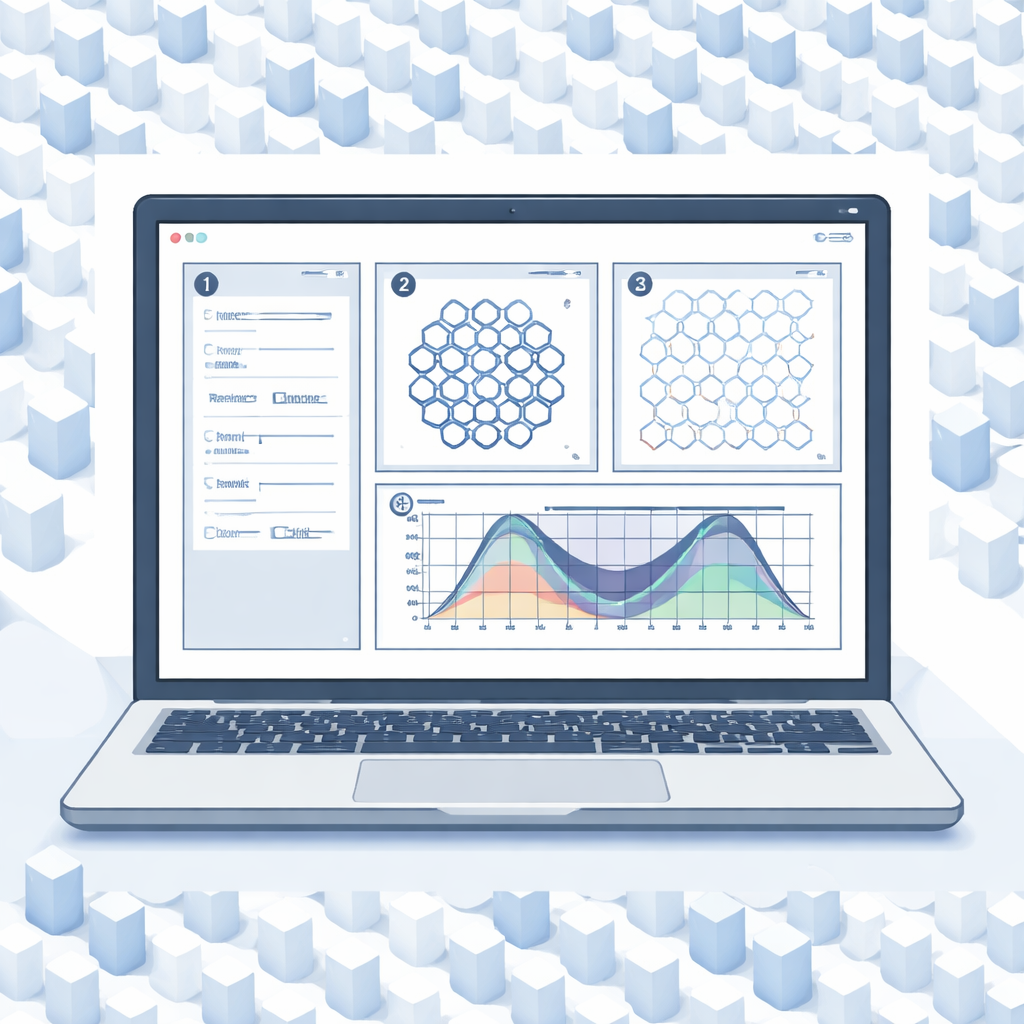
ZenBand is organized like a digital workbench. One panel lets users sketch the basic building block of a photonic crystal: shapes such as cylinders, rings, or frames arranged on square or hexagonal grids, with adjustable sizes and material properties. A second panel provides buttons to launch calculations, such as the “band diagram,” which shows which colors of light can and cannot pass through the structure, and “iso-frequency contours,” which reveal how light spreads in different directions. A third panel offers extras, from creating animated GIFs of how light fields evolve to importing custom material layouts prepared in other software. Even newcomers can start with built‑in examples, while advanced users can load unusual or highly tailored geometries.
From Crystal Pattern to Light Bands
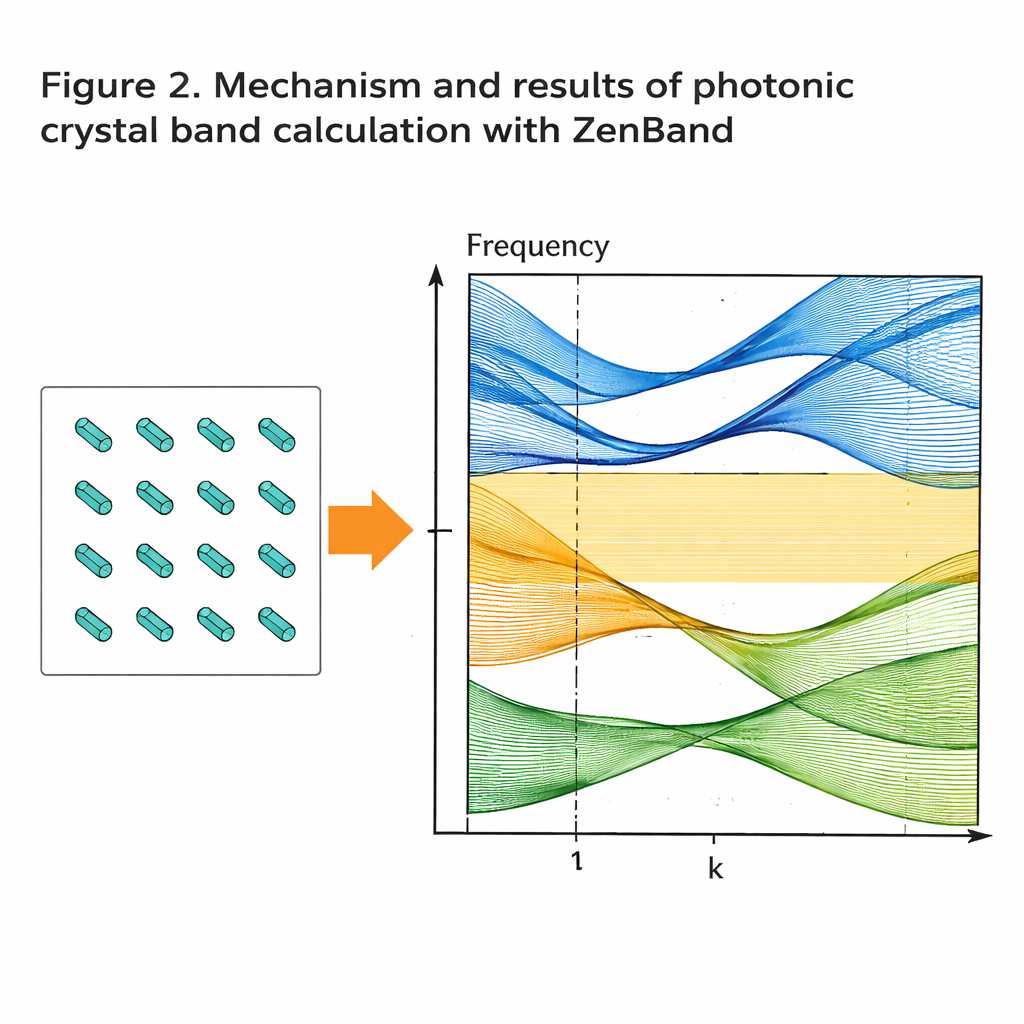
Under the hood, ZenBand turns Maxwell’s equations—the fundamental rules of electromagnetism—into a large but structured math problem. Because the crystal repeats in space, the electric and magnetic fields can be expressed as combinations of simple waves. ZenBand builds and solves the resulting equations to obtain “bands,” curves that link light frequency to its momentum inside the crystal. These bands reveal gaps where light cannot propagate and special points where beams stay tightly collimated or split in controlled ways. The program supports both common, uniform materials and more complex “diagonally anisotropic” ones, whose response depends on direction, opening the door to engineered steering and focusing effects that are hard to explore by hand.
Checking Accuracy and Speed
To show that its results are trustworthy, the authors used ZenBand to reproduce published studies on square, hexagonal, and honeycomb photonic crystals, including devices with strong waveguiding and “Dirac point” behavior where several bands meet at a single frequency. Band diagrams, field patterns, and special beam‑collimation effects closely matched those obtained with other well‑established methods, with only tiny differences attributed to numerical details. The team also compared how quickly ZenBand runs in Python versus similar approaches in MATLAB and other codes. For many common cases, especially when the math problem is slightly simpler, the Python implementation is competitive in speed while remaining fully open and modifiable.
A Free Toolbox for Future Light-Based Devices
In plain terms, this work delivers a practical, free design tool for materials that sculpt light in sophisticated ways. ZenBand helps users see which colors of light are allowed or forbidden in a given pattern, where energy concentrates, and how design tweaks—like changing hole size or lattice spacing—shift those properties. Because it is open-source and equipped with a visual interface, the program can serve both as a teaching aid and as a starting point for cutting-edge research on compact lasers, advanced waveguides, or topological photonic devices. The broader message is that powerful optical design capabilities no longer need to be locked behind expensive licenses: they can be shared, inspected, and improved by the entire scientific community.
Citation: Zinkevičius, A., Lukošiūnas, I. & Gailevičius, D. ZenBand: a numerical solver of photonic crystals with a graphical user interface. Sci Rep 16, 7242 (2026). https://doi.org/10.1038/s41598-026-37129-2
Keywords: photonic crystals, numerical simulation, open-source software, band structure, computational photonics