Clear Sky Science · en
Developing digital biomarker for predicting cognitive response to multi-domain intervention
Why Training Games for the Brain Matter
As people live longer, more of us worry about memory slips and the possibility of dementia. Mild cognitive impairment (MCI) sits between normal aging and dementia: daily life is mostly intact, but thinking and memory are clearly weaker. Doctors and families are eager for tools that not only help protect thinking skills, but also reveal early on who is most likely to benefit from such help. This study explores whether detailed data from tablet-based brain-training games can act as a new kind of “digital biomarker” to guide and personalize prevention programs for older adults at risk.
A New Clue Hidden in Game Play
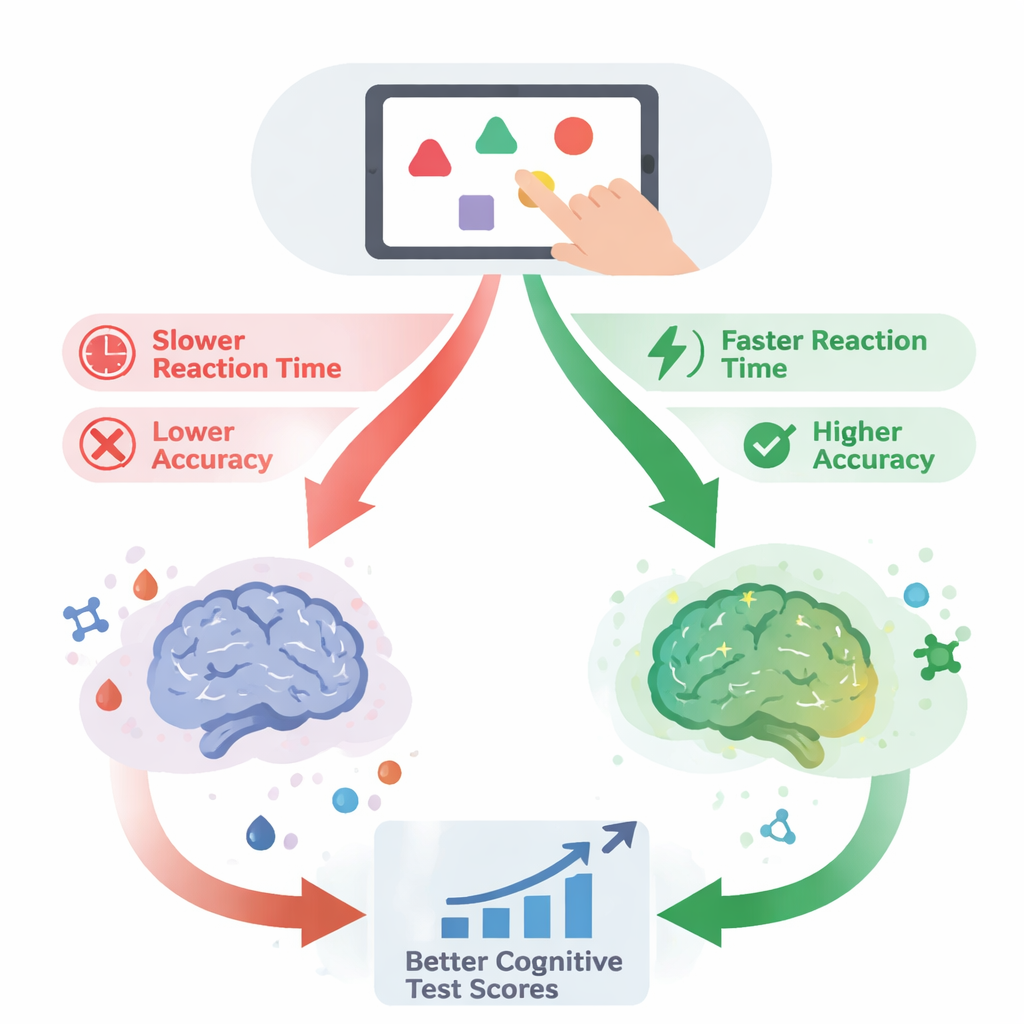
The researchers focused on a measure they call RTACC, short for Reaction Time–Accuracy Correlation. In simple terms, every time participants played short cognitive games on a tablet, the system recorded how fast they responded and how often they were right. Rather than looking at speed or accuracy alone, RTACC captures how these two move together over hundreds of game rounds. If someone gets faster but sloppier, the correlation tends to be positive; if they become both faster and more accurate, it turns negative. The team suspected that this pattern might reflect deep changes in how efficiently the brain is processing information.

Inside the Multi‑Step Brain Health Program
The data came from 130 South Korean adults aged 60 to 85 with MCI who took part in the SUPERBRAIN‑MEET clinical trial. For 24 weeks, all participants received a broad lifestyle program, inspired by earlier European work, that combined five elements: computer-based cognitive games, structured physical exercise, nutrition education, careful control of blood pressure and other vascular risks, and motivational support. Cognitive performance was measured with a standard test battery called RBANS at the start and end of the program. Blood samples were also taken to assess brain-related proteins, including brain-derived neurotrophic factor (BDNF), which is involved in learning and brain plasticity.
What the Digital Biomarker Revealed
By running statistical models, the researchers found that RTACC was strongly linked to how much a person’s RBANS score improved over 24 weeks, even after taking age, sex, education, genes, and starting scores into account. Participants whose game play showed a negative RTACC—meaning they tended to respond both faster and more accurately over time—were the ones who gained the most on formal cognitive tests. Strikingly, this signal appeared after only about two weeks of training data, and it remained robust regardless of which specific games were included, suggesting that RTACC captures a general pattern of efficient learning rather than quirks of any single task.
Hints from Brain Chemistry and Prediction Power
The team also examined whether RTACC might be tied to changes in blood-based markers. There was a borderline association between more favorable RTACC values and increases in BDNF, pointing to a possible link with brain plasticity, although this needs confirmation in larger studies. In a separate analysis, the researchers tested whether RTACC could help flag “good responders,” defined as those whose RBANS scores rose over the six months. A model using only basic clinical information had modest accuracy; adding RTACC improved performance, producing an overall discrimination level that suggests practical, though not perfect, predictive value.
What This Means for Everyday Patients
For patients, families, and clinicians, the key message is that the way someone plays brain-training games may hold more information than just a final score. A simple statistic that tracks the balance of speed and accuracy across many short sessions can help indicate who is truly getting more efficient at thinking and who may need extra support or a different approach. While the results are preliminary and come from a single study, RTACC and similar digital biomarkers could become useful, low-cost tools to personalize multi‑component lifestyle programs, helping target resources to those most likely to benefit and adjusting care early for those who are not improving as hoped.
Citation: Park, J.H., Kim, H.S., Choi, S.H. et al. Developing digital biomarker for predicting cognitive response to multi-domain intervention. Sci Rep 16, 6730 (2026). https://doi.org/10.1038/s41598-026-37123-8
Keywords: mild cognitive impairment, digital biomarker, brain training, dementia prevention, cognitive intervention