Clear Sky Science · en
Probabilistic risk assessment of occupational exposure to respirable crystalline silica among ceramic workers in an industrial town in Iran: a Monte Carlo simulation approach
Why Dust in a Ceramic Shop Matters
Behind every shiny tile or decorative plate lies a cloud of fine dust that most people never see. In many small ceramic workshops, workers breathe in tiny mineral particles day after day. This study looks closely at one of the most dangerous of these particles—respirable crystalline silica—and asks a simple but urgent question: how risky is the dust that ceramic workers in a western Iranian industrial town are actually breathing?
Invisible Particles, Real Dangers
Respirable crystalline silica is a mineral dust created when materials containing quartz are cut, ground, or polished. Because its particles are so small, they slip deep into the lungs, where they can cause long-lasting damage. Decades of research have linked this dust to silicosis (an irreversible scarring of the lungs), chronic breathing problems, and lung cancer. International health agencies classify it as a proven cancer-causing substance in humans, and its impact is magnified for smokers. Yet in many traditional industries, especially small ceramic workshops, routine measurement and control of this dust are still rare.
How the Researchers Measured Risk
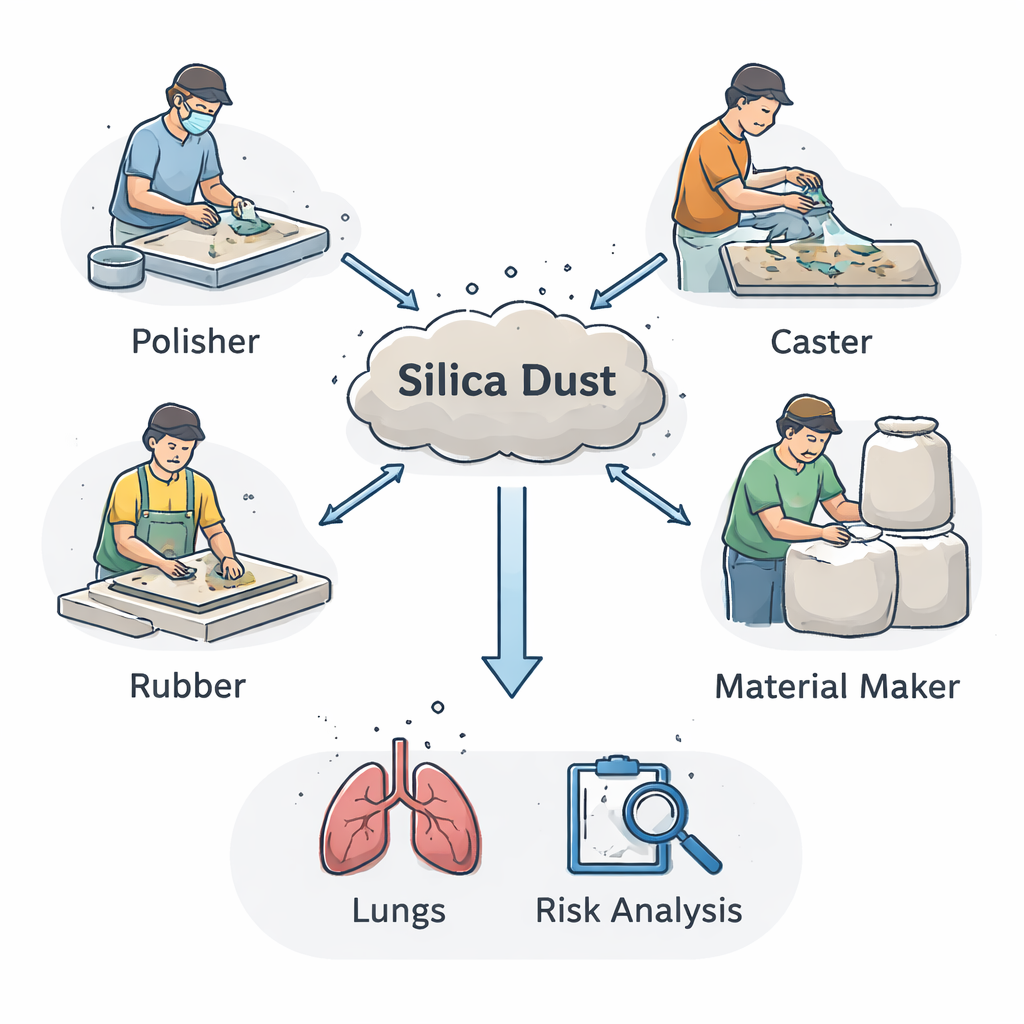
The researchers examined four types of ceramic workers: polishers who blast tiles with compressed air, rubbers who smooth surfaces, casters who mold items, and material makers who handle raw powdered clay. Using standard personal air-sampling pumps worn close to each worker’s nose and mouth, they collected air over several work shifts and analyzed the filters in the laboratory with infrared spectroscopy to find out how much crystalline silica was present. They then combined these measurements with information about how long workers were on the job, how often they worked each year, and typical breathing rates, building a detailed picture of each group’s exposure.
Rolling the Dice with Monte Carlo
Instead of calculating a single “average” risk, the team used a technique called Monte Carlo simulation to reflect real-life variability. They treated each input—such as dust level in the air, hours worked per day, years on the job, and body weight—as a range of possible values, described by probability distributions. A computer then ran 10,000 “what if” scenarios, each time drawing slightly different values from those ranges and calculating two key measures: the chance of developing cancer over a lifetime, and the likelihood of serious non-cancer lung damage. This approach does not just show a typical outcome; it reveals the full spread of possible risks, including extreme but plausible “worst-case” situations.
What the Dust Levels Reveal
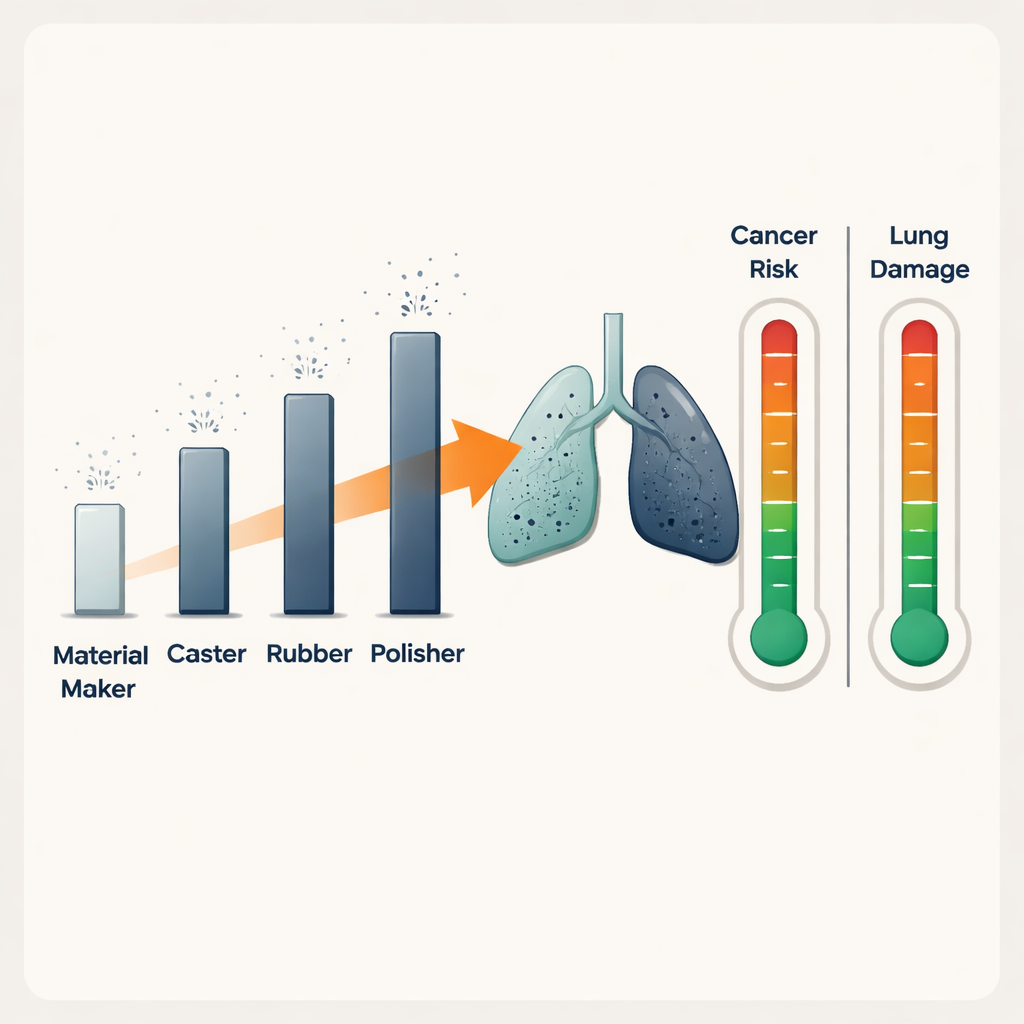
The results were alarming. Dust levels for all four job groups were far above both Iranian and international occupational limits. Polishers were in the worst position: on average, their exposure to respirable crystalline silica was more than 100 times the Iranian occupational limit and over 50 times the U.S. workplace limit. Even material makers, the least exposed group, regularly breathed dust levels many times higher than recommended. When these exposure levels were fed into the Monte Carlo model, every job group showed lifetime cancer risks well above what U.S. environmental guidelines consider negligible, and non-cancer risk estimates (expressed as hazard quotients) were far beyond the level considered safe.
Who Faces the Greatest Harm
The analysis showed a steep risk gradient across the workshop. Polishers, who rely on dry, high-pressure air to clean ceramics in often cramped and poorly ventilated rooms, faced the highest probability of both lung cancer and severe lung disease. Their average cancer risk was hundreds of times higher than common regulatory benchmarks, and the chance of serious non-cancer effects was extreme, with many simulated scenarios indicating conditions strongly linked to silicosis and chronic breathing problems. Rubbers, casters, and material makers also faced clearly unsafe conditions, though their risks were lower than those of polishers, partly because some of their work occurred in more open or better-ventilated spaces and involved less aggressive dust-generating methods.
What Needs to Change
For a layperson, the message is straightforward: the way many ceramic products are currently made comes with a heavy, hidden health cost for the people who shape and finish them. This study shows that, under present conditions, workers in these Iranian ceramic workshops face a high likelihood of developing serious and sometimes fatal lung diseases. The authors argue that this is preventable. They call for stronger enforcement of dust limits, better ventilation, wet cutting and cleaning methods instead of dry air-blasting, consistent use of effective respirators, and regular health checkups and training for workers. In simple terms, the beauty of ceramic goods should not come at the price of the workers’ lungs—and there are practical steps that can greatly reduce that trade-off.
Citation: Saeedizadeh, S., Assari, M.J., Ghorbani-Shahna, F. et al. Probabilistic risk assessment of occupational exposure to respirable crystalline silica among ceramic workers in an industrial town in Iran: a Monte Carlo simulation approach. Sci Rep 16, 6190 (2026). https://doi.org/10.1038/s41598-026-37121-w
Keywords: silica dust, ceramic workers, lung disease, occupational exposure, Iran industry