Clear Sky Science · en
Influence of laser beam intensity profile on deep bone ablation in laser osteotomy
Cutting Bone with Light, Not Blades
Surgeons increasingly dream of bone operations that feel more like precision engineering than carpentry. Traditional saws and drills are fast and reliable, but they shake, heat, and bruise bone, leaving debris and microscopic damage that can slow healing. This study explores whether carefully shaped laser light can cut deep, narrow channels in bone more efficiently and gently than today’s tools—bringing the vision of quiet, contact-free robotic bone surgery a step closer to reality.
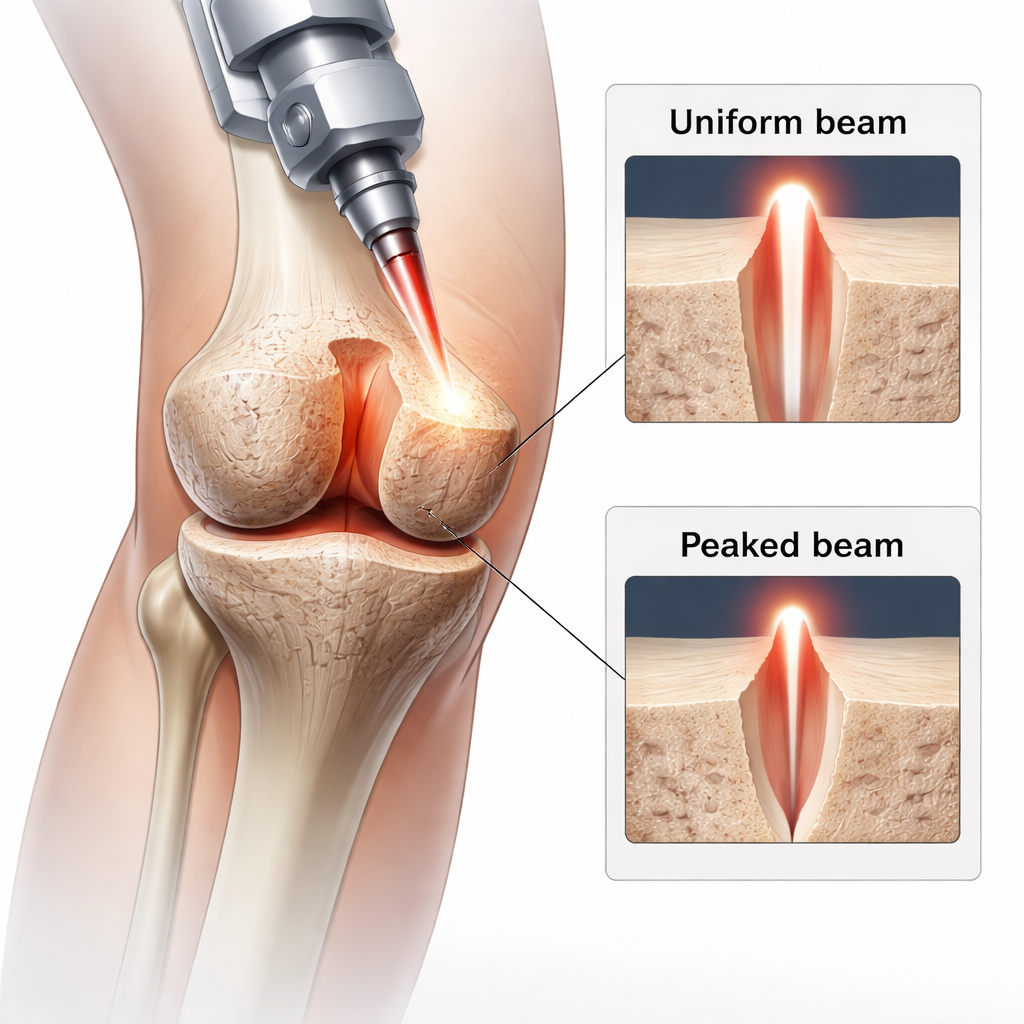
Why Replace Saws with Lasers?
In operations like total knee replacement, surgeons must remove sizable volumes of hard bone quickly and accurately. Conventional instruments can remove bone at roughly 11 cubic millimeters per second and reach depths of around 70 millimeters, but they do so by grinding and sawing, which generates heat and mechanical stress. Lasers, by contrast, can cut without touching the tissue, follow complex 3D paths, and integrate easily with imaging and robotic guidance. The challenge is speed: earlier laser systems removed bone several times more slowly than saws and could not cut deeply enough to be practical for large joints.
Shaping the Beam to Shape the Cut
The researchers focused on an Er:YAG laser, a type already known to interact efficiently with bone because it targets water and mineral components. Instead of changing the laser’s color or power, they changed how its energy is distributed across the beam. One system produced a “Gaussian” profile, where light is strongest in the middle and fades toward the edges. The other produced a “tophat” profile, where the brightness is nearly uniform across the beam. Using bovine thigh bone, they compared how these two profiles performed under identical pulse energy, timing, and advanced water–air cooling designed to keep bone temperature low.
Deeper, Cleaner Cuts with a Flatter Beam
When the team measured how fast material was removed from the surface, the tophat beam consistently outperformed the Gaussian beam. In dry conditions, the tophat profile removed bone at about 1.58 cubic millimeters per second, roughly twice the rate of the Gaussian beam, though at the cost of some surface charring. Under optimized water and air cooling—the clinically relevant setup—the tophat beam still removed bone nearly twice as fast. More importantly, in deep-cut experiments lasting about 11 minutes, the tophat beam reached a maximum depth of 44.51 millimeters, compared with 26.51 millimeters for the Gaussian beam. That depth is more than double previous records for this kind of laser under similar cooling, and it approaches the dimensions needed for knee replacement cuts.
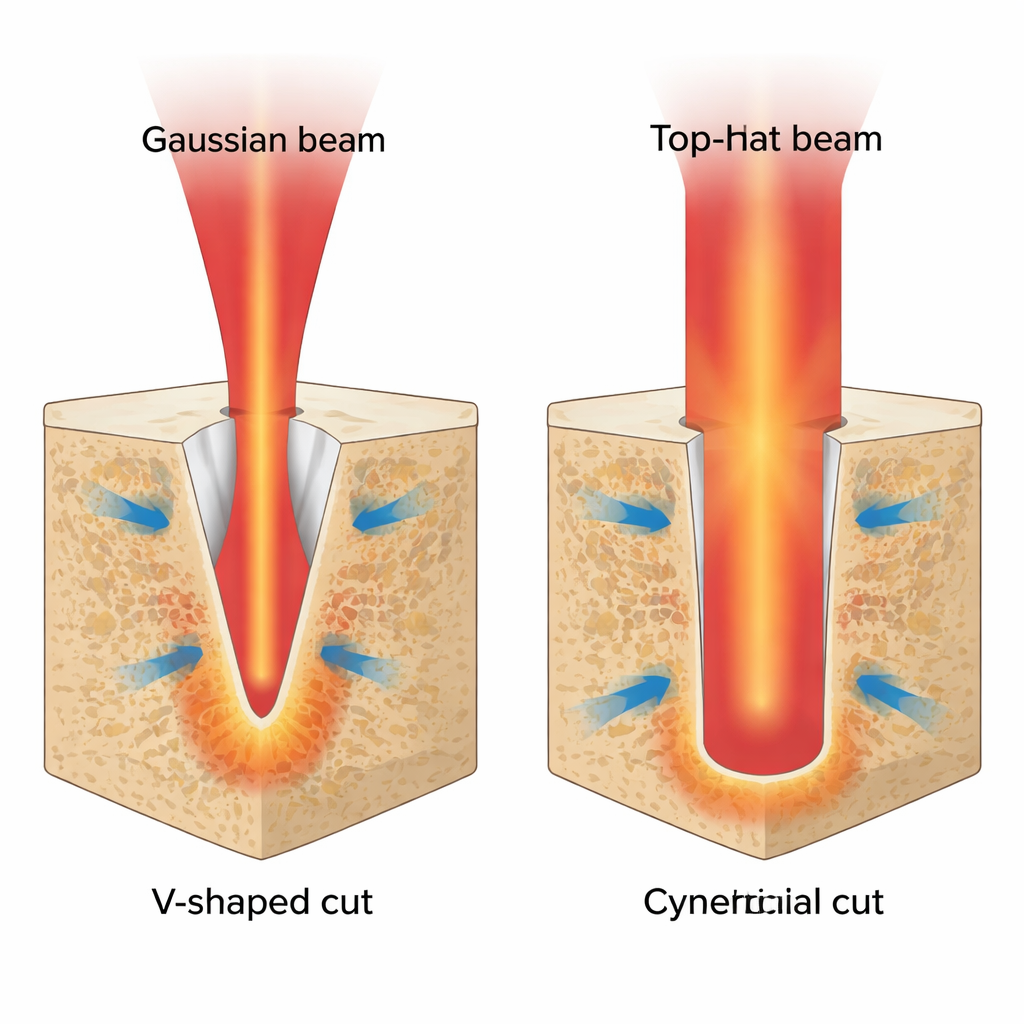
How Beam Shape Changes Energy Use
Micro–CT scans of the cut channels revealed why the beam profile matters so much. The Gaussian beam created a V-shaped trench that narrowed with depth, acting like a funnel that blocked much of the incoming light; most of the beam never reached the bottom. By contrast, the tophat beam produced a straighter, more uniform channel whose shape more closely matched the beam itself, allowing useful energy to penetrate further before being clipped by the walls. Measurements of beam profiles along the depth confirmed that the tophat beam kept a high fraction of its energy above the threshold needed to remove bone over a longer distance, overcoming a key bottleneck that has limited laser depth in the past.
Keeping Bone Alive and Healthy
Speed and depth would be meaningless if the laser cooked the surrounding tissue. To check this, the team examined the bone under scanning electron microscopy and used Raman spectroscopy, which reveals changes in chemical structure. In water-cooled cuts, the microscopic cavities that house bone cells remained visible and intact near the cut edge, and key molecular “fingerprints” of bone mineral and collagen were preserved. Only deliberately over-heated, dry-ablated samples showed the charcoal-like surfaces and spectral signatures of real burning. These findings suggest that, with proper cooling, even relatively powerful Er:YAG laser cuts can achieve deep, rapid ablation while keeping thermal damage to a very thin zone.
What This Means for Future Surgery
To a non-specialist, the core message is simple: by flattening the profile of a surgical laser beam, surgeons can cut bone more quickly and deeply while still preserving bone health. The tophat-shaped Er:YAG beam nearly doubles both cutting depth and material removal rate compared with a conventional beam shape and does so with minimal heat damage when aided by water and air cooling. Though the experiments were done on animal bone outside the body, and true operating-room conditions are more complex, this work shows that “how” light is delivered can be as important as “how much” light is used. With further refinement and robotic guidance, such beam-shaped lasers could one day rival mechanical saws in speed while surpassing them in precision and gentleness.
Citation: Liu, M., Hamidi, A., Blaser, D. et al. Influence of laser beam intensity profile on deep bone ablation in laser osteotomy. Sci Rep 16, 7101 (2026). https://doi.org/10.1038/s41598-026-37117-6
Keywords: laser bone surgery, Er:YAG osteotomy, beam shaping, tophat laser profile, orthopedic robotics