Clear Sky Science · en
Collaborative strategies for planning post-earthquake waste disposal facilities: a bounded rationality perspective
Why Earthquake Debris Is Everyone’s Problem
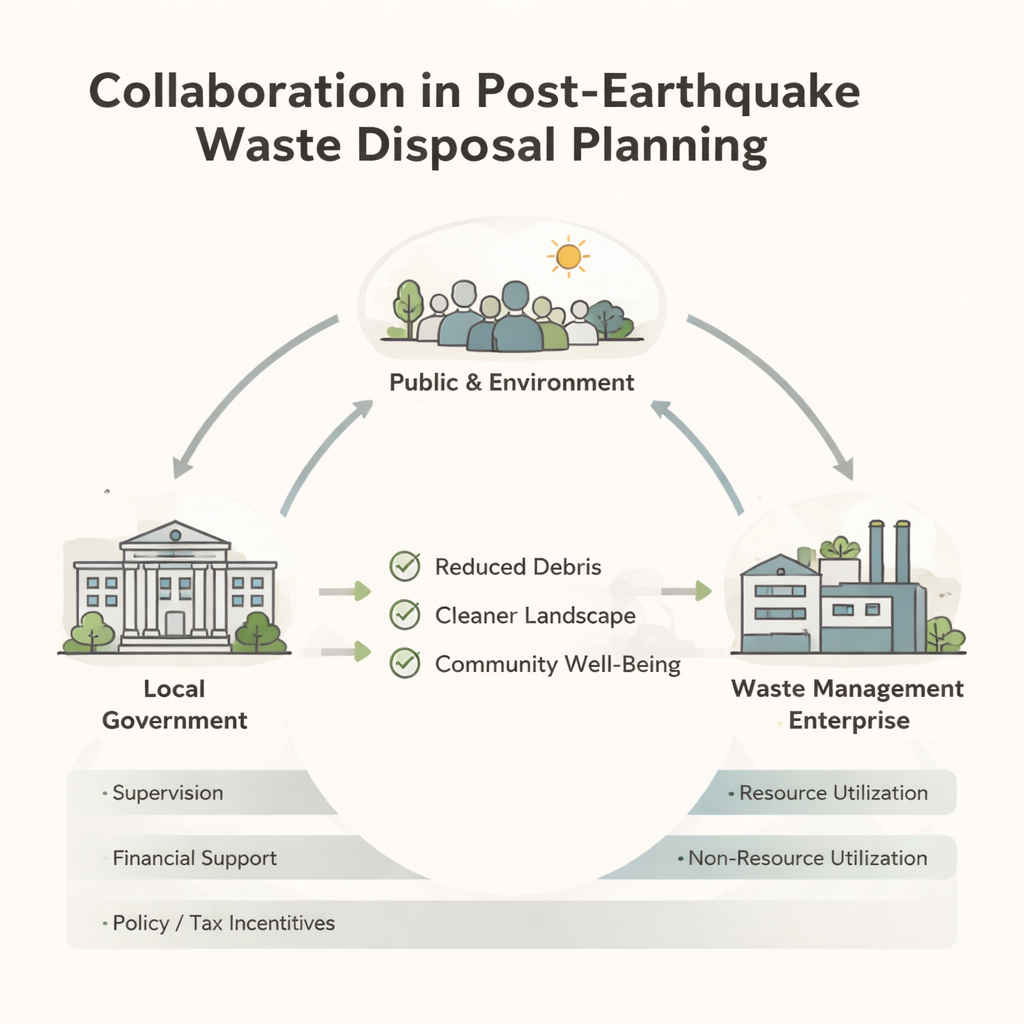
When a powerful earthquake strikes, the broken buildings and shattered roads it leaves behind are more than a symbol of loss—they are a massive practical challenge. In a matter of hours, a city can accumulate more debris than it would normally generate in many years. What happens to this mountain of rubble affects how quickly people can return home, how safe their environment is, and how much public money is ultimately spent. This study looks at how local governments and waste companies can work together, or fall apart, when deciding where and how to handle post-earthquake waste, and what kinds of policies can nudge them toward cleaner, more cooperative choices.
The Hidden Politics of Rubble
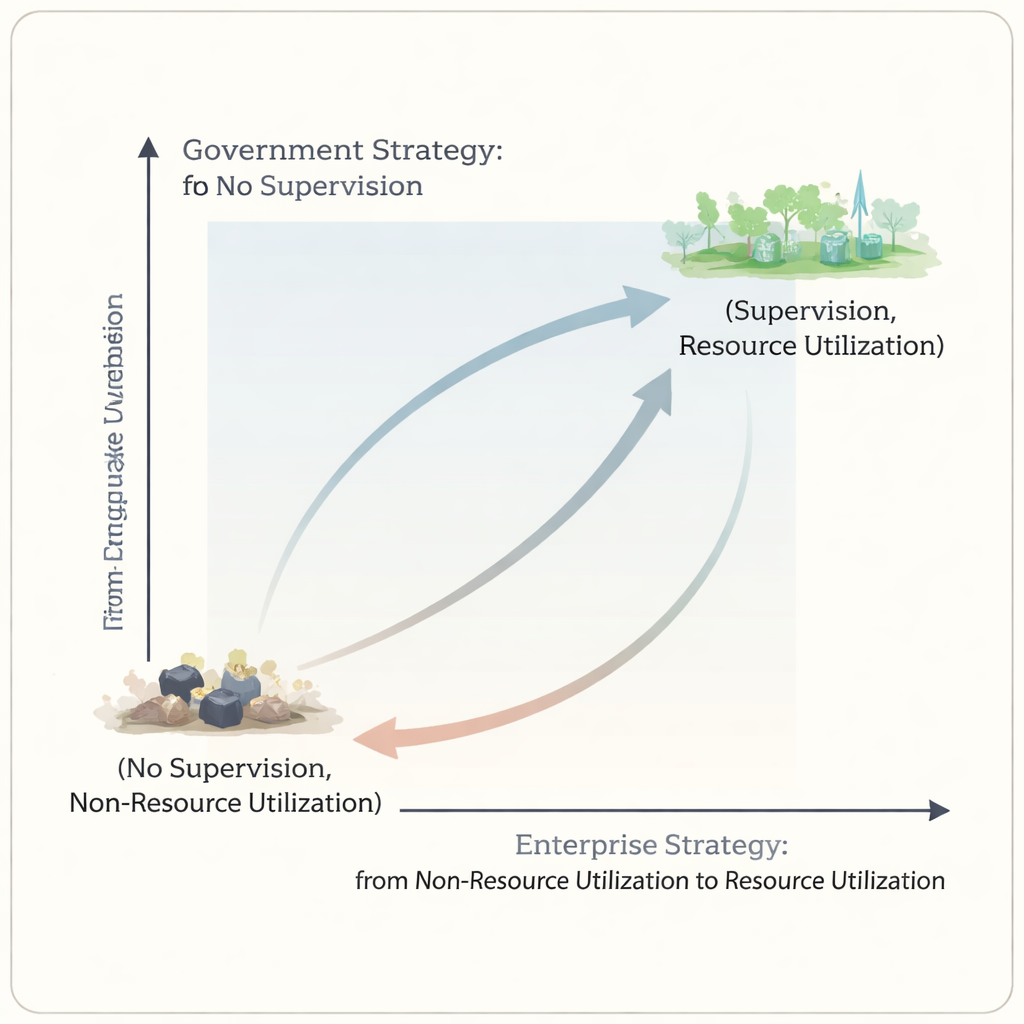
After a major quake, local governments are under pressure to clear streets, protect public health, and show they are in control. Waste management firms, by contrast, worry first about costs and profits. Turning debris into reusable materials—such as recycled concrete or metal—can bring environmental and social benefits, but it is usually more expensive and risky than simply dumping it. The two sides must therefore choose between four basic combinations: governments can either supervise or not, and companies can either invest in resource recovery or focus on cheap, quick disposal. The study argues that these choices are shaped not just by money and laws, but also by psychology—how each side perceives gains and losses under stress and uncertainty.
Using Game Thinking to Map Their Choices
The researchers build an “evolutionary game” model to capture how government and company strategies change over time as each observes the other’s behavior and adjusts its own. Rather than assuming perfect rationality, they invoke the idea of bounded rationality: in chaotic post-disaster settings, decision-makers use rules of thumb and react to perceived risks instead of calmly calculating every outcome. To reflect this, the model incorporates prospect theory, a behavioral framework showing that people fear losses more than they value equivalent gains and judge probabilities in biased ways. In the model, government payoffs include prestige, supervision costs, financial support, and the risk of social unrest if waste is mishandled; company payoffs include extra income from recycling, added processing costs, tax breaks, and the danger of reputational damage or protests.
Two Very Different Endgames
When these ingredients are combined mathematically, the system tends to drift toward one of two long-term patterns. In the positive outcome, governments actively supervise and firms embrace resource recovery, leading to cleaner environments and higher public trust. In the negative outcome, governments avoid the expense of supervision and companies skip recycling, opting for fast, cheap dumping that can harm communities and the environment. Which pattern emerges depends not only on starting attitudes, but also on key levers such as tax incentives, government oversight costs, expected profits from recycling, and the perceived risk of public backlash. The model shows that collaboration is inherently fragile: small shifts in these factors can tip the balance from a cooperative path to a destructive one.
Lessons from the Wenchuan Earthquake
To test their ideas, the authors plug real-world numbers from China’s devastating 2008 Wenchuan earthquake into the model. That event generated an enormous volume of construction waste and prompted a wave of policies: tax relief for recycling firms, financial support from higher-level authorities, and new rules encouraging the reuse of debris. Simulations suggest that stronger tax breaks, higher revenues from selling recycled materials, and lower supervision costs all make it more likely that the system settles into the cooperative state where governments supervise and firms recycle. Conversely, if supervision is expensive or recycling barely pays, both sides are pulled toward neglect: officials look the other way, and companies stick with simple dumping even when society pays a long-term price.
What This Means for Future Disasters
For non-specialists, the main takeaway is that better disaster waste management is not just about having the right technology or enough trucks. It is about aligning incentives and perceptions so that governments find it worthwhile to enforce rules, and companies find it attractive to invest in cleaner methods. Well-designed tax incentives, moderate supervision costs, and clear reputational stakes can push both sides toward cooperation. If these conditions are missing, even well-intentioned actors may slide into a pattern of neglect that leaves communities surrounded by unsafe, poorly managed debris long after the shaking stops.
Citation: Yang, Q., Liu, S., Zhang, F. et al. Collaborative strategies for planning post-earthquake waste disposal facilities: a bounded rationality perspective. Sci Rep 16, 7257 (2026). https://doi.org/10.1038/s41598-026-37102-z
Keywords: earthquake debris, disaster waste management, government–enterprise collaboration, evolutionary game, prospect theory