Clear Sky Science · en
Characterization of acoustic emission parameters and identification of staged fracture propagation in solidified body-coal combination based on experimental and machine learning approaches
Listening for Trouble Deep Underground
Modern coal mines rely on underground pillars and man‑made backfill to hold up hundreds of meters of rock. If these supports fail suddenly, the result can be catastrophic roof collapses. This study shows how engineers can "listen" to tiny cracking sounds inside a combined solidified backfill–coal pillar structure and use artificial intelligence to recognize the warning stages before failure, pointing toward smarter, earlier safety alerts in real mines.
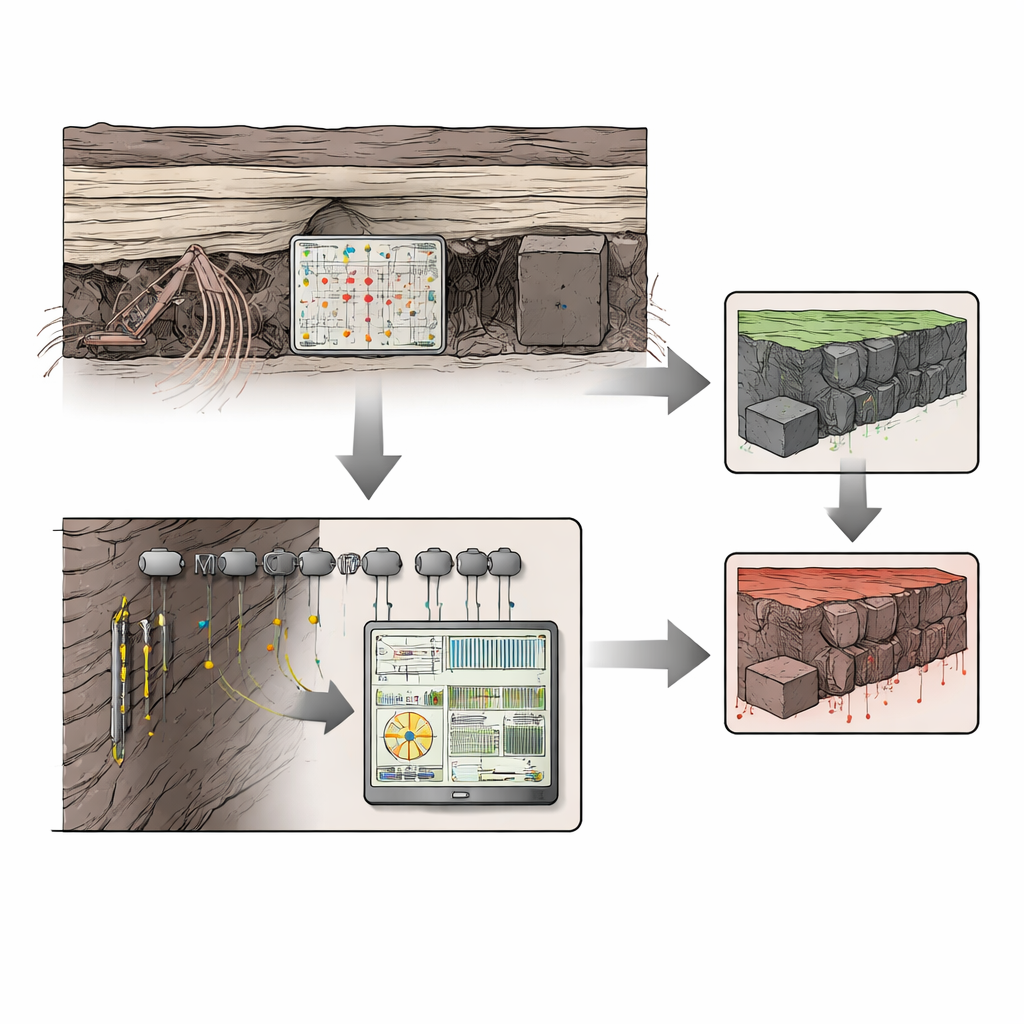
How a Man‑Made Rock and Coal Work Together
In some Chinese mines, a technique called continuous driving and gangue backfilling replaces part of the coal with a solidified block made from waste rock, cement, and sand. This block and the remaining coal pillar share the job of supporting the ground above, forming what the authors call a solidified body–coal combination. Because this structure sits in a zone of concentrated stress and is disturbed by ongoing mining, understanding exactly how and when it starts to crack is essential for long‑term stability and worker safety.
Turning Tiny Cracks into Useful Signals
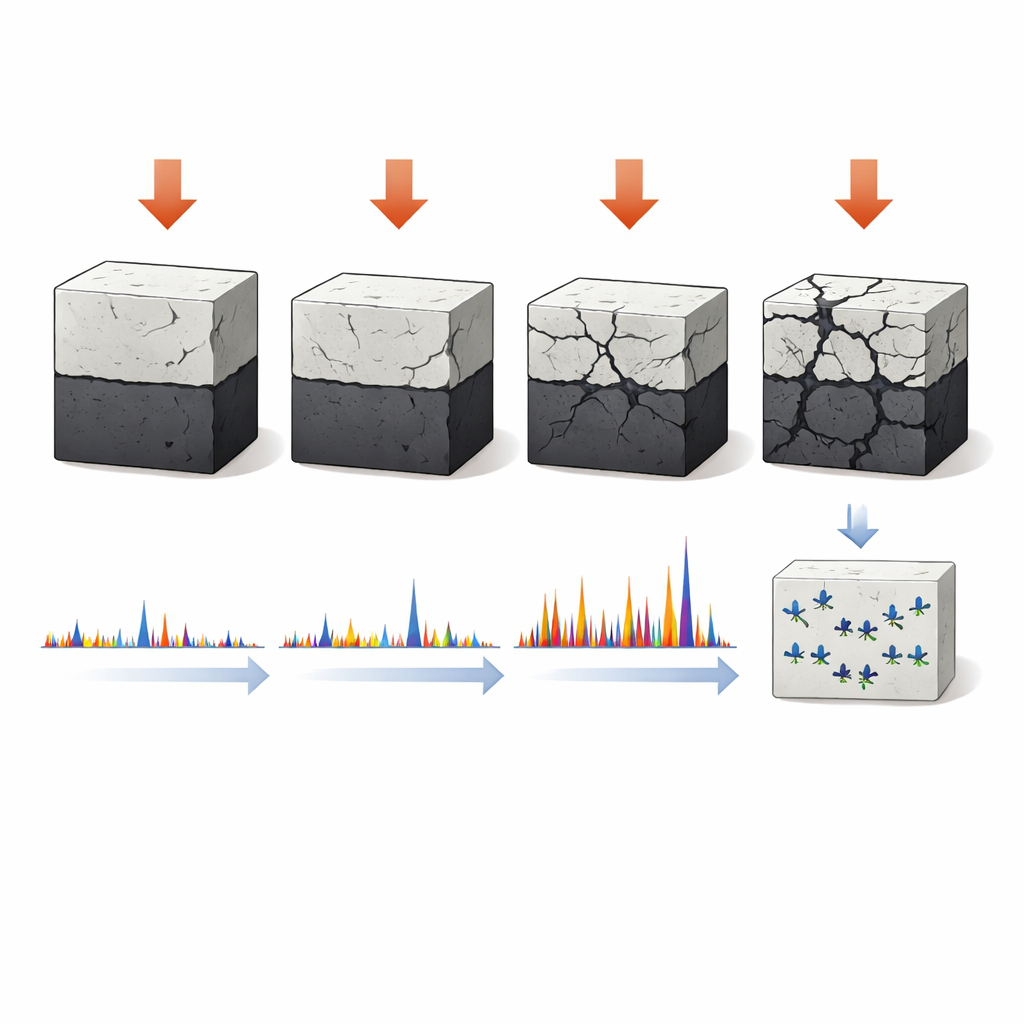
When rocks are squeezed, they emit high‑frequency elastic waves as micro‑cracks form and grow. Sensitive acoustic emission sensors, glued to the sides of lab specimens, can pick up these signals long before any visible damage appears. The researchers created combined specimens of coal and solidified backfill, then slowly compressed them while recording millions of acoustic events. They examined several aspects of these signals: how often they occurred, how their energy was distributed, and how their waveforms changed over time. By tracking these parameters alongside the stress and strain of the specimens, they could link changes in sound patterns to distinct stages of internal damage.
Crack Growth in Recognizable Stages
The tests showed that the combined structure does not fail all at once; instead, it passes through a sequence of stages. Initially, pores and small gaps are simply squeezed shut, with only a few weak acoustic signals. As loading increases, the material enters an elastic stage where micro‑cracks begin to nucleate, and activity rises sharply, producing a first peak in signal counts. Later, as larger cracks initiate, connect across the backfill and coal, and interact with one another, the signal patterns become more intense and complex, leading to a second, stronger peak associated with unstable fracture and final failure. Measures based on energy‑frequency distribution and waveform shape responded in characteristic ways during these stages, meaning that the "sound signature" of compaction, stable crack growth, and unstable break‑through can each be distinguished.
Teaching Machines to Read the Warning Signs
To turn these patterns into a practical tool, the team fed four key acoustic parameters into several machine‑learning models designed to recognize which damage stage the specimen was in at any moment. They tested random forests, support vector machines, and two advanced gradient‑boosting methods. All four learned to classify the stages with high accuracy, but the light gradient boosting machine performed best, correctly identifying more than 85% of time windows across all stages. The authors then used a popular interpretability method to see which parameters mattered most, and used those importance scores to build a single combined warning index. This index blends different aspects of the acoustic behavior into one curve that rises as the structure moves from safe to dangerous states.
What This Means for Mine Safety
In plain terms, the study shows that the backfill–coal support system talks before it breaks, and that computers can learn to understand its language. By monitoring a handful of carefully chosen acoustic features and fusing them into a single warning indicator, engineers can, in principle, detect when the structure shifts from harmless cracking to rapidly spreading fractures that precede collapse. Although the proposed index is still based on controlled laboratory tests and must be adjusted for the noisier, more complex conditions underground, it offers a clear framework for future mine monitoring systems that aim to turn faint underground whispers into reliable early warnings.
Citation: Tan, Y., Cheng, H., He, M. et al. Characterization of acoustic emission parameters and identification of staged fracture propagation in solidified body-coal combination based on experimental and machine learning approaches. Sci Rep 16, 8314 (2026). https://doi.org/10.1038/s41598-026-37101-0
Keywords: acoustic emission, coal mine stability, rock fracture, machine learning monitoring, early warning systems