Clear Sky Science · en
Optimization and accuracy analysis of track straightness measurement based on total station free station method
Why measuring “straight lines” really matters
From high‑speed trains to giant machine tools, many of the technologies we rely on every day depend on rails and guideways that are almost perfectly straight over long distances. Even a bend of a fraction of a millimeter can cause vibration, extra wear, or outright failure. Yet checking the straightness of tracks that stretch more than 100 meters through cluttered, real‑world environments is surprisingly hard. This study describes a way to use a familiar surveying instrument—the total station—in a smarter, “free station” setup that keeps errors below a third of a millimeter, even when working around obstacles and imperfect conditions.
A flexible way to check long tracks
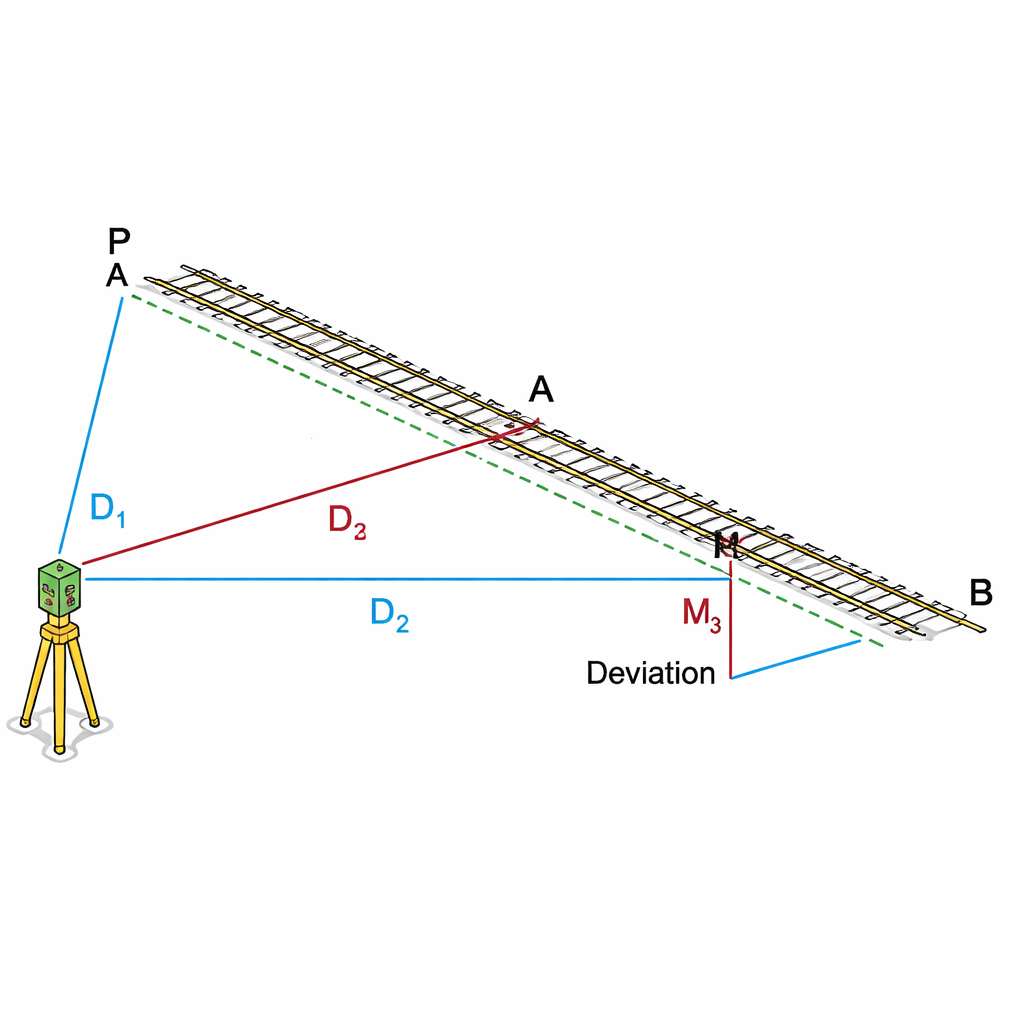
Traditional straightness checks rely on rigid tools like straightedges, stretched wires, or delicate laser setups. These can work well over short distances in clean factory spaces, but they struggle outdoors or in large industrial halls, where supports, machinery, or poor visibility break the line of sight. Total stations, widely used in surveying and construction, are attractive because they can measure angles and distances from almost any convenient spot. However, their accuracy depends strongly on where the instrument is placed and how its own errors combine. The authors focus on a “free station” approach, where the total station is not constrained to fixed positions but can be set up wherever conditions allow, and they ask: under what conditions can this flexible method truly deliver sub‑millimeter straightness checks?
Turning geometry into a practical tool
The researchers first build a geometric model that links what the total station actually reads—angles and distances to two reference points on the track and to a test point—to the tiny sideways offset, or deviation, of that test point from an ideal straight line. Using triangle areas, they derive a nonlinear formula for this deviation that works even when the instrument is set off to the side and not centered. In simple terms, the method compares the area of a triangle formed by the two reference points and the instrument with the areas formed when a slightly misaligned point on the rail is added. The difference in these areas, scaled correctly, reveals how far the rail point strays from perfect straightness.
Simulating where errors really come from
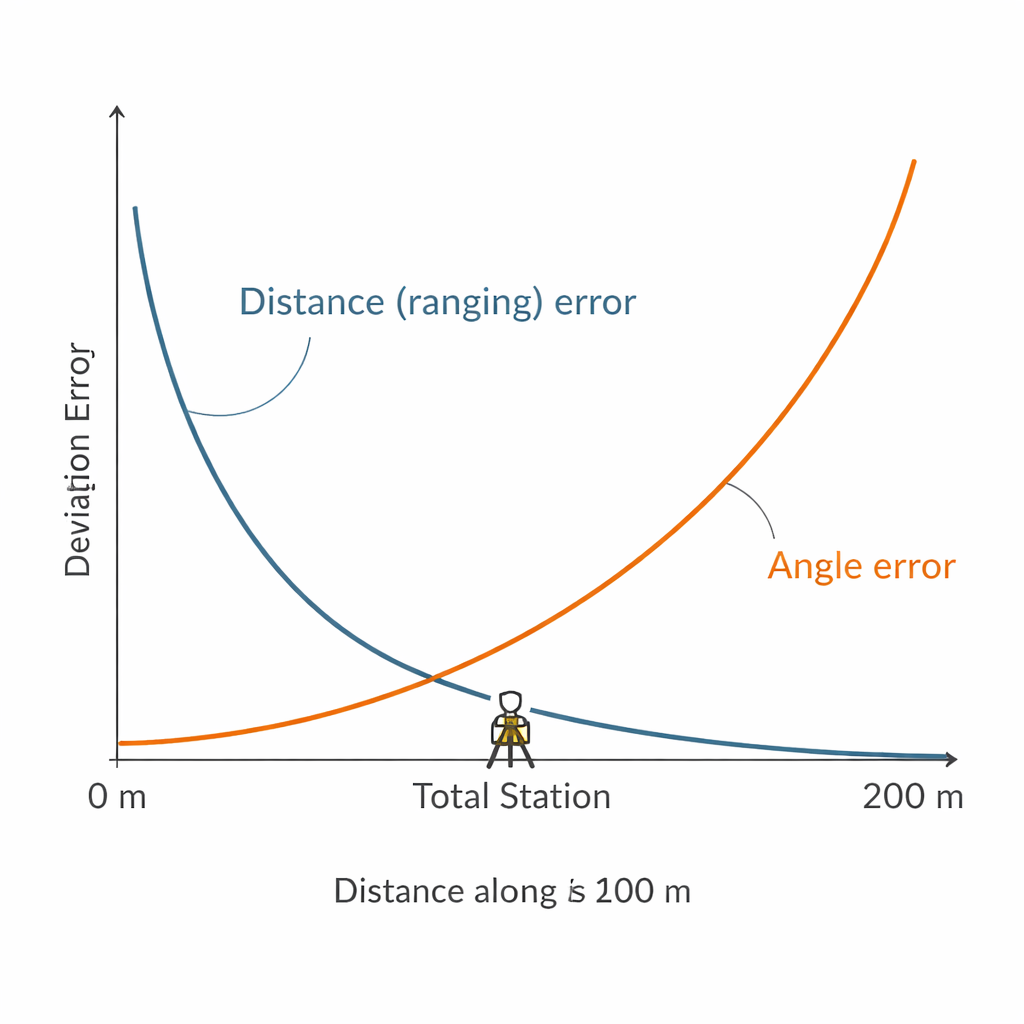
Because the formula is nonlinear and depends on several measurements at once, it is not obvious which error sources matter most. The team uses Monte Carlo simulation: a computer repeatedly perturbs the input angles and distances within realistic error ranges and watches how the calculated deviation changes. This allows them to map how uncertainty varies along a 200‑meter reference line and to separate the influence of distance errors from angle errors. They find a consistent pattern: right next to the instrument, distance errors dominate and the uncertainty spikes; farther away, angle errors control the accuracy. Sensitivity analysis shows that one particular angle in the geometry becomes overwhelmingly important toward the ends of the track, while the distance from instrument to the measured point dominates very close to the station.
Picking the right instrument and the right spot
Armed with these simulations, the authors explore how different total station specifications and mounting positions affect performance. When they vary only distance‑measurement accuracy, the overall shape of the error curve stays the same, and beyond about 20 meters from the instrument, the effect of worse ranging is small. In contrast, degrading angle accuracy quickly worsens errors at the far ends of the track. The key design rule emerges: choose a high‑precision angle‑measuring total station—about 0.5 arcsecond—while distance accuracy can be modest (up to 2 mm) as long as measurements closer than roughly 20 meters to the station are avoided. They also show that placing the instrument closer to the track and thoughtfully choosing its position along the line can “flatten” the error profile, preventing any one zone from becoming a weak point.
Putting the method to the test on a real rail
To demonstrate the method in practice, the team evaluates a 160‑meter‑long track used in a drag water pool facility, where the straightness tolerance is within about half a millimeter. They position the total station 4 meters to the side of the track and, guided by their simulations, set it up at two locations along the line, at 50 meters and 100 meters. Each setup is used only to measure segments where the predicted uncertainty is low. With 54 measurement points spaced every 3 meters and six repeated readings per point over several days, the resulting mean error in point deviation is about ±0.30 mm, with the largest measured deviation only 0.29 mm. Despite environmental influences that make the real‑world performance slightly worse than the ideal simulations, the track easily meets the required straightness tolerance.
What this means for real‑world engineering
For non‑specialists, the message is that you do not always need fragile laser systems or perfectly controlled environments to verify that long rails and tracks are “straight enough” for high‑performance machines and trains. By combining a clever geometric model, statistical simulations, and careful choices about where to place a standard total station, engineers can achieve reliable, sub‑millimeter straightness checks in messy, obstructed settings. This optimized free‑station strategy could help keep high‑speed rail lines, precision guideways, and other large engineered structures safer and more efficient, without demanding unrealistic measurement conditions.
Citation: Yang, D., Zou, J. Optimization and accuracy analysis of track straightness measurement based on total station free station method. Sci Rep 16, 5985 (2026). https://doi.org/10.1038/s41598-026-37100-1
Keywords: track straightness, total station, precision measurement, Monte Carlo simulation, rail alignment