Clear Sky Science · en
High prevalence of Trypanosoma spp. and apparent trypanocidal drugs inefficacy in cattle in Al Radom National Park, Sudan
Deadly parasites hiding in plain sight
Across much of rural Africa, cattle are the backbone of family income, food, and transport. In Sudan’s Al Radom National Park, herds look healthy from a distance, but many animals quietly carry blood‑dwelling parasites called trypanosomes. These microscopic invaders sap strength, stunt growth, and can kill outright. A new study reveals that more than one in three cattle in this park are infected, and that the medicines relied on for decades may no longer be doing their job.
A hidden threat in a remote park
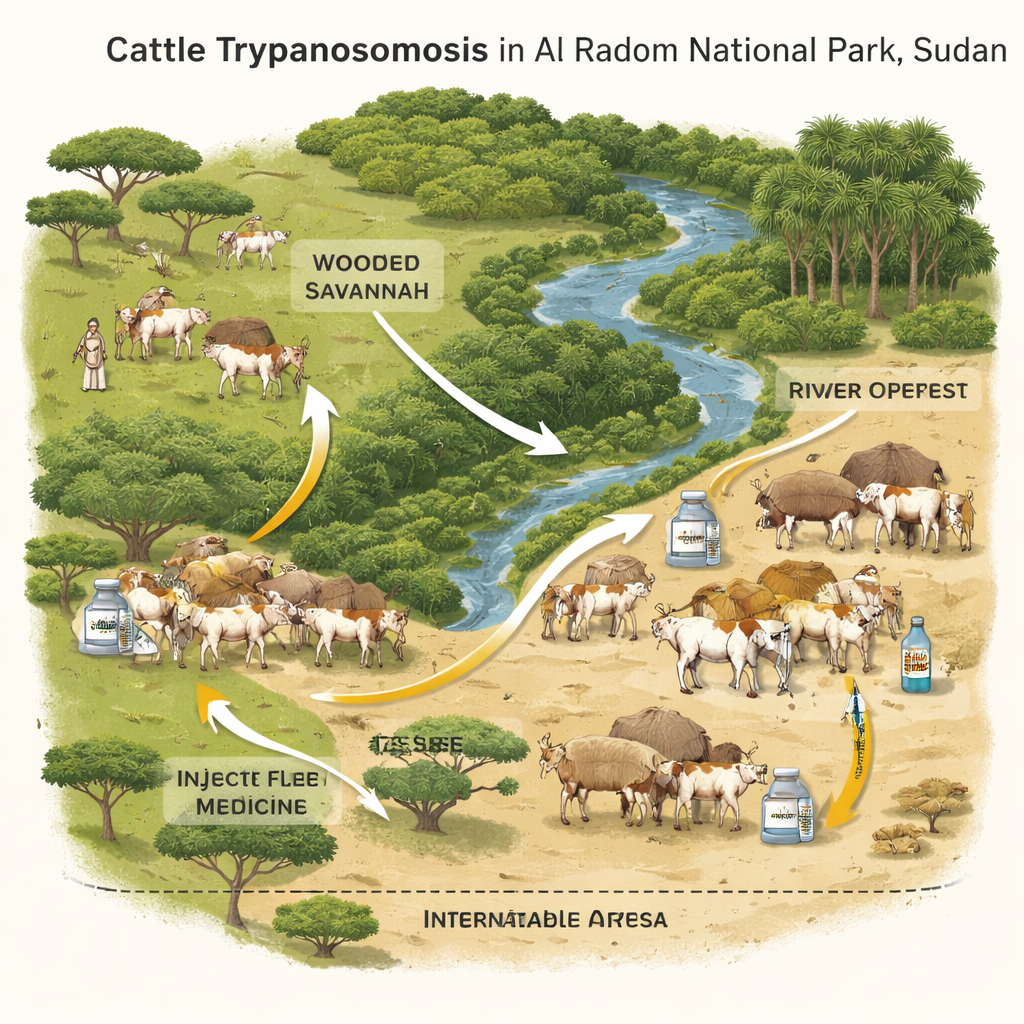
The research team worked in Al Radom National Park in southwest Sudan, a wooded savannah criss‑crossed by rivers and shared by wildlife and nomadic herders. Here, tsetse flies—stout, biting insects—are common. When they feed on blood, they can pass trypanosomes from animal to animal. The scientists focused on local Baggara cattle, a hardy zebu breed central to pastoral livelihoods. They visited herds in three main grazing regions and at a busy livestock market, sampling over 500 animals that differed in age, sex, and origin.
Finding infections that routine tests miss
To understand how widespread infection really was, the team used three kinds of tests. Field microscopy, the same simple blood‑smear method used in many rural clinics, only found parasites in about 3% of cattle. A more sensitive technique that concentrates the parasite‑rich layer of blood picked up roughly 20%. But when the researchers applied DNA‑based testing (PCR), which can detect very low parasite levels, they discovered that 36% of cattle were infected. Older animals were hit hardest, likely because they have spent more time in fly‑infested areas and accumulate infections over the years.
Several parasite species and double infections
DNA analysis showed that the picture was not just one parasite, but a mix. The most common was Trypanosoma congolense of the savannah type, a species known to cause severe disease. Also present were T. vivax, T. brucei, and T. theileri. Some animals carried two species at once, most often T. vivax together with T. theileri. Infection patterns varied between locations: cattle at the livestock market and at a wetter, more forested site had the highest rates, reflecting both richer habitat for tsetse flies and the practice of bringing older, often less robust animals to market.
Heavy drug use, yet many animals still infected
During interviews, 27 nomadic cattle owners showed striking awareness of trypanosomosis: all recognized tsetse flies, could list symptoms, and knew that special drugs are used for treatment and prevention. In practice, they relied heavily on three long‑standing medicines, given alone or in combinations, and often repeated within weeks. Fully 87% of cattle had received at least one trypanocidal drug in the month before sampling. Yet DNA tests showed that nearly a third of the entire herd population was both treated and still infected. This was true not only after short‑acting drugs, where reinfection is possible, but also after combinations that are supposed to protect animals for two to four months. Statistical modelling found no meaningful link between recent treatment and testing negative, pointing to poor drug performance.
Health impact and the puzzle of mild symptoms
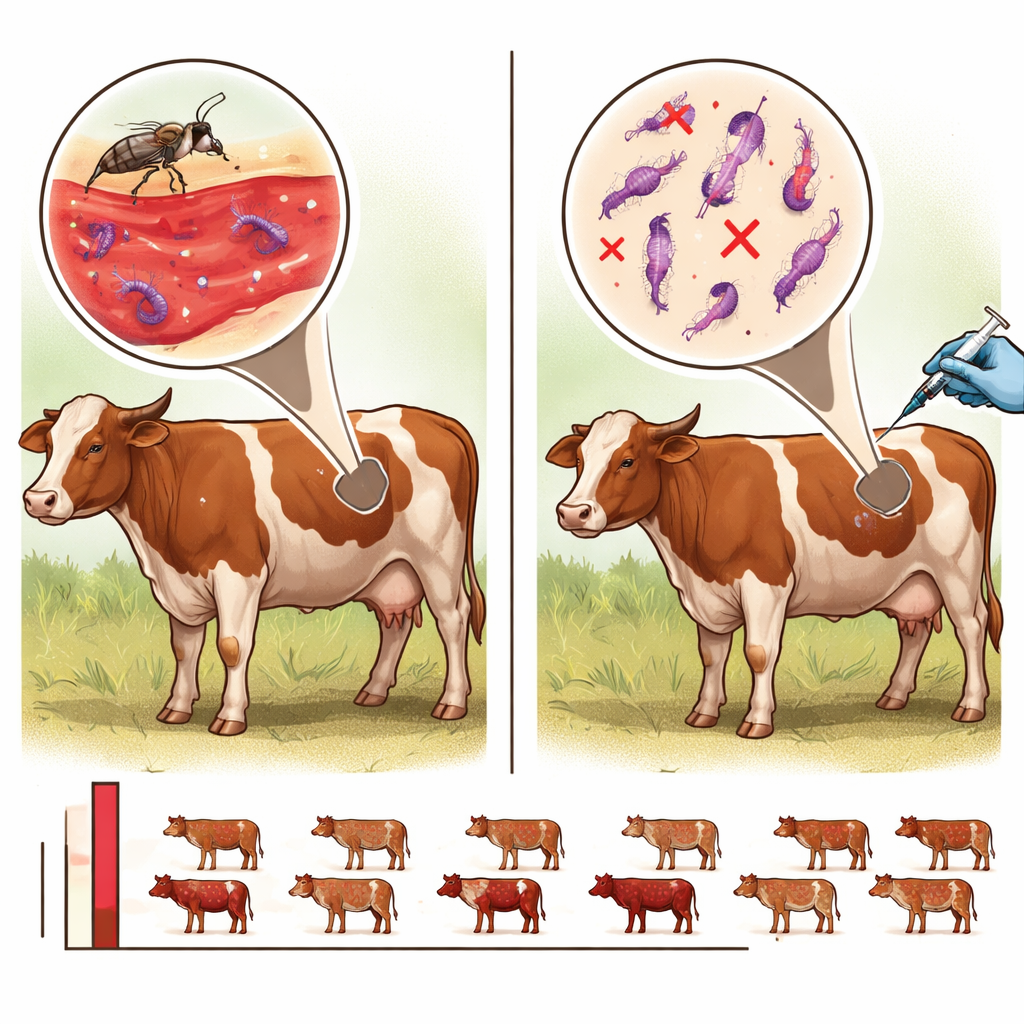
One hallmark of trypanosomosis is anaemia, a drop in red blood cells. The researchers measured this with a simple packed cell volume (PCV) test. Surprisingly, most cattle—infected or not—had values within the normal range. This suggests that, in these Baggara cattle, partial drug action or long‑term adaptation may be keeping parasite levels low enough to avoid obvious crisis, even while infections persist. The drugs seem to help animals avoid severe anaemia, but not to clear the parasites, which quietly continue to circulate through flies and herds.
What this means for herders and animal health
For people whose livelihoods depend on cattle, this study carries a double warning. First, trypanosome infections in Al Radom National Park are far more common than routine tests reveal, sapping productivity and threatening herd survival. Second, the cornerstone drugs used for generations appear to be losing their punch, whether due to true parasite resistance, poor‑quality products, or frequent, unsupervised dosing. The authors argue that Sudan and neighbouring South Sudan need coordinated control plans that combine better diagnostics, careful drug use, and renewed efforts to manage tsetse flies. Without such action, the silent spread of drug‑tolerant parasites could further undermine food security for millions who depend on cattle.
Citation: Mohammedsalih, K.M., Mukhtar, M.M., Ibrahim, A.I.Y. et al. High prevalence of Trypanosoma spp. and apparent trypanocidal drugs inefficacy in cattle in Al Radom National Park, Sudan. Sci Rep 16, 3472 (2026). https://doi.org/10.1038/s41598-026-37097-7
Keywords: cattle parasites, tsetse flies, trypanosomosis, drug resistance, Sudan livestock