Clear Sky Science · en
Study on vibration characteristics of roadheader cutting pre-cracked hard rock
Why cracking rock matters underground
As mines and tunnels go deeper into hard rock, the machines that chew through that rock are pushed to their limits. Roadheaders – large cutting machines with rotating heads – face huge forces, intense vibration, and rapid wear when they bite into tough rock. This study explores a simple but powerful idea: if you deliberately crack the rock in advance, can you make cutting smoother, safer, and less damaging to the machinery?
Breaking rock the smart way
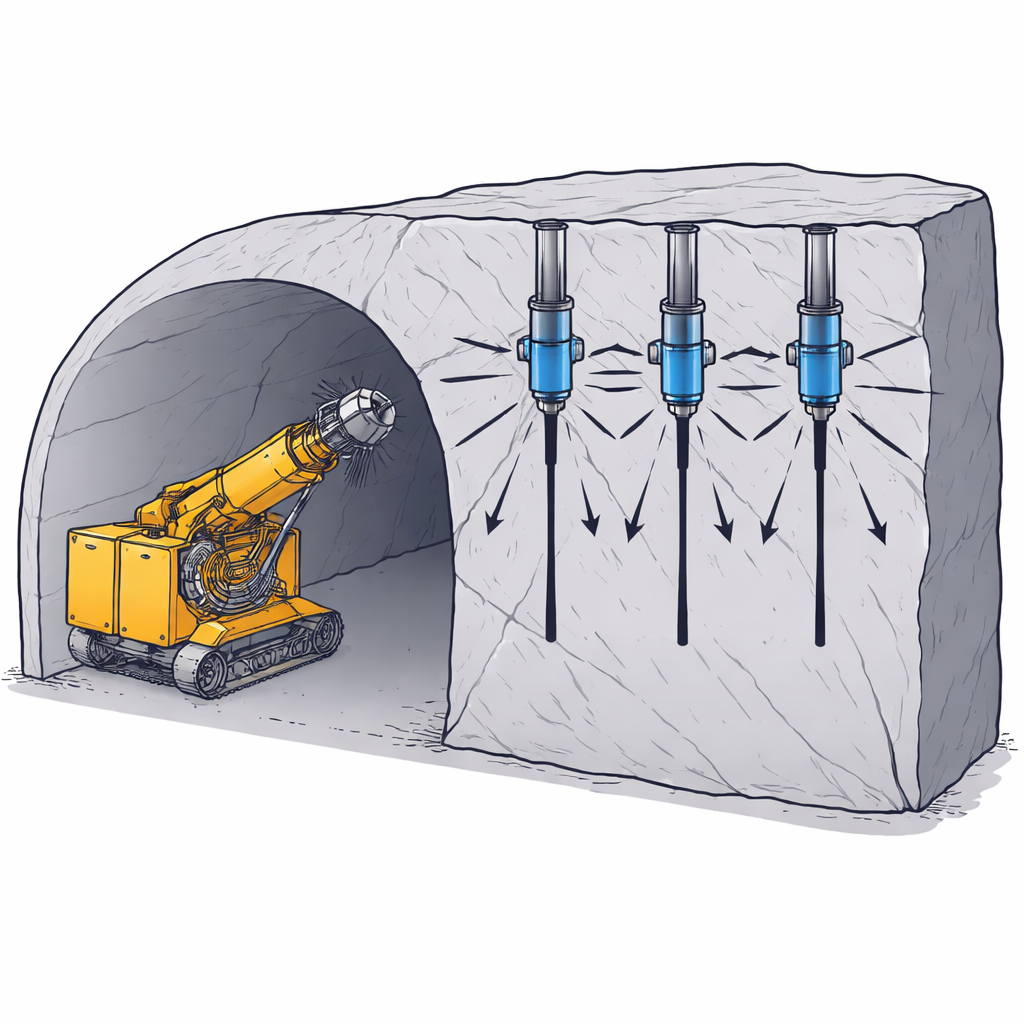
Instead of relying only on brute-force cutting, the researchers use a method called mechanical pre-cracking. First, holes are drilled into the rock face. Then a hydraulic device, shaped like a wedge, is inserted into each hole and slowly pushed outward. Because rock is much weaker in tension than in compression, this steady outward push opens controlled cracks that run from the holes toward the surface. In effect, the rock face is turned into a network of pre-made fault lines so that later, when the roadheader arrives, it is cutting weakened, already damaged rock rather than a solid, unbroken wall.
Building a virtual rock wall and machine
To study this process safely and cheaply, the team built detailed computer models instead of experimenting only underground. They represented the rock wall as a dense pack of virtual particles bonded together so that those bonds could break and form cracks. This allowed them to simulate how cracks start and spread when the hydraulic wedge pushes inside the drilled holes. In parallel, they created a three-dimensional model of a real roadheader – including a flexible cutting arm and the rotating table that steers it – so they could see how the machine bends and vibrates when it works.
Letting rock and machine interact
The key step was to make these two models talk to each other in real time. As the virtual cutting head moved and rotated into the rock, the rock model returned the forces from countless tiny contacts back to the machine model. This two-way exchange reproduced both how the rock broke apart and how the machine shook in response. The researchers ran two scenarios under the same cutting conditions: one with an intact hard-rock wall and one where three pre-cracked holes had first been opened, just as in a real pre-cracking operation.
Lighter loads and calmer shaking
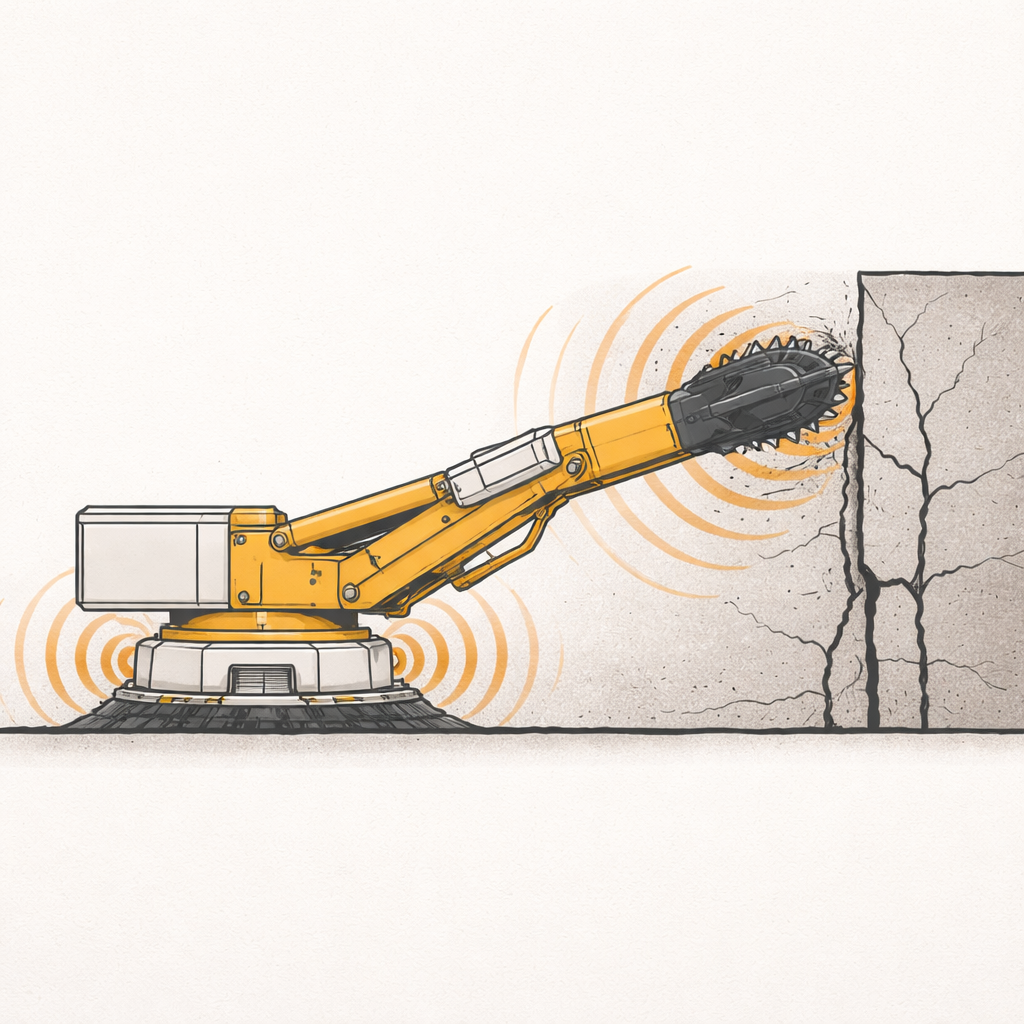
The simulations showed that pre-cracking makes the roadheader’s job noticeably easier. On average, the overall load on the cutting head dropped by about 8 percent, and fluctuations in that load – the sudden spikes that can damage parts – also became smaller. Looking at the directions separately, the forces pulling the machine forward, pushing sideways into the rock, and pressing up or down were all reduced once cracks were present. When the team converted the vibration signals into frequency plots, they found that most of the shaking energy sat in the 20 to 30 hertz range. In this band, vibration at the cutting head, the cutting arm, and the rotary table fell by roughly 15, 9, and 4 percent, respectively, after pre-cracking, revealing a clear step-by-step weakening of vibration along the machine.
Checking the model in the real world
To make sure the virtual results reflected reality, the researchers ran full-scale tests with an actual roadheader cutting into siltstone blocks, with and without pre-cracked holes. They mounted three-direction vibration sensors on the cutting head and arm and compared the measurements to the simulations. The shape and strength of the vibration signals, especially along the vertical direction, matched closely; the statistical agreement was very high. This gave confidence that the combined rock–machine model faithfully captures how pre-cracking changes both cutting forces and vibration.
What this means for future tunneling
For a layperson, the takeaway is straightforward: by weakening hard rock in a controlled way before cutting, you can turn a brutal, hammering process into a smoother, more predictable one. Carefully spaced pre-crack holes reduce the stiffness of the rock mass, guide how it breaks, and in doing so lower both the average load and the violent shaking that roadheaders must endure. That can extend machine life, cut maintenance costs, and improve safety for workers, especially in deep, high-stress tunnels. While more work is needed to cover long-term wear and a wider range of rock types, this study shows that smart preparation of the rock can be as important as the power of the machine that cuts it.
Citation: Liu, H., Li, F., He, J. et al. Study on vibration characteristics of roadheader cutting pre-cracked hard rock. Sci Rep 16, 5933 (2026). https://doi.org/10.1038/s41598-026-37089-7
Keywords: hard rock tunneling, roadheader vibration, mechanical pre-cracking, rock cutting, underground mining