Clear Sky Science · en
Improved circle-SCA-BSO optimized gas turbine speed PID controller for enhanced speed tracking and interference rejection
Why faster, steadier turbines matter
Every time a power plant ramps up to meet evening demand, or a jet engine throttles for takeoff, a gas turbine has to change speed quickly and safely. If its control system reacts too slowly or overshoots, the result can be wasted fuel, higher emissions, or even damage. This paper explores a new way to automatically fine‑tune a very common type of industrial speed controller so that gas turbines can respond faster, hold a steadier speed, and better shrug off disturbances in real‑world operation.
Getting a grip on turbine behavior
Before you can control a gas turbine well, you need a good digital stand‑in for how it behaves. The authors first build such a stand‑in, called a dynamic model, using a type of neural network that learns how the turbine’s speed and exhaust temperature respond to inputs like fuel flow, inlet temperature, and guide vane angle. They train this model on data from a real turbine running from ignition up to full speed with no load, and carefully normalize and test the data so the model does not just memorize one set of conditions. The resulting model predicts turbine behavior with more than 99.9% accuracy, making it a reliable sandbox for trying out and tuning new control methods. 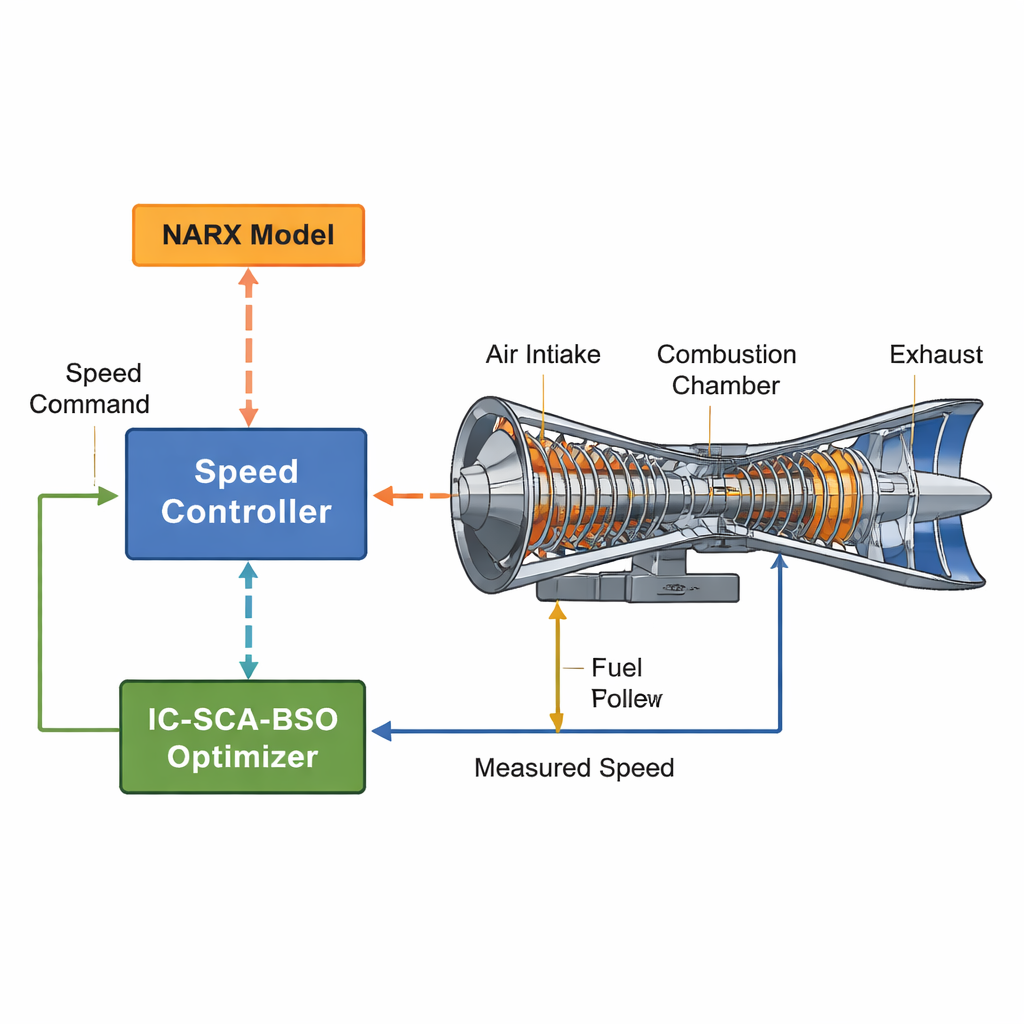
Why tuning common controllers is still hard
In industry, the workhorse of automatic control is the PID controller, which adjusts an output—in this case fuel flow—based on how far, how long, and how quickly the turbine speed differs from its target. PID units are simple and trusted, but choosing their three key settings is notoriously tricky. Traditionally, skilled engineers tweak these values by hand, a process that is slow and hard to reproduce. Many research groups now use search algorithms inspired by nature—like swarms of birds or insects—to hunt automatically for better PID settings, but these methods can get stuck in second‑best solutions or take too long to converge.
A smarter swarm for automatic tuning
The authors introduce an upgraded search strategy, called IC‑SCA‑BSO, that combines and refines several swarm‑inspired ideas. It starts by spreading virtual “beetles” (candidate solutions) evenly across the search space using a circular pattern, rather than scattering them at random. It then adjusts how boldly the swarm explores over time, using a carefully shaped curve instead of a simple linear fade‑out. Finally, it borrows rhythmic steps from a sine‑and‑cosine‑based method to keep the beetles from settling too early into local dead ends. Together, these steps allow the algorithm to search widely at first and then zoom in smoothly on the best combination of PID settings, measured by how small and short‑lived the speed error is over time.
Putting the new controller to the test
Using their neural‑network turbine model and a standard simulation platform, the researchers compare five versions of the speed controller: a hand‑tuned baseline and four automatically tuned PIDs based on different swarm methods. They judge each one on how quickly the turbine reaches new speed commands, how much it overshoots, how steady it is once settled, and how well it recovers from a sudden 5% bump in fuel flow, which mimics real operational disturbances. Across three step changes in target speed and the disturbance test, the IC‑SCA‑BSO‑tuned controller consistently reaches the desired speed sooner, overshoots less, and settles more calmly than the others—all without demanding extra computing power. 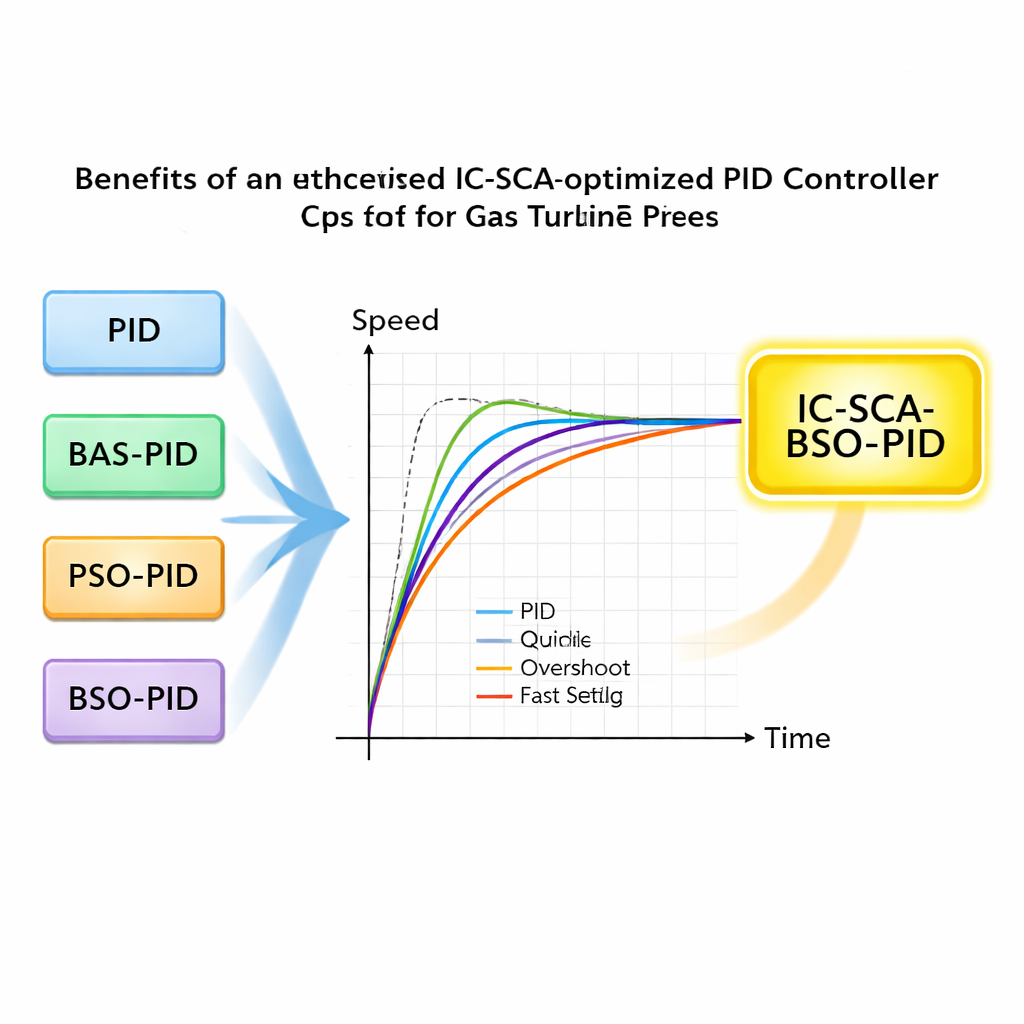
What this means for real turbines
In plain terms, the study shows that a smarter way of “auto‑tuning” a familiar, industry‑standard controller can make gas turbines react more like a well‑trained driver than a nervous beginner: quick off the mark, smooth when settling into cruising speed, and stable when the road turns rough. While the exact settings they found apply to one specific turbine and operating range, the approach—combining an accurate learned model with an improved search algorithm—offers a roadmap for plant engineers to reduce trial‑and‑error work, cut fuel use and emissions, and make power and propulsion systems both more efficient and more robust.
Citation: Dong, Y., Liu, X., Wang, Z. et al. Improved circle-SCA-BSO optimized gas turbine speed PID controller for enhanced speed tracking and interference rejection. Sci Rep 16, 5871 (2026). https://doi.org/10.1038/s41598-026-37087-9
Keywords: gas turbine control, PID tuning, swarm optimization, neural network modeling, industrial automation