Clear Sky Science · en
Techno economic integrated planning of solar integrated electric vehicle charging infrastructure in India using an AI enabled multi objective planning framework
Why Smarter Charging Matters
As India races toward electric mobility, a hidden question sits behind every new vehicle: where will all these cars, scooters, and buses plug in—and who will pay for the power? This study looks at how to design charging stations that are not only convenient for drivers but also affordable, kind to the electric grid, and closely aligned with India’s abundant sunshine. Using advanced artificial intelligence and economic modelling, the authors propose a way to plan charging networks that work better for cities, highways, and the power system that connects them.
Linking Traffic, Sunshine, and the Power Grid
The researchers start from a simple but often ignored fact: EV charging demand, solar energy and grid capacity all vary hour by hour and place by place. Instead of treating these elements separately, they build a unified planning framework that connects them. First, they forecast hourly charging needs at different types of locations—dense urban neighborhoods, busy transit hubs, and highway rest stops—using AI models that learn from time-of-day patterns, land use, and typical travel flows. Next, they estimate how much solar power each station could produce, based on local sunlight and realistic losses from heat, dust, and equipment. At the same time, they factor in India’s 2024 EV tariffs, which make electricity cheaper during daytime “solar hours” and more expensive at night, and they represent the limits of real transformers and distribution lines that feed the stations. 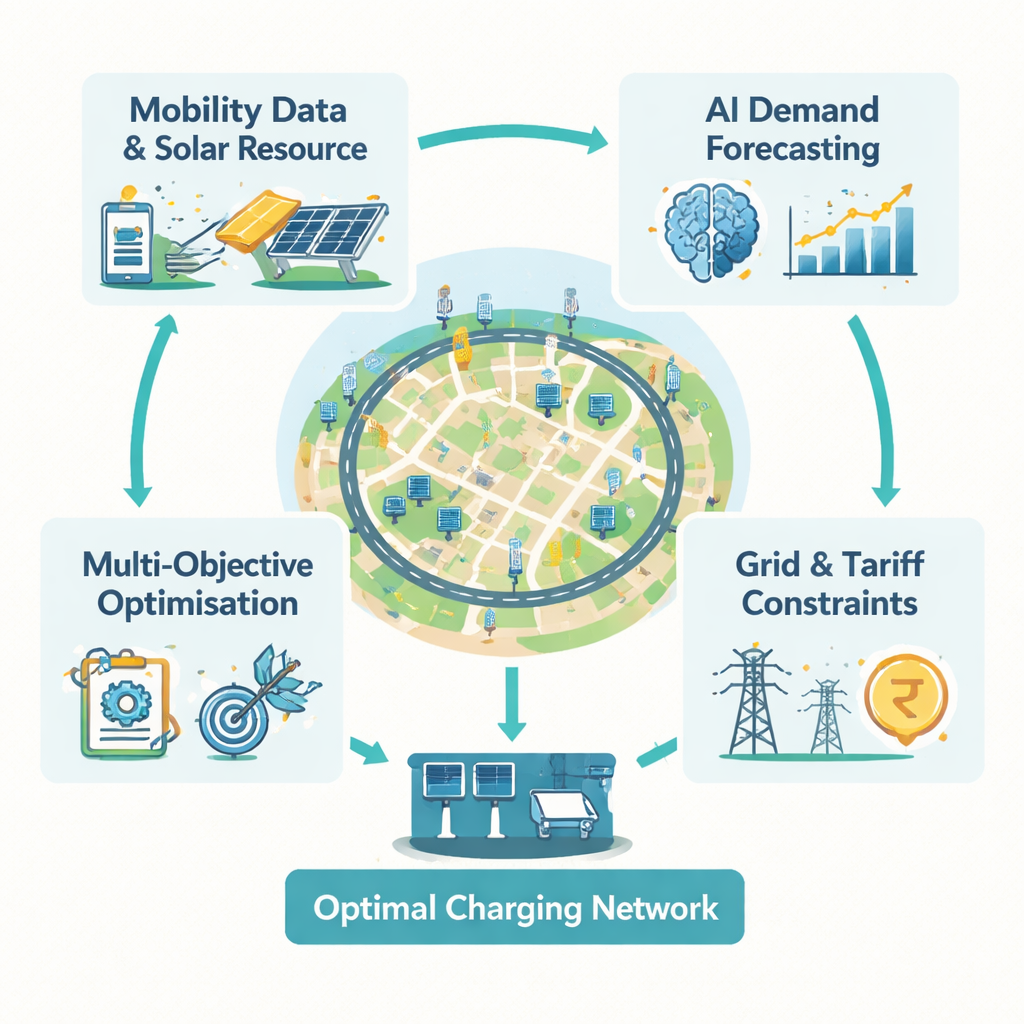
Designing the Stations as a Whole System
With these ingredients in hand, the framework treats every charging station as part of a larger system. For each possible site, it chooses how many chargers to install, how powerful they should be, what internal electronics they should use, and how much solar capacity to add on-site. The model captures how charger design affects efficiency at different load levels, which in turn changes how much power must be drawn from the grid. It also checks that local transformers are not overloaded and that voltage remains within safe limits. On top of the engineering details, the authors build a money picture: they calculate up-front capital costs, yearly operating expenses for energy and maintenance, and the revenue from selling charging services. This allows them to assess long-term measures such as the levelised cost of charging, payback period, and net present value for investors.
Letting Algorithms Explore Trade-Offs
Because there is no single “best” design that simultaneously minimises cost, grid stress and carbon impact, the team uses an evolutionary optimisation method called NSGA-II to explore thousands of configurations. The algorithm searches for combinations of station locations, charger sizes, and solar capacities that strike different balances between three goals: lowering total cost, cutting the peak power taken from the grid, and maximising the share of energy supplied by solar panels. Rather than forcing these goals into a single score, the method produces a family of “Pareto-optimal” designs—each one unbeatable on all three counts at once. Planners can then choose along this frontier, depending on whether they care most about investor returns, grid relief, or renewable use. 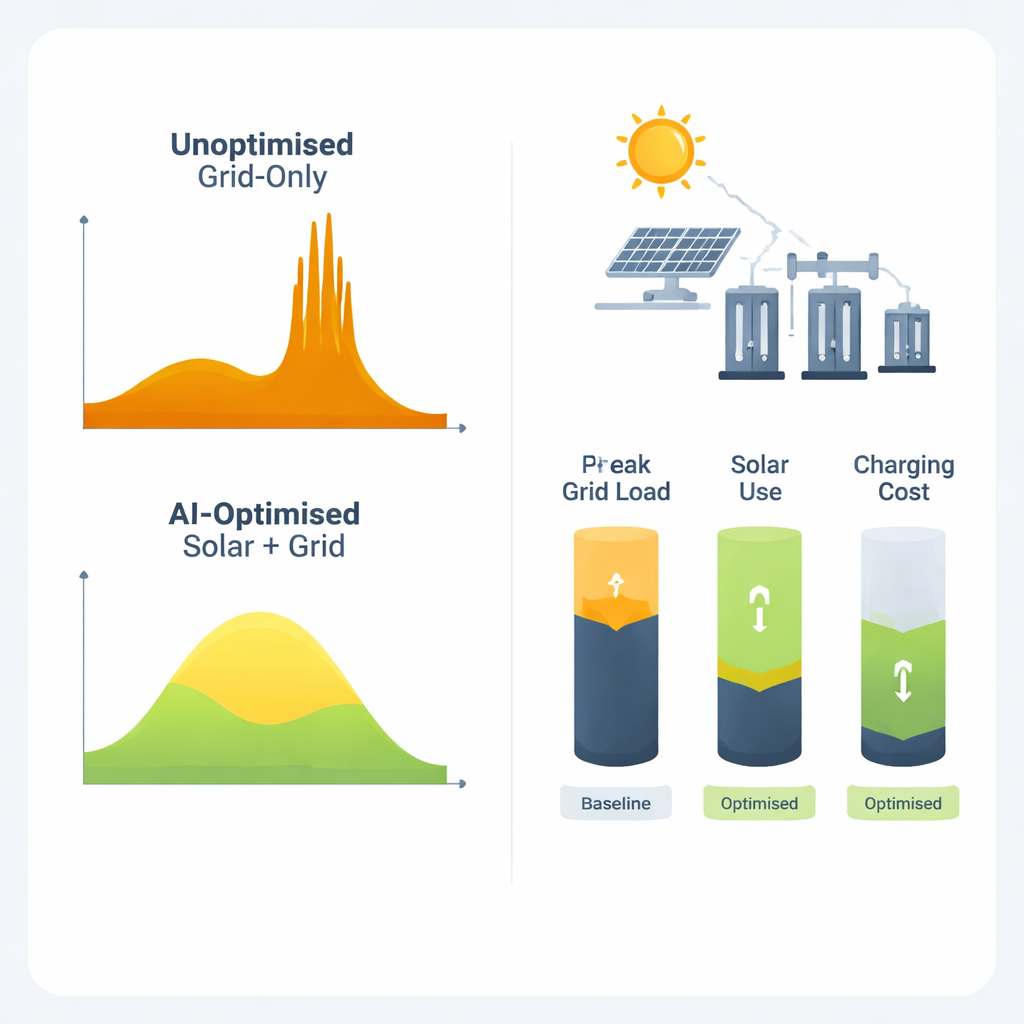
What Happens When Everything Is Optimised
The framework is tested on a realistic mixed region resembling Hyderabad’s urban core and its surrounding expressway. The authors compare three approaches: a basic grid-only network with no solar and no optimisation; a simple rule-based design that adds some solar sized as a fixed share of peak demand; and their fully optimised co-design. The results are striking. In the optimised case, peak grid load at stations falls by about 28–35 percent, helping avoid transformer overloads and expensive network upgrades. Average utilisation of chargers and solar equipment rises by 40–70 percent, meaning hardware is used more efficiently instead of sitting idle. Operating costs drop by 14–19 percent, and the long-term cost of charging energy falls by 12–18 percent compared with the baseline. Crucially, projects that look financially weak under traditional planning become attractive, with shorter payback times and healthier returns.
What This Means for Drivers and Policymakers
For the everyday EV driver, the takeaway is that well-planned, solar-powered charging can make refuelling cleaner and cheaper without straining the grid that keeps the lights on. For utilities, city planners and private investors, the study provides a practical, AI-enabled tool to decide where to build stations, how big they should be, and how much to lean on the sun versus the grid. By designing charging networks that follow real travel patterns, respect local grid limits and exploit India’s daytime solar advantage, the authors show that the transition to electric mobility can be both economically viable and technically sound. In simple terms, smarter planning turns EV chargers from a potential problem for the grid into a coordinated, sun-powered asset for India’s energy future.
Citation: Kotla, R.W., Anil, N., Lagudu, J. et al. Techno economic integrated planning of solar integrated electric vehicle charging infrastructure in India using an AI enabled multi objective planning framework. Sci Rep 16, 6393 (2026). https://doi.org/10.1038/s41598-026-37080-2
Keywords: electric vehicle charging, solar power, smart grid, India energy policy, AI forecasting