Clear Sky Science · en
A lightweight YOLO11n seg framework for real time surface crack detection with segmentation
Why tiny cracks matter
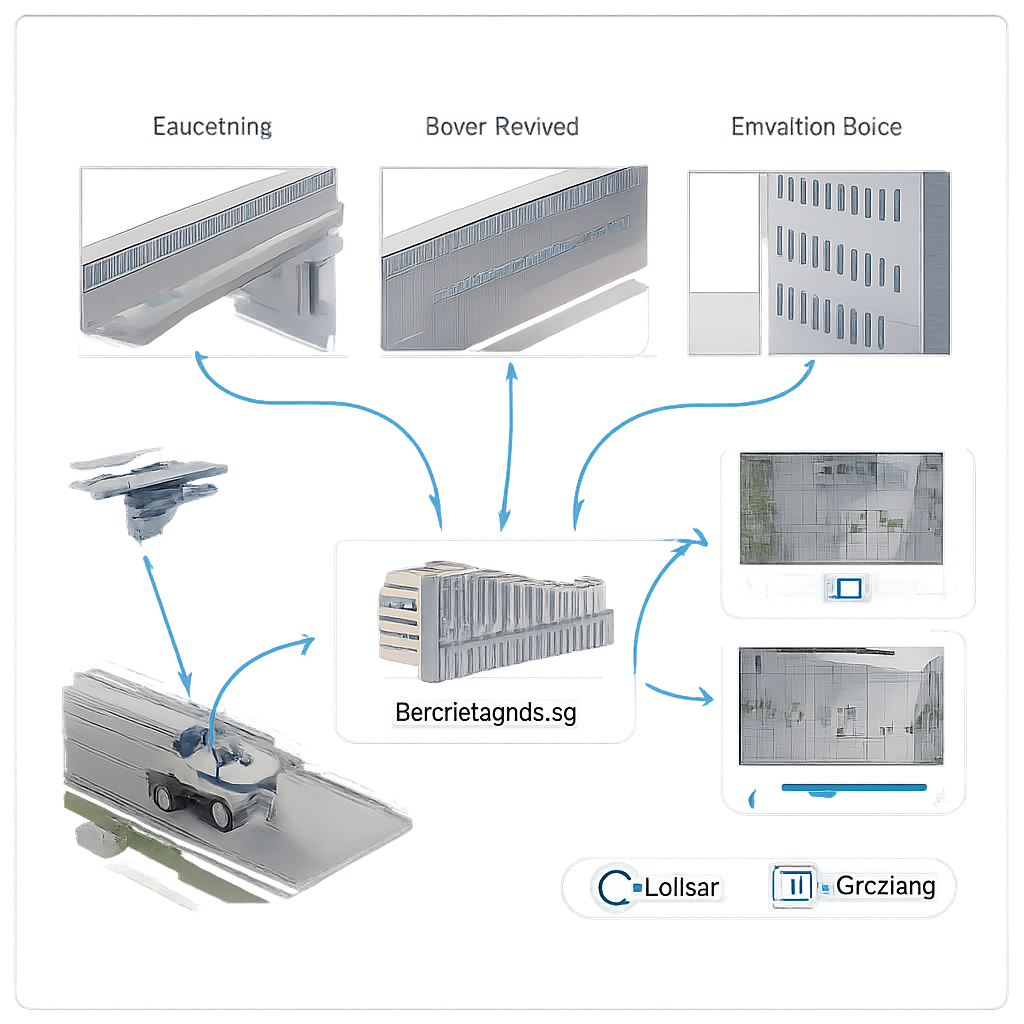
Hidden cracks in roads, bridges, and buildings may look harmless, but they are often the first warning signs that a structure is wearing out. Catching these lines early can prevent costly repairs or even disastrous failures. Yet most inspections are still done by people walking or driving slowly along surfaces, taking notes by hand. This study explores how a compact artificial intelligence system can spot and outline cracks in real time, fast enough to run on drones, small robots, and low‑power sensors instead of only in powerful data centers.
From manual checks to machine vision
Engineers have long tried to automate crack detection using traditional image processing tricks such as edge detection and thresholding. These methods work in clean laboratory settings but quickly break down in the real world, where shadows, stains, and rough textures confuse simple algorithms. More recently, deep learning has changed the game: neural networks can learn what cracks look like directly from images. Early versions could say whether a small image patch contained a crack, but they struggled to mark exactly where the crack was and were often too slow for live inspections.
How a lean model learns to see cracks
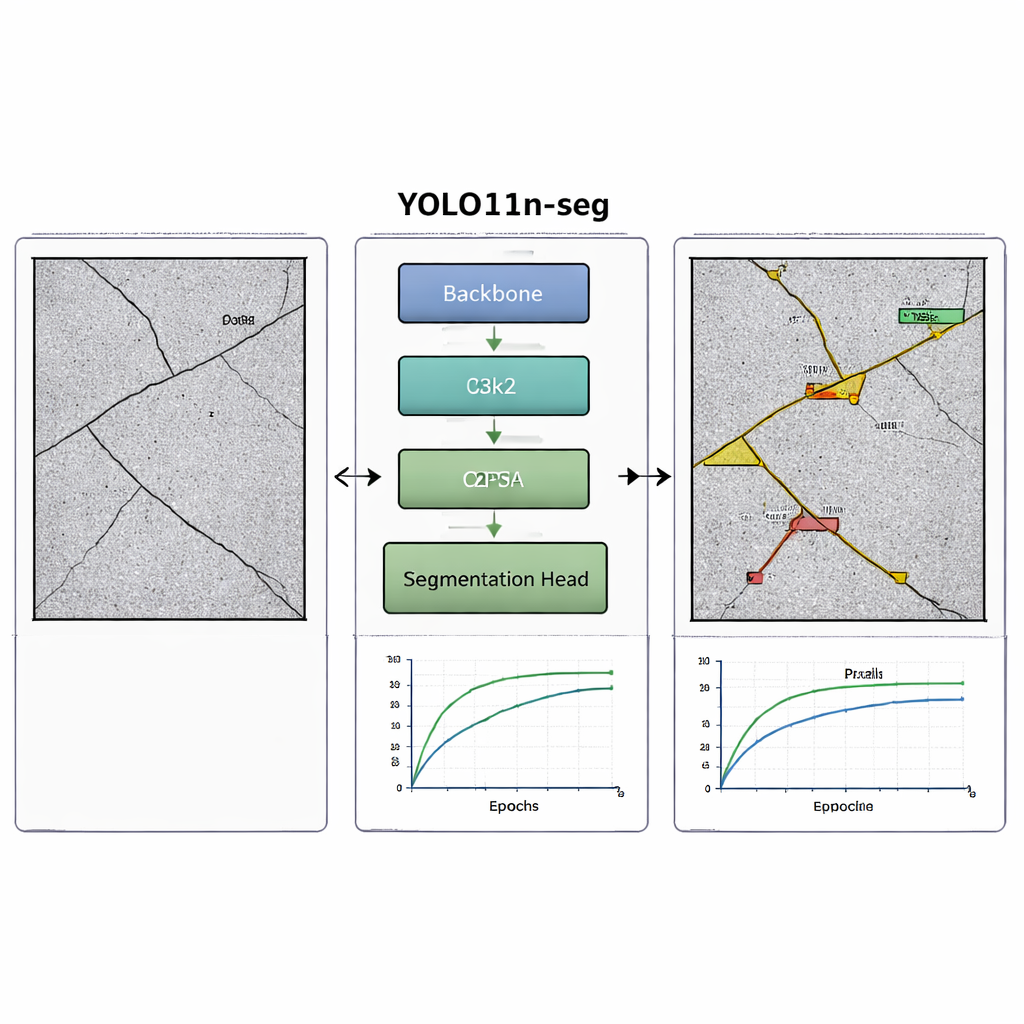
The authors build on the YOLO family of models, a popular set of tools in computer vision known for spotting objects in a single, fast pass through the network. They focus on a very small version called YOLO11n-seg, tailored to trace the exact shape of cracks, not just draw rough boxes around them. The model is trained on the Crack-Seg dataset, which contains over 11,000 carefully labeled road images where every crack pixel is marked. Images are resized to a standard format and fed into the network, which gradually learns to distinguish the thin, winding patterns of real damage from harmless background details like texture or dirt.
Smart tricks for tiny details
To spot hairline fractures on rough concrete, the model uses two design tricks. First, a special building block called C3k2 automatically switches between small and slightly larger viewing windows, allowing it to follow both very fine and longer cracks. Second, a spatial attention module called C2PSA teaches the model to focus on likely crack regions while ignoring distractions such as oil stains, shadows, or patterned surfaces. Together, these additions help the system outline cracks more cleanly and reduce the chance of mistaking background blemishes for structural damage, all while keeping the model small enough to run on modest hardware.
Fast results without heavy hardware
In tests, the lightweight network contains only about 2.8 million parameters—tiny compared with many modern deep-learning systems—yet it performs at a level similar to larger, slower designs. On the Crack-Seg benchmark, it correctly identifies crack regions with a precision of about 79% and achieves strong scores for how well its predicted crack shapes match the ground truth. Crucially, it processes each image in roughly 3.6 milliseconds on a standard GPU, corresponding to hundreds of frames per second. When compared with widely used models such as U-Net, Mask R-CNN, and an earlier YOLO variant, it delivers competitive or better segmentation accuracy while being dramatically faster, making it practical for continuous video streams from drones or inspection vehicles.
Toward automatic structural checkups
For non‑experts, the main takeaway is that this work shows it is now possible to build small, efficient AI tools that not only find cracks but also trace their exact shape and size fast enough for real-time monitoring. Although extremely faint cracks in poor lighting or bad weather remain challenging, the proposed YOLO11n-seg system offers a promising balance of speed and reliability. With further improvements and integration into field equipment, such models could help cities and agencies detect damage earlier, prioritize repairs, and keep vital infrastructure safer with less manual effort.
Citation: Tiwari, S., Gola, K.K., Kanauzia, R. et al. A lightweight YOLO11n seg framework for real time surface crack detection with segmentation. Sci Rep 16, 6566 (2026). https://doi.org/10.1038/s41598-026-37073-1
Keywords: infrastructure cracks, computer vision, deep learning, real-time inspection, YOLO segmentation