Clear Sky Science · en
Assessment of health risks from exposure to indoor volatile organic compounds in European educational buildings
Why the Air in Classrooms Matters
Most of us assume that schools are safe places for children to learn and grow. Yet the air they breathe indoors can quietly carry chemicals that affect their health for years to come. This study looks at invisible gases called volatile organic compounds, or VOCs, in European day care centres, schools, high schools and universities, and asks a simple question: are the levels in these buildings safe for children and teenagers who spend much of their day there?
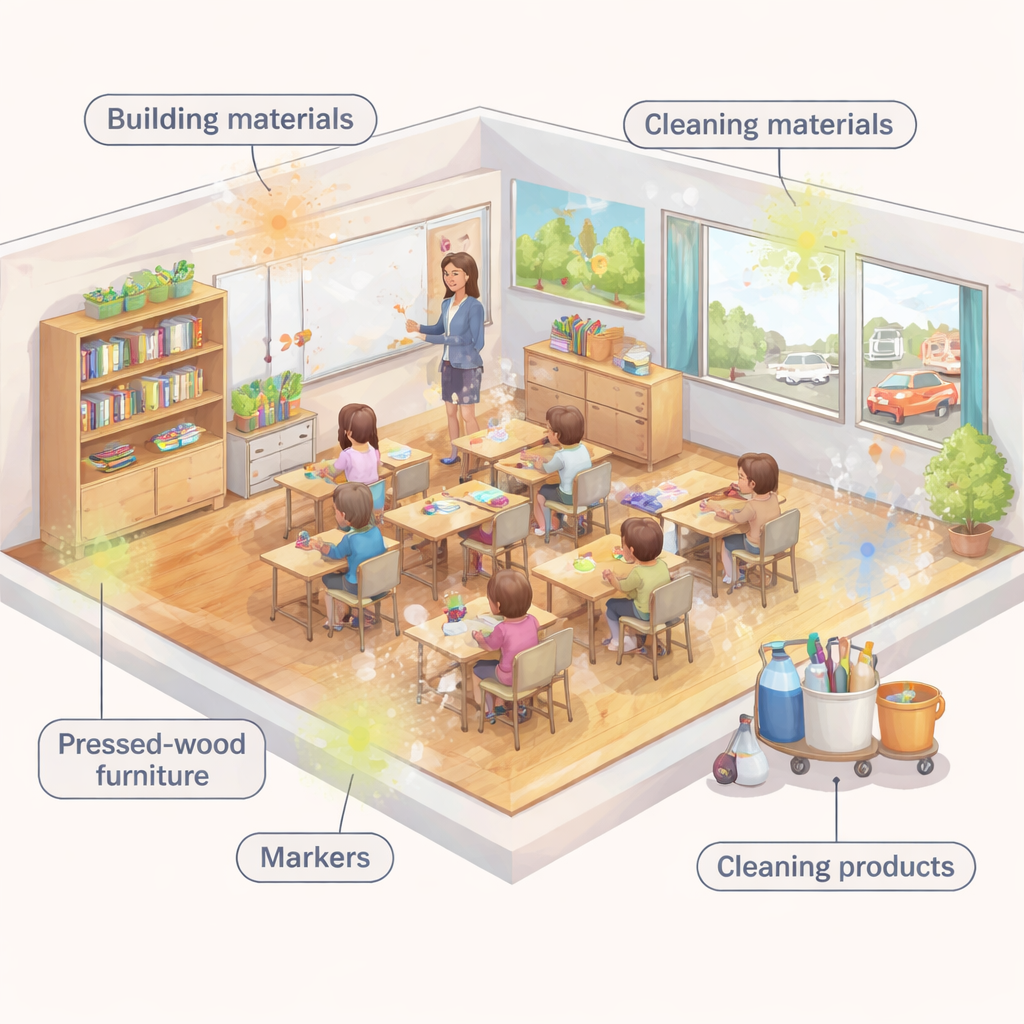
Invisible Chemicals All Around Us
VOCs are a large family of gases that easily evaporate from many everyday materials. They drift out of building products like pressed-wood furniture, flooring, paints and glues, as well as from cleaning sprays, air fresheners and even some electronics. Because modern buildings are tightly sealed to save energy, these chemicals can build up indoors to levels several times higher than outdoors. Short bursts of exposure can trigger stinging eyes or headaches. Years of breathing them can contribute to asthma, heart disease, damage to the nervous system and some cancers. Children are especially at risk because their lungs and immune systems are still developing and they breathe more air per kilogram of body weight than adults.
What the Researchers Set Out to Measure
The authors gathered measurements of nine common VOCs, including formaldehyde and benzene, from 28 studies carried out between 2010 and 2023 in educational buildings across 17 European Union countries. For each study they noted the average concentrations found in classrooms and grouped the chemicals by the body systems they are known to affect, such as the lungs, heart, brain or the risk of cancer. To translate these numbers into health meaning, they used a World Health Organization software tool called the Indoor Air Quality Risk Calculator, designed specifically to estimate risks to children from the combined effects of several indoor air pollutants.
Turning Concentrations into Health Risk
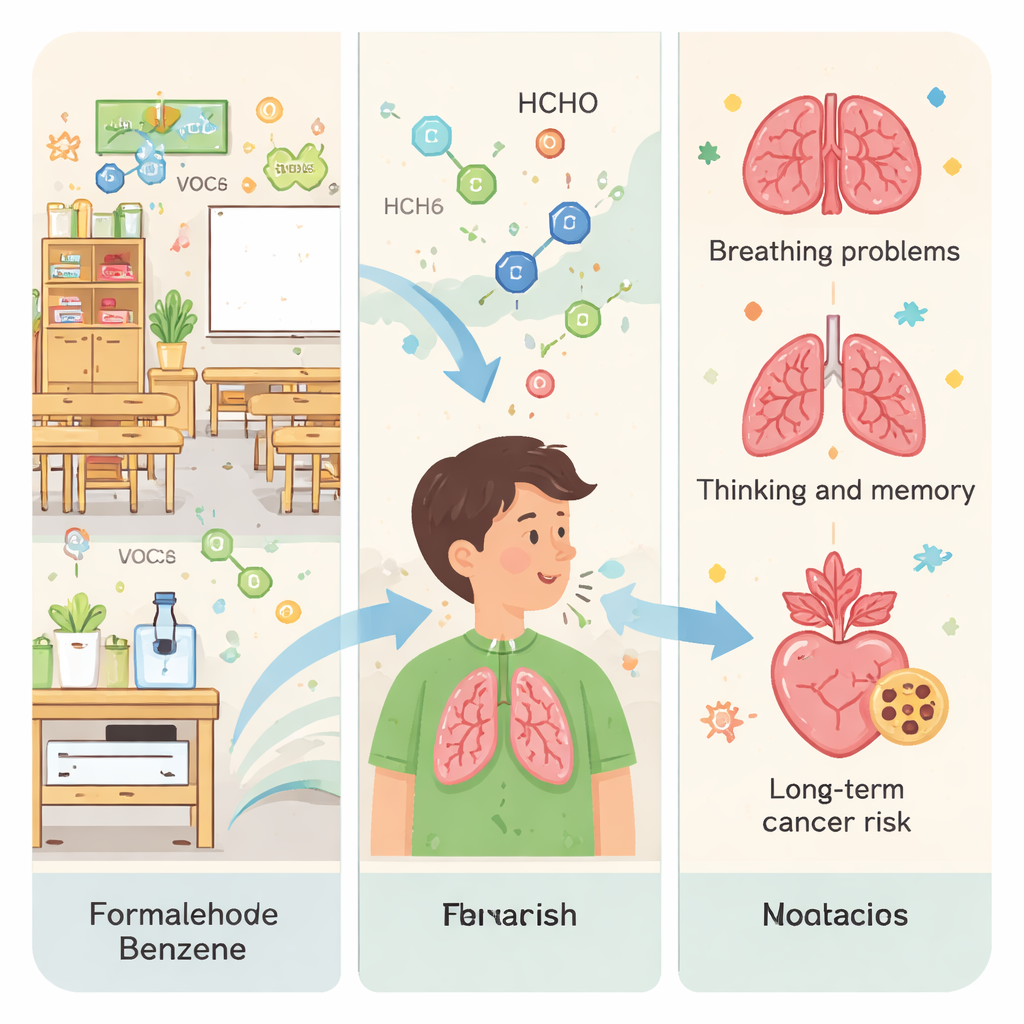
The WHO tool compares the measured classroom levels of each chemical to reference levels that are considered safe over a lifetime of exposure. It does this in stages, from simple screening to more refined calculations. For non-cancer effects like breathing problems or damage to the nervous system, the software produces an index called the adjusted point of departure index. If this index is below one, the risk is regarded as acceptable. If it climbs above one, it signals that the exposure could be high enough to matter and that action or further study is warranted. For chemicals known to cause cancer in humans, such as formaldehyde and benzene, the tool also estimates how many extra cancer cases might appear in a population of one million people exposed to the same conditions.
What Was Found in European Schools
For seven of the nine VOCs, the combined risk indices stayed below the safety line, suggesting limited concern. However, formaldehyde and benzene stood out. In many countries, benzene levels were low enough that the added cancer risk was small, but in school buildings in Germany, Greece, Hungary and Italy the index for harm to the nervous system rose above one, pointing to possible effects on brain function with long-term exposure. Formaldehyde was even more worrying. In educational buildings in 14 of the 17 countries studied, the risk index for breathing-related problems was higher than one. In some Portuguese schools it also exceeded the threshold for effects on the nervous system. For cancer, formaldehyde levels in hundreds of buildings implied more than 10 extra cases per million people, the level that European health authorities treat as a signal for concern.
What Can Be Done to Protect Students
The study does not simply raise alarms; it points to practical solutions. Many of the most important sources of benzene and formaldehyde are known and can be reduced. These include choosing low-emission building materials and furnishings, limiting high-VOC cleaning products and air fresheners, improving ventilation systems and placing schools away from heavy traffic where possible. Regular monitoring of indoor air and public reporting of results can help identify problem buildings and track progress as improvements are made. Education of school staff about safe product choices and storage is another key piece of the puzzle.
What This Means for Families and Policymakers
For parents and policymakers, the message is straightforward: the air inside many European educational buildings is not as clean as it should be, mainly because of formaldehyde and, in some places, benzene. While the increased risks are generally small for any single child, they affect millions of young people and can add up across a population. Ensuring that classrooms have low-emitting materials, good ventilation and sensible cleaning practices is a realistic goal. By treating indoor air quality in schools as seriously as clean water or safe playgrounds, societies can better safeguard children’s lungs, brains and long-term health.
Citation: Chatterjee, A., Pál, L., Lovas, S. et al. Assessment of health risks from exposure to indoor volatile organic compounds in European educational buildings. Sci Rep 16, 6554 (2026). https://doi.org/10.1038/s41598-026-37072-2
Keywords: indoor air quality, volatile organic compounds, school environments, formaldehyde, benzene