Clear Sky Science · en
The relationship between speed and curvature differs in autistic and non-autistic tracing movements
How Our Movements Reveal Hidden Differences
Everyday actions like writing your name, waving to a friend, or swiping on a phone feel effortless, but underneath the surface they follow surprisingly regular patterns. This study asks a simple but important question: do autistic and non-autistic adults follow the same hidden rules of movement when they trace shapes? The answer may help explain why many autistic people experience challenges with tasks such as handwriting and could point toward better ways to design tools and support.
Drawing Shapes to Understand Daily Actions
Instead of studying complex activities directly, the researchers focused on simple tracing movements. Twenty-one autistic and nineteen non-autistic adults, matched for age, intelligence, and sex, used a stylus on a tablet to repeatedly trace a set of smooth shapes. These included spirals, looped forms, petal-like figures, ellipses, rounded triangles, and rounded squares—basic building blocks that, when combined, can approximate almost any doodle, gesture, or handwritten flourish. As people traced, the tablet recorded the precise position of the stylus over time.
From these recordings, the team examined how fast the stylus moved at each point and how sharply the path curved. In typical movement, people naturally slow down at tighter bends and speed up on straighter stretches, following a family of mathematical regularities known as “power laws.” By comparing how closely the two groups followed these regularities across many different shapes, the researchers could test whether autistic and non-autistic movements share the same underlying patterns.

Sharper Speed Changes in Autistic Movement
Across all shapes, autistic participants showed a steeper relationship between speed and curvature than non-autistic participants. Put simply, when a line straightened out, they tended to speed up more, and when it bent into a tighter corner, they tended to slow down more. This pattern held across the entire range of shapes, and was especially strong for those with nested loops, which somewhat resemble repeated, looping gestures seen in handwriting or decorative doodles. Importantly, both groups traced the shapes with similar accuracy and overall paths, so the differences were not about how the shapes looked, but about how movement speed changed along the way.
Another striking finding was that neither group matched the textbook values of the classic movement rules perfectly. While earlier theories suggested that power laws are near-universal templates for smooth biological motion, this study adds to growing evidence that people often deviate from these ideal values. Still, because the same equipment and analysis were used for everyone, the consistent gap between autistic and non-autistic participants points to genuine differences in how their movements are controlled or carried out.
What a Frequency Lens Reveals About Movement
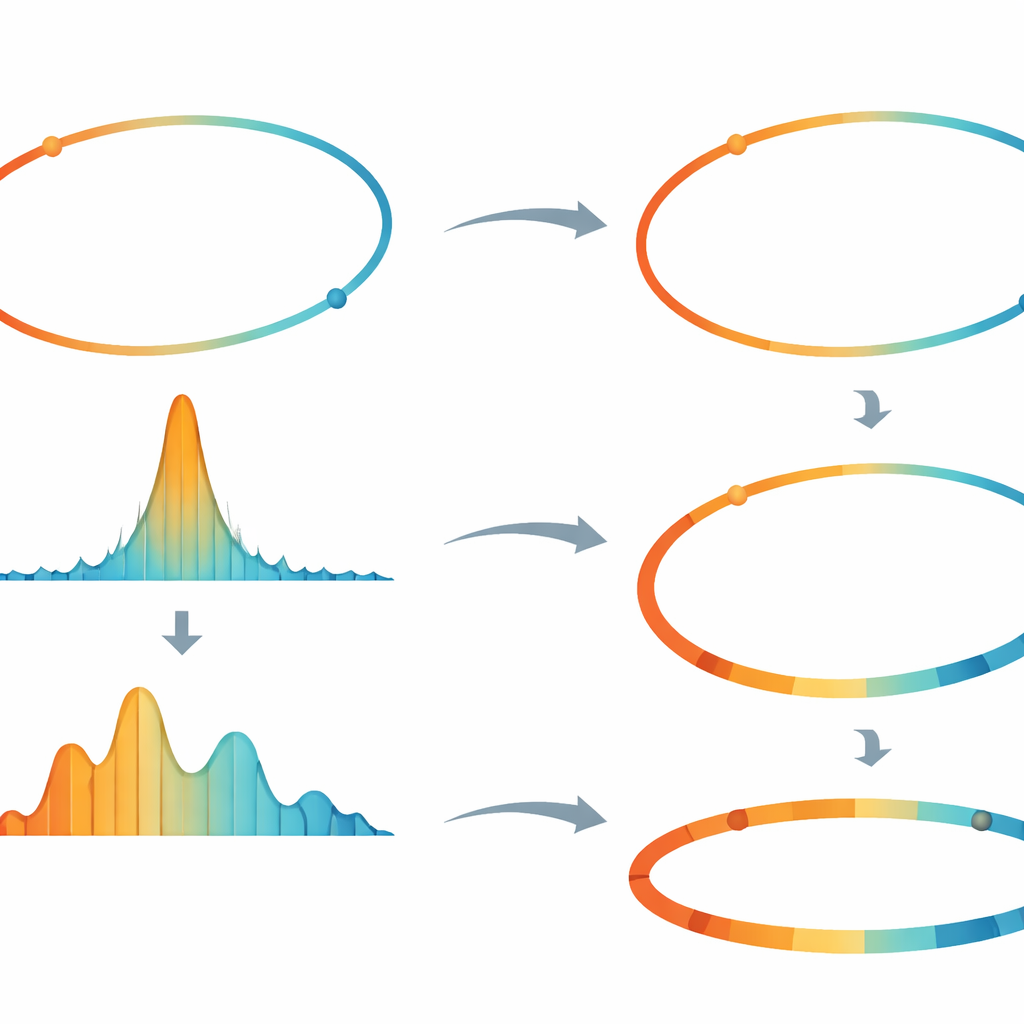
To probe the underlying mechanism, the researchers transformed each person’s speed pattern into a “frequency spectrum,” using a method similar to how sound waves are broken down into low and high pitches. For a perfectly regular tracing of, say, an ellipse, most of the “energy” should cluster around one particular frequency linked to how often the path bends. In the non-autistic group, these spectra showed tall, narrow peaks tightly focused at the expected frequency. In the autistic group, the peaks were noticeably broader and lower, spreading more into neighboring frequencies. This suggests that autistic participants’ speed changed in a less tightly tuned way around the ideal pattern, even though their overall paths were similar.
From Lab Tracings to Real-World Movements
These findings hint at differences either in how the brain plans movements, in how the body’s muscles and joints filter those plans, or both. One possibility is that the body usually smooths out noisy commands into graceful, economical motions, and that in autism this filtering is broader and less selective, leading to sharper speed changes and higher “jerk” (rapid shifts in acceleration). The results also echo work in hearing, where autistic individuals sometimes show broader “filters” for sound. Practically, such movement differences could help explain why some autistic people find writing, ball games, or certain gestures more tiring or less precise, especially when actions involve repeated loops or curves.
Why This Matters for Support and Screening
By carefully mapping how speed and curvature relate in tracing tasks, this study offers a window into a general style of movement that may influence many everyday actions. The authors suggest that these movement profiles could one day contribute to nonverbal tools that help identify autism earlier or more fairly, and to training approaches that support smoother, less tiring movements in tasks like handwriting. For now, the work underscores that autistic and non-autistic bodies often move differently in subtle, measurable ways—and that understanding those differences is a key step toward designing environments, technologies, and supports that better fit a diverse range of motor styles.
Citation: Cook, J.L., Fraser, D.S., Hickman, L.J. et al. The relationship between speed and curvature differs in autistic and non-autistic tracing movements. Sci Rep 16, 9175 (2026). https://doi.org/10.1038/s41598-026-37067-z
Keywords: autism motor control, handwriting and movement, speed curvature law, tracing kinematics, movement spectrum