Clear Sky Science · en
Ecological and human health risks of potentially toxic elements across land uses in a dust-prone region of Central Iran
Dust, Dirt, and Hidden Dangers
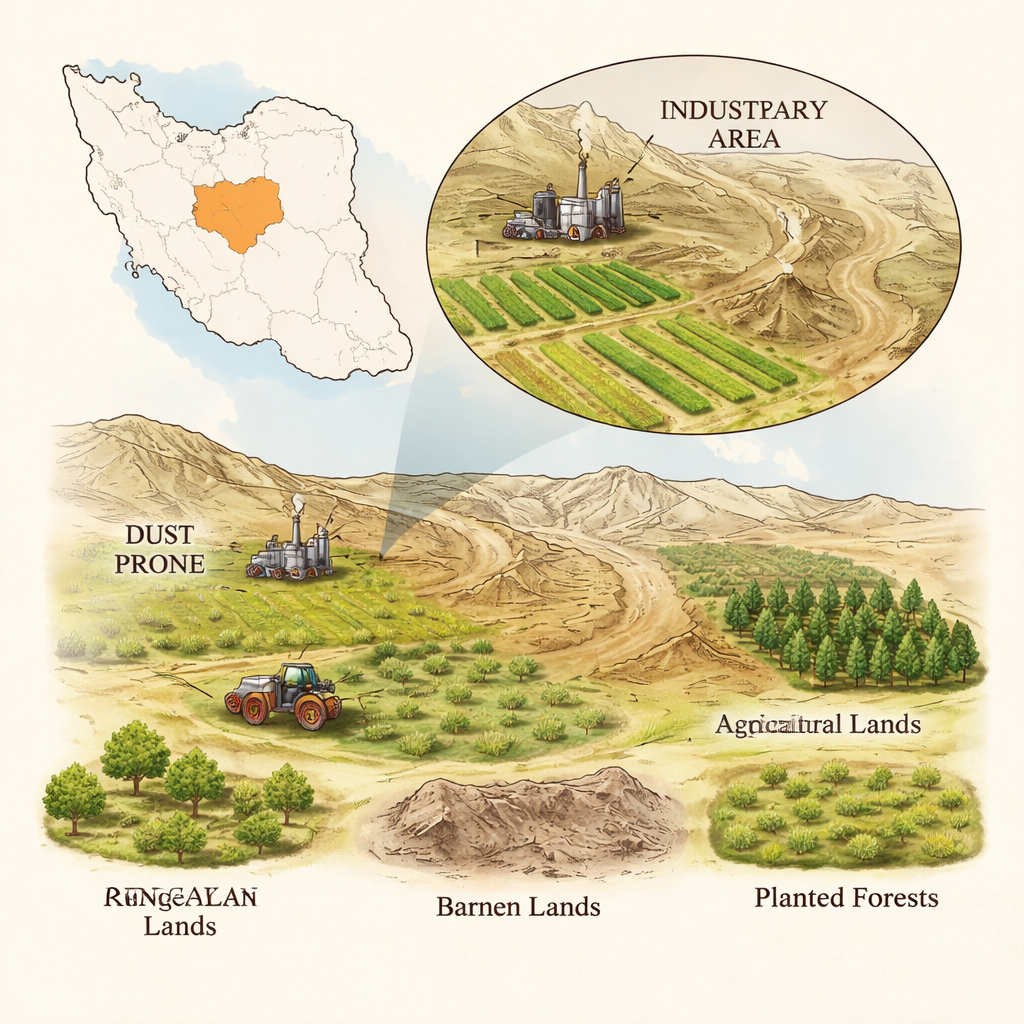
In many dry parts of the world, dust storms are a familiar nuisance. But in central Iran’s Ardakan Plain, scientists have asked a deeper question: what exactly is in that dust, and could it slowly harm the people who live there? This study digs into the soils beneath farms, industrial zones, rangelands, barren lands, and planted forests to find out how much potentially toxic metal is present, how it moves into the air as dust, and what that might mean for long‑term human health.
Tracing Metals in a Harsh Landscape
The researchers focused on a dry, wind‑eroded region in Yazd Province, where rapid industrial growth, expanding agriculture, and mining all leave their mark on the land. They collected over a hundred surface soil samples, plus deeper subsurface samples, from five types of land use: industrial areas, agricultural fields, rangelands, barren lands, and planted forests. In each sample they measured eight metals that can be harmful in excess: arsenic, cadmium, lead, nickel, chromium, zinc, copper, and vanadium. The deeper soils were used as a local “background” to see how much human activity has changed surface conditions.
Where the Metals Build Up
Contrary to what many might expect, the highest average metal levels were not always found right next to factories. Planted forests—tree belts established along highways and around industrial zones to trap dust—often showed the greatest build‑up, followed by industrial lands, rangelands, and barren areas. Agricultural soils and planted forests had higher average concentrations of all measured elements than their local background levels, suggesting strong human influence from industry, traffic, fertilizers, and pesticides. In contrast, high cadmium in barren lands likely reflects natural geology or old mining rather than recent farming or factory emissions.
Measuring Pollution, Not Just Concentrations
To move beyond simple comparisons, the team used an “improved weighted index,” which combines how far metal levels rise above background with how toxic and persistent each element is. This index also takes into account how metals tend to appear together in certain patterns, using a statistical method called principal component analysis. Overall, about one‑third of sampling sites were classified as unpolluted, nearly half as low‑pollution, and one‑fifth as moderately polluted. All of the moderately polluted sites were in planted forests, highlighting that these green belts, while useful for catching dust, can become long‑term sinks for contaminants that may later be re‑released.
Health Risks for Children and Adults
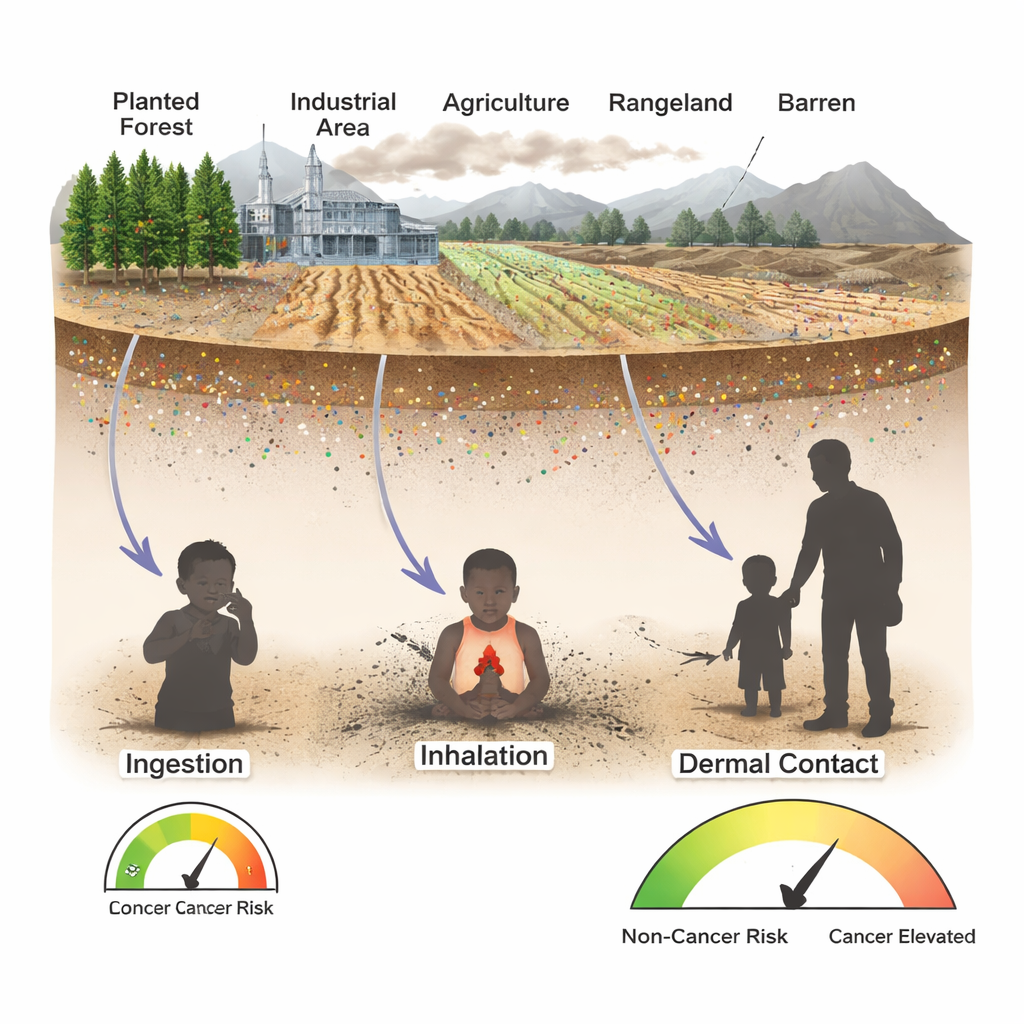
The researchers then applied a widely used U.S. Environmental Protection Agency model to estimate how people might take in these metals through three everyday routes: swallowing soil and dust, breathing dust, and contact through the skin. They assessed both non‑cancer health effects and the lifetime chance of developing cancer, for adults and for children. The encouraging news is that the overall “hazard index” for non‑cancer effects stayed below the level of concern for both age groups in all land uses. However, children consistently faced higher potential impacts than adults, mainly because they are smaller, closer to the ground, and more likely to ingest soil and dust through hand‑to‑mouth behavior.
When Low Exposure Adds Up Over a Lifetime
The picture changes when cancer risk is considered. For metals such as arsenic, chromium, nickel, and lead, the model suggests that lifetime cancer risk from soil exposure in this region falls into a “non‑permissible” range by regulatory standards, with the highest values in industrial areas and the lowest in agricultural lands—but with only modest differences between land types. Ingestion of contaminated soil and dust was the dominant route of concern, with dermal contact and inhalation playing smaller but still notable roles. Sensitivity analyses showed that arsenic in planted forests was especially important for non‑cancer risk, while lead in rangelands contributed most to variations in estimated cancer risk, even though its absolute risk remained moderate.
What It Means for People on the Ground
For residents of this dust‑prone area, the study’s message is nuanced. On one hand, current soil metal levels are not expected to trigger obvious, immediate health problems. On the other, slow, lifelong exposure—especially to arsenic, chromium, and nickel—may raise cancer risks beyond what is typically considered acceptable, particularly for children. Because planted forests and nearby farmlands are functioning as quiet collectors of industrial and traffic‑related pollution, the authors recommend regular monitoring and better land‑use management. In simple terms, the dust and soil of this arid region carry a chemical memory of human activity, and while the danger is not dramatic or sudden, it is real enough to warrant careful, long‑term attention.
Citation: Okati, N., Ebrahimi-Khusfi, Z. & Ghouhestani, M. Ecological and human health risks of potentially toxic elements across land uses in a dust-prone region of Central Iran. Sci Rep 16, 6483 (2026). https://doi.org/10.1038/s41598-026-37065-1
Keywords: soil pollution, heavy metals, dust storms, health risk, land use