Clear Sky Science · en
Multifunctional application of zeolite for ammonium removal and ammonia emission mitigation in wastewater, carcass leachate, and paddy
Why cleaning up invisible nitrogen matters
Much of the world’s food supply depends on nitrogen-based fertilizers, but the same nitrogen can turn into a hidden pollutant once it escapes into water and air. Too much ammonium in rivers and lakes helps fuel algal blooms and fish kills, while ammonia gas from farm soils worsens air quality and wastes valuable fertilizer. This study explores whether a common natural mineral called zeolite can act as a reusable sponge for excess nitrogen—cleaning wastewater, trapping pollution from decomposing animal carcasses, and cutting ammonia loss from rice paddies.
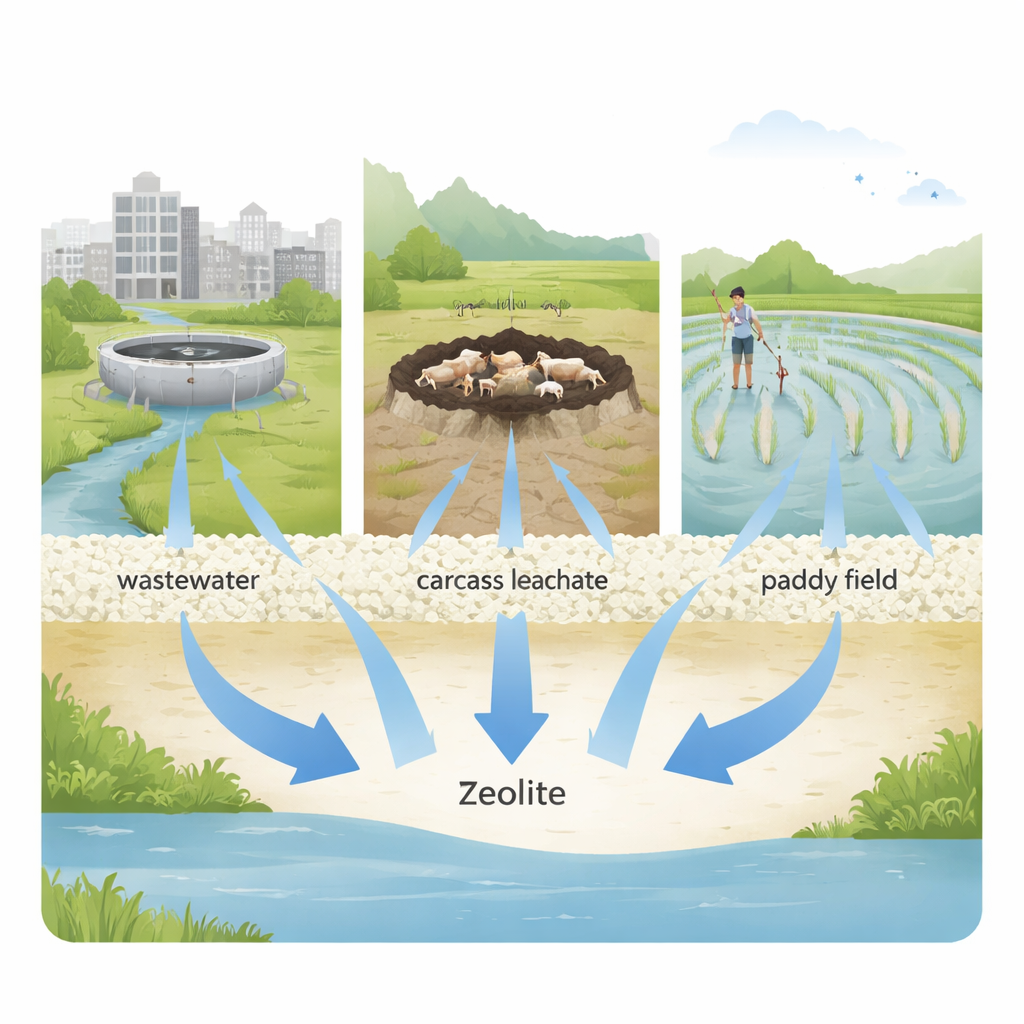
A rock that behaves like a sponge
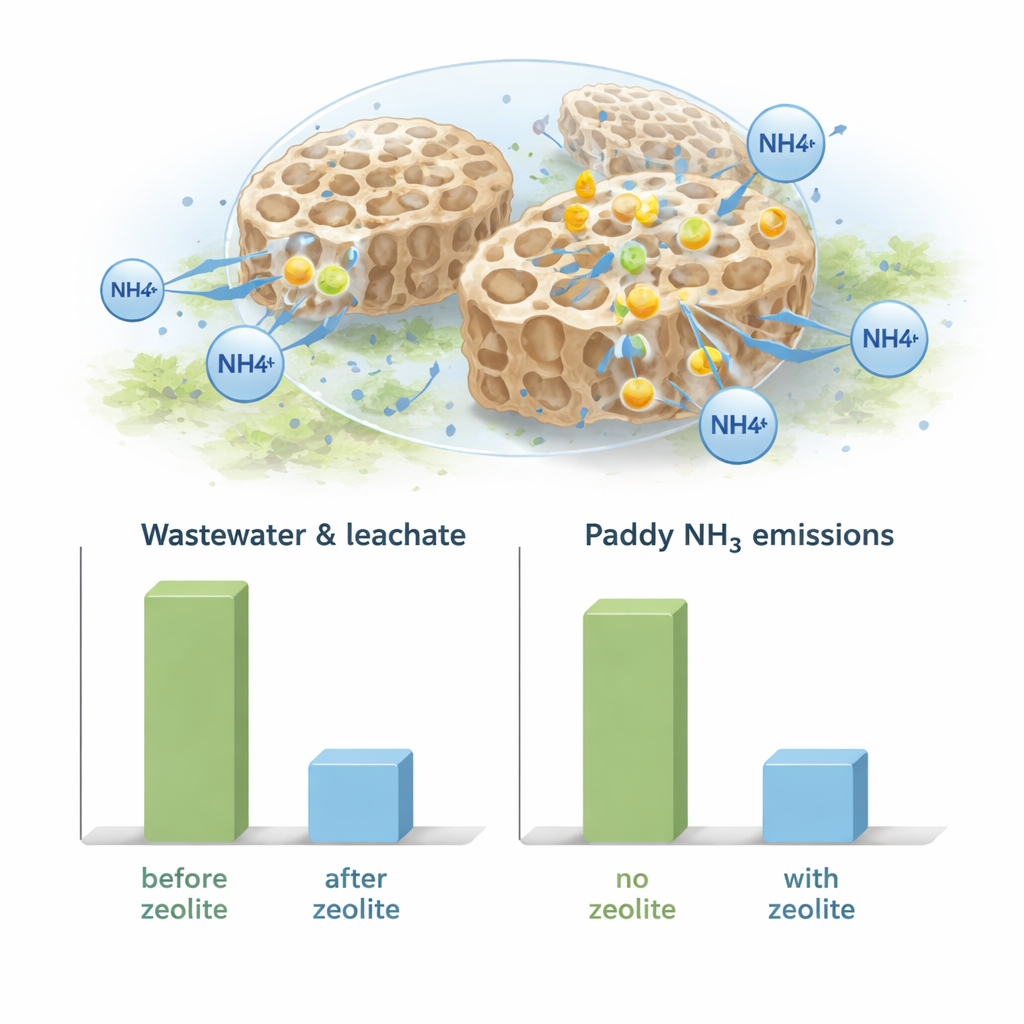
Zeolites are volcanic minerals with a cage-like structure full of tiny channels that can hold and swap charged particles such as ammonium. The researchers first took a detailed look at a natural zeolite called clinoptilolite. Using microscopes and chemical tests, they confirmed it has a rough, porous surface, a large internal area, and many negatively charged sites—traits that make it well suited to latch onto positively charged ammonium ions. They also measured how heat treatment changes the mineral, since heating is often used to “activate” materials for better performance.
Finding the sweet spot for cleanup in water
The team tested how well zeolite removed ammonium from synthetic wastewater. They found that the mineral worked quickly: most of the ammonium was captured within 30 minutes, and the maximum amount it could hold was about 10 milligrams per gram of zeolite. Careful analysis showed that ammonium does not simply stick in a single smooth layer; instead, it binds in multiple layers to uneven surface sites, and the process behaves like a chemical reaction rather than simple physical trapping. When zeolite was heated up to 300 °C, its performance stayed similar, but at higher temperatures the crystal framework began to collapse. By 900 °C, the mineral had lost almost all of its ability to capture ammonium, meaning that the untreated, “pristine” zeolite was actually best for cleaning water.
Dealing with leachate from livestock carcasses
Disposing of dead farm animals after disease outbreaks can create burial pits that leak nitrogen-rich liquid into surrounding soil and groundwater. The researchers simulated leachate from thermochemically treated pig carcasses and mixed it with zeolite. With an initial ammonium level of about 50 milligrams per liter, a zeolite dose equal to 20% of the carcass mass removed over 84% of the ammonium, and increasing the dose to 40% pushed removal close to 90%. Moderate heating of the zeolite (around 300–500 °C) slightly improved performance in this complex liquid, but strong heating again damaged the mineral. These results suggest that barriers filled with zeolite could be placed around burial sites to intercept and clean up contaminated groundwater before it spreads.
Cutting fertilizer loss and ammonia smell from rice fields
The study also examined ammonia emissions from flooded paddy soil fertilized with urea, a common nitrogen fertilizer. In small, controlled paddy boxes, the team sprinkled different amounts of zeolite onto the soil surface before flooding and fertilization. Over 12 days, they collected the ammonia that escaped as gas. As the weather warmed, emissions rose, but plots treated with zeolite consistently lost less nitrogen to the air. The highest dose tested (30 grams per chamber) cut cumulative ammonia loss by about 46% compared with soil without zeolite. Because the amount of ammonium actually held by zeolite in this setup was far below its laboratory capacity, the authors argue that real fields could likely benefit without saturating the mineral.
What this means for farms and clean water
In simple terms, this work shows that a low-cost, naturally occurring rock can help hold onto valuable nitrogen instead of letting it leak or evaporate away. Pristine clinoptilolite zeolite rapidly cleans ammonium from wastewater and carcass leachate and can noticeably reduce ammonia gas escaping from rice paddies. That means cleaner rivers, fewer odors and air pollutants, and better use of fertilizer that farmers have already paid for. The experiments were done in the lab and in simulated fields, so long-term field trials are still needed, but the study points to zeolite as a practical tool for more sustainable nitrogen management in both agriculture and waste treatment.
Citation: Lee, JI., Lee, CG., Hong, SC. et al. Multifunctional application of zeolite for ammonium removal and ammonia emission mitigation in wastewater, carcass leachate, and paddy. Sci Rep 16, 6327 (2026). https://doi.org/10.1038/s41598-026-37062-4
Keywords: zeolite, ammonia pollution, wastewater treatment, livestock carcass leachate, paddy field emissions