Clear Sky Science · en
Optimization of ecological and efficient restoration technology for green mines based on hesitant fuzzy TOPSIS
Healing Scarred Landscapes
Modern society depends on minerals, but open-pit mines can leave behind bare, unstable slopes that shed dust, erode soil, and struggle to grow plants. This study shows how combining advanced 3D mapping with a smart decision system can turn those rocky walls into greener, safer landscapes—faster, more reliably, and at lower cost than traditional one-size-fits-all fixes.
Seeing the Mine in High Definition
Instead of treating a mined slope as one uniform surface, the authors start by mapping it in fine detail. Using a long-range 3D laser scanner, they build a digital terrain model, or DTM, of the B Mine in Shandong Province, China. This model captures the exact shape, height, and steepness of each part of the pit wall. Combined with field surveys of rock types, fractures, water conditions, and climate, it lets the team divide the slope into seven distinct zones, each with its own geology and stability. This precise picture is the foundation for a more tailored restoration plan. 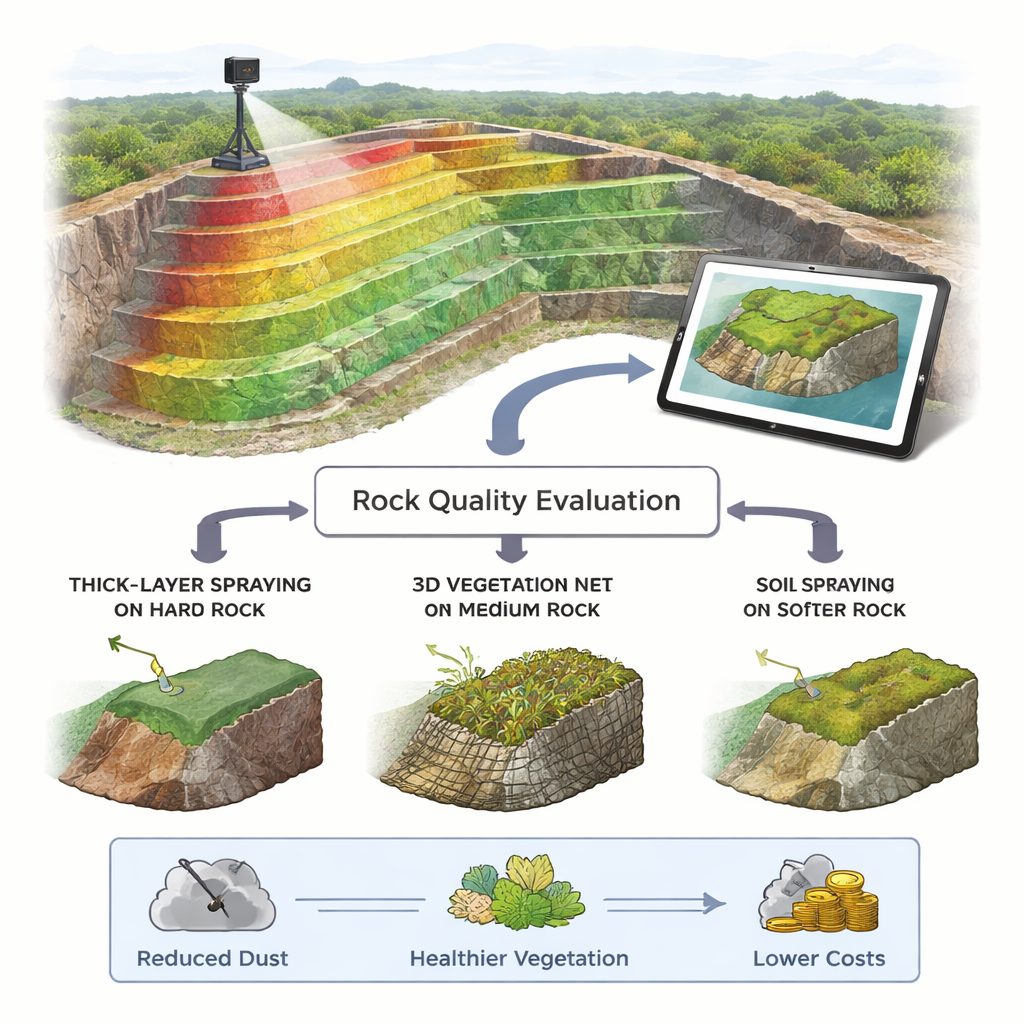
Making Sense of Uncertain Ground
Choosing how to restore a mine slope is tricky because many important factors—like how solid the rock is or how well plants might take root—are hard to pin down with a single number. Experts may hesitate between ratings, and classic scoring methods often hide that uncertainty. To tackle this, the authors use a decision approach called hesitant fuzzy TOPSIS. In simple terms, it lets experts express a range of possible values for eight key indicators, including rock strength, fracture spacing, groundwater, and blasting damage. A mathematical routine then weighs these indicators, compares each slope zone with an ideal “best” and “worst” case, and calculates how close each zone is to the desired state. Zones with higher scores are judged to have stronger, more stable rock; those with lower scores are weaker and more fragile.
Matching the Right Fix to the Right Place
Once each slope zone’s rock quality is rated, the next step is to match it with the most suitable restoration method. Strongest rock (Grade I) in two zones receives thick-layer substrate spraying: a robust blanket of soil, fertilizer, binder, and seeds designed to cling to hard, nearly bare rock and support dense vegetation. Medium-quality rock (Grade II) in four zones is treated with a three-dimensional vegetation network—a mesh-like material laid over the slope that anchors plant roots and resists rainfall erosion. The weakest zone (Grade III), where rock is soft and broken, is restored using soil-spraying techniques that add lighter, more flexible soil cover better suited to unstable ground. This “Zoning–Assessment–Decision” loop replaces rule-of-thumb choices with a clear, data-driven link between local conditions and treatment. 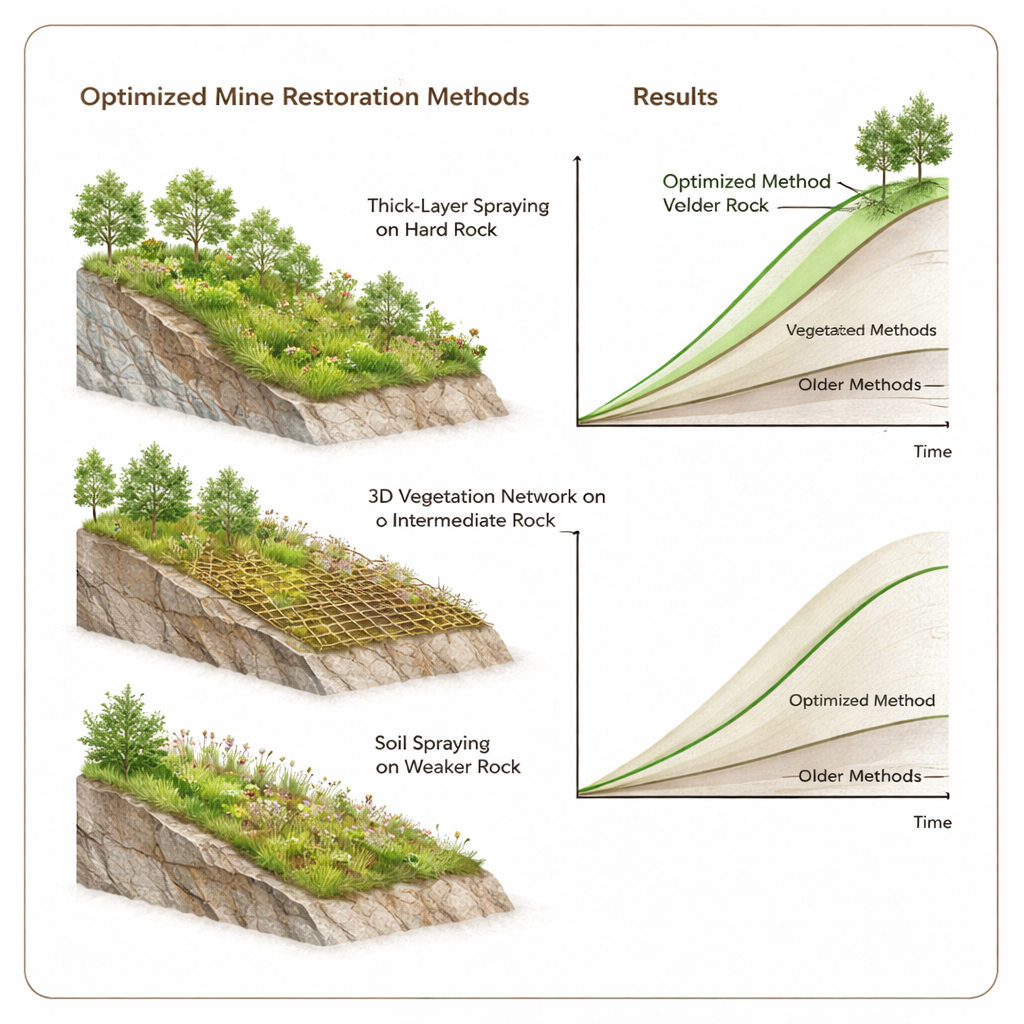
Cleaner Air, Greener Slopes, Lower Bills
The team then tests how well this tailored strategy works at B Mine. Over 12 months, they measure vegetation cover, near-ground dust, and soil erosion, and compare the results with earlier methods reported in the literature. The optimized approach boosts vegetation restoration to about 25 percent, while comparison methods stay below 15 percent. Dust levels near the ground drop measurably, improving air quality for workers and nearby communities, and soil loss from test plots falls more than in the competing techniques, especially over longer periods. Because the most expensive spraying method is reserved only for the zones that truly need it, the overall restoration cost is cut by roughly 29 percent compared with using that method everywhere.
From One Mine to Many
For a non-specialist, the key takeaway is that not all parts of a mine are equal, and treating them as if they were wastes money and weakens results. By carefully mapping the terrain, honestly handling uncertainty in expert judgments, and tailoring restoration tools to local rock conditions, this framework turns a damaged pit wall into a more stable, greener landscape while saving costs. Although the study so far is based on a single mine, the same logic could guide restoration in many other sites as the mining industry moves toward genuinely “green” operations.
Citation: Wang, B., Guo, D., Sun, J. et al. Optimization of ecological and efficient restoration technology for green mines based on hesitant fuzzy TOPSIS. Sci Rep 16, 6586 (2026). https://doi.org/10.1038/s41598-026-37060-6
Keywords: mine restoration, green mining, slope stability, vegetation recovery, dust and erosion control