Clear Sky Science · en
XGBoost based surrogate technique for system reliability analysis of foundation over cavity aided with bootstrapping
Why hidden holes under buildings matter
Cities are increasingly being built over old mines, tunnels, and other underground cavities. These hidden voids can slowly undermine the ground, causing buildings to tilt, crack, or even fail. Engineers try to design foundations that stay safe despite such risks, but traditional methods for checking safety under many possible conditions can be extremely time‑consuming. This study shows how modern machine‑learning tools can make those safety checks faster and more realistic, helping protect structures built above cavities.
Foundations over unseen ground risks
A building’s foundation must do two main jobs: it must not punch through the soil (bearing capacity), and it must not sink or tilt too much (settlement). Cavities beneath the surface—left by mining, tunneling, or natural processes—make both jobs harder. Soil can shift or collapse into the void, reducing support for the foundation over time. Traditional design often relies on a single “factor of safety,” which compares how strong the foundation system appears to be with how strong it needs to be. But real soils vary from place to place and change over time, so a single safety factor can hide important risks.
From heavy simulations to smart stand‑ins
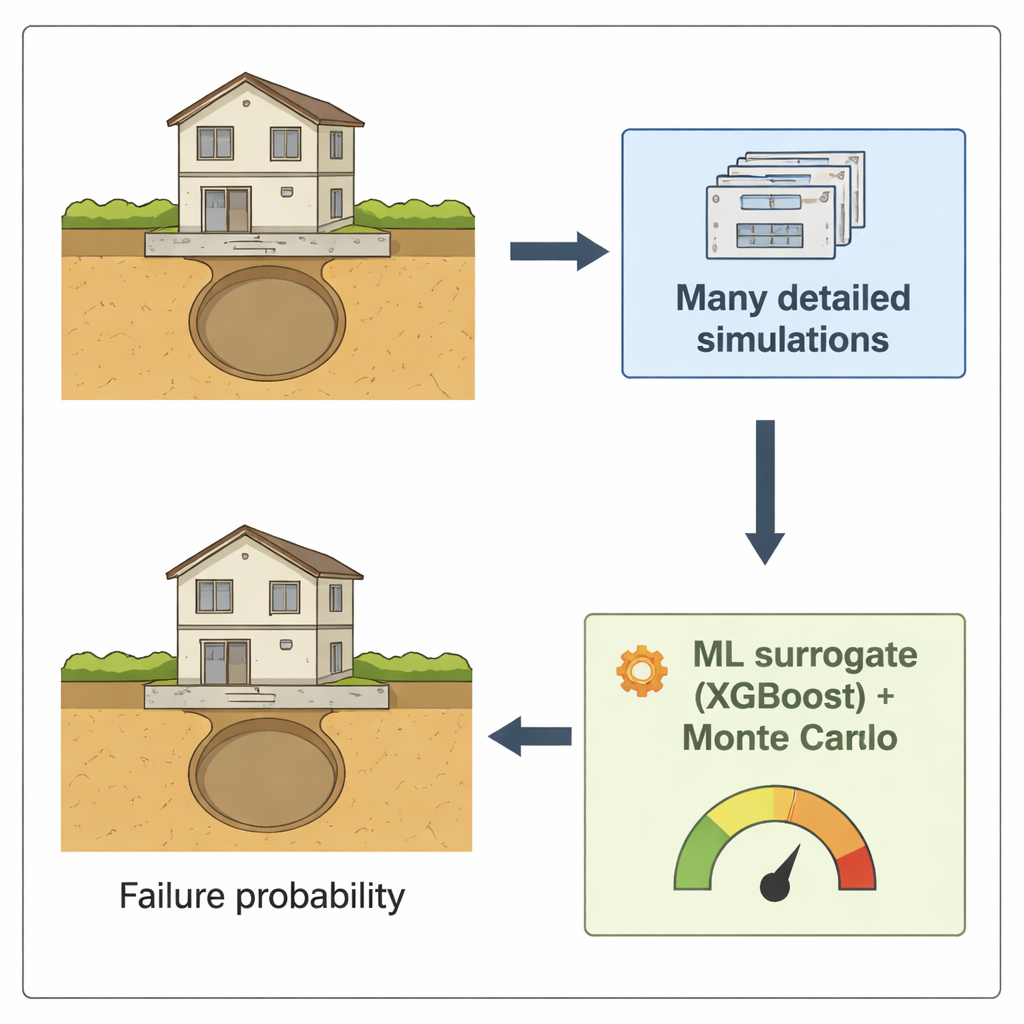
To explore these risks properly, engineers would ideally run thousands of detailed computer simulations that vary soil strength, cavity shape, and other factors. In practice this is too slow. The authors instead created a large dataset of 272 high‑quality simulations of a strip foundation over a circular cavity using a specialist geotechnical program. They then trained a machine‑learning model called XGBoost to mimic these simulations, predicting both bearing capacity and settlement from inputs such as soil weight, cohesion, friction angle, cavity depth, and stiffness. The surrogate model reproduced the detailed simulations with high accuracy, especially for bearing capacity, meaning it can act as a fast stand‑in for the more expensive calculations.
Making sense of messy data and uncertainty
Real geotechnical data rarely line up neatly with simple statistical assumptions—they can be skewed, have multiple peaks, and show wide scatter. The authors systematically tested many mathematical transformations to make their predicted bearing capacity and settlement values behave more like ideal bell‑shaped curves. None worked perfectly on their own. They found the best balance by first applying a logarithmic transformation and then using a technique called bootstrapping, which repeatedly resamples the data to build an empirical distribution. This combination let them describe uncertainty robustly without forcing the data into an unrealistic shape.
Calculating chances of failure today and in the future
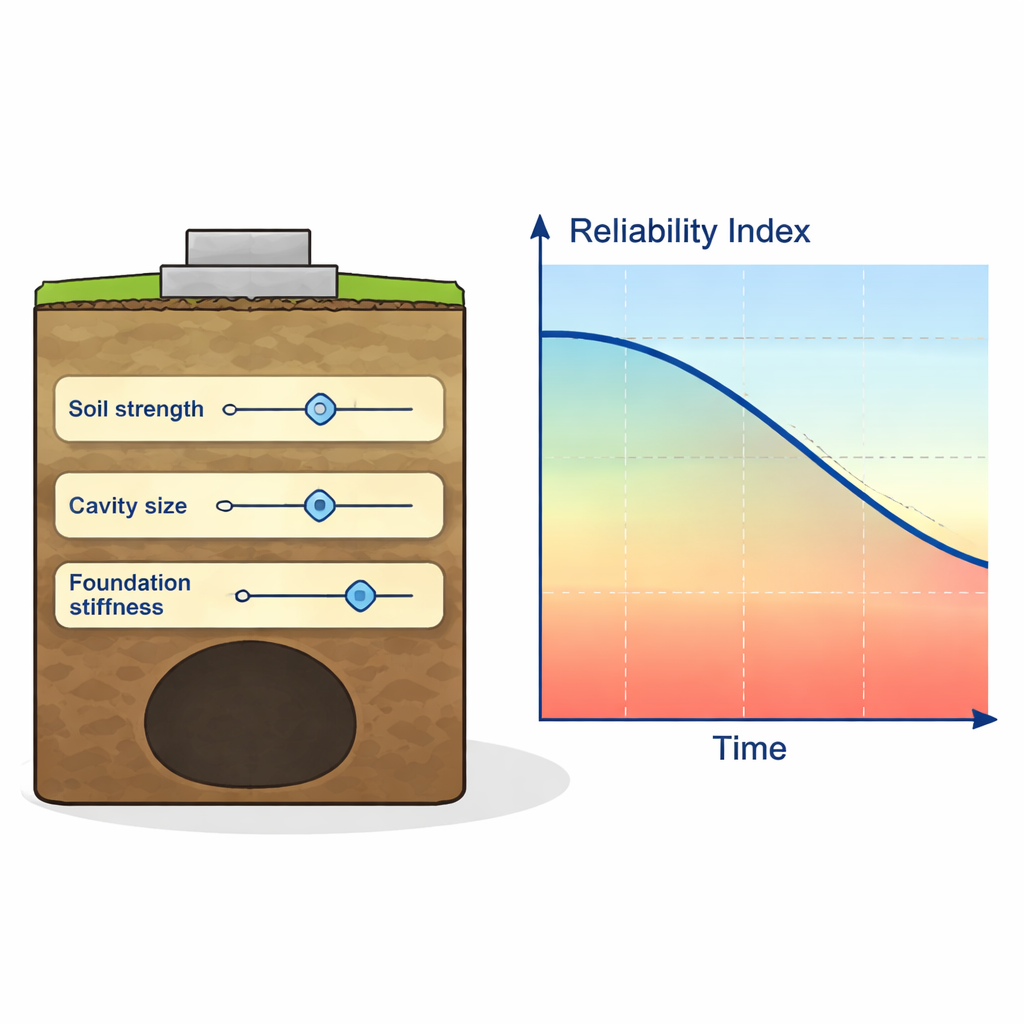
With the surrogate model and improved data treatment in place, the team used Monte Carlo simulation to estimate how often foundations would fail under two criteria: loss of bearing capacity and excessive settlement. They found that the settlement limit was more critical than bearing capacity, increasing the probability of failure by nearly 30 percent when considered on its own. When both criteria were combined into a system view—where failure occurs if either is violated—the overall chance of failure rose even more, by over 50 percent compared with looking at bearing capacity alone. The study also explored how safety might degrade over decades by gradually reducing bearing capacity and increasing expected settlement. Under these assumed trends, reliability indices steadily declined, approaching a coin‑flip level of risk after about a century.
What this means for safer building design
For non‑specialists, the key message is that safety of buildings over underground cavities cannot be judged reliably by a single safety factor or by checking only one failure mode. By pairing a well‑trained machine‑learning surrogate with careful statistical treatment and Monte Carlo simulation, engineers can rapidly explore thousands of “what if” scenarios, accounting for uncertain soil properties, cavity geometry, and time‑dependent changes. This approach reveals that settlement and system‑level behavior can govern risk, even when bearing capacity appears comfortable. In practical terms, the framework provides a faster, more realistic way to flag foundations that may look safe on paper but could become vulnerable as the ground evolves beneath them.
Citation: Shubham , K., Metya, S., Sinha, A.K. et al. XGBoost based surrogate technique for system reliability analysis of foundation over cavity aided with bootstrapping. Sci Rep 16, 7113 (2026). https://doi.org/10.1038/s41598-026-37058-0
Keywords: foundation reliability, underground cavities, machine learning, Monte Carlo simulation, geotechnical engineering