Clear Sky Science · en
Mechanical performance and life cycle assessment of a Persian gum-waste carpet fiber soil composite for landfill bottom liners
Turning Trash into a Safer Landfill Shield
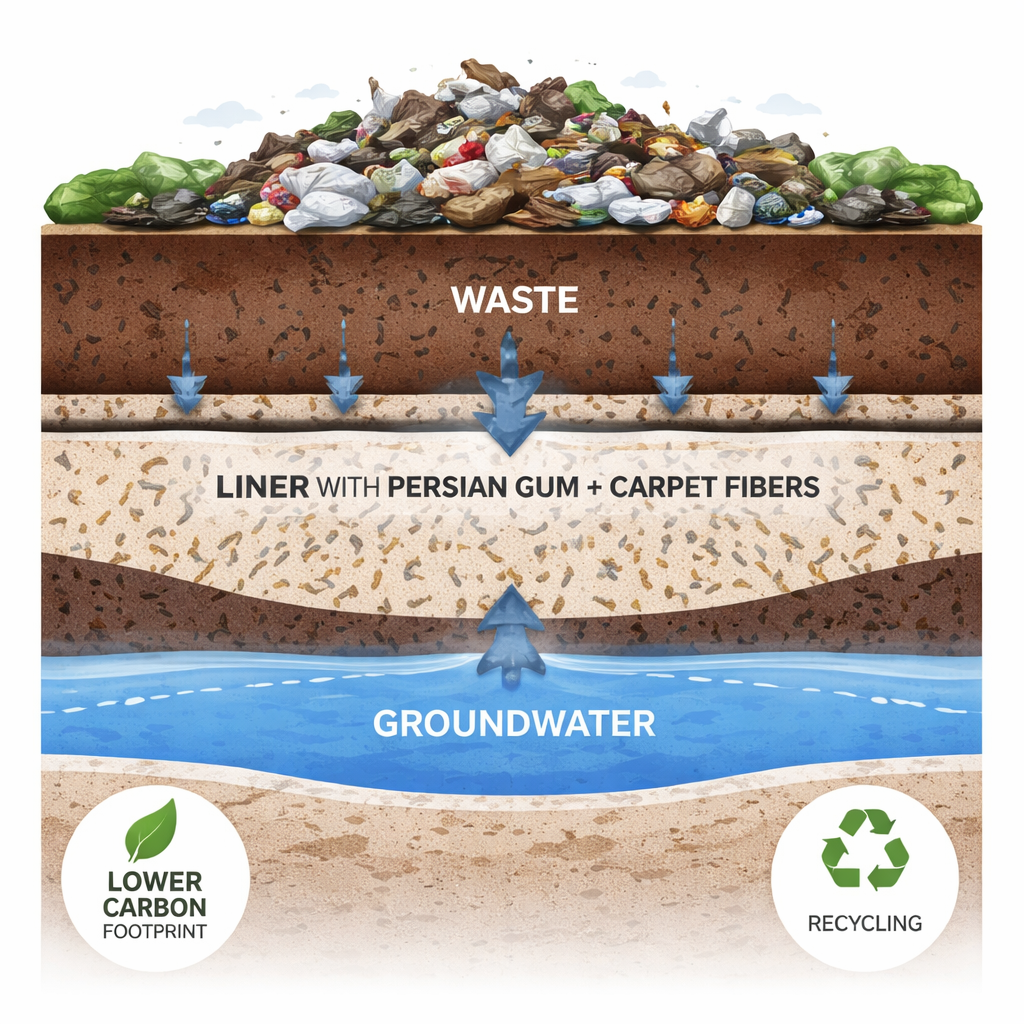
Modern cities generate mountains of garbage, and much of it still ends up in landfills. If the protective liner at the bottom of a landfill cracks or leaks, polluted liquid known as leachate can seep into groundwater and threaten nearby communities. This study explores an inventive way to build safer, greener landfill liners by binding ordinary soil with a plant-based gum and recycled carpet fibers—materials that could cut pollution risks while shrinking the carbon footprint of waste disposal.
Why Landfill Liners Matter for Health and Water
When buried waste breaks down, it produces a dark, chemical-rich liquid that can carry heavy metals and toxic organics. Past failures, such as well-known pollution cases in the United States and Nigeria, show that leaking landfills can contaminate drinking water and increase health risks. To prevent this, regulations require liners that are both strong and almost watertight. Traditional liners rely on good-quality clay soils or on soils treated with cement or lime. These can work well, but they may crack under drying and ground movement, and cement and lime come with high energy use and greenhouse gas emissions. Engineers are therefore searching for liner materials that are tough, crack-resistant and far less damaging to the climate.
A New Mix: Plant Gum and Carpet Waste
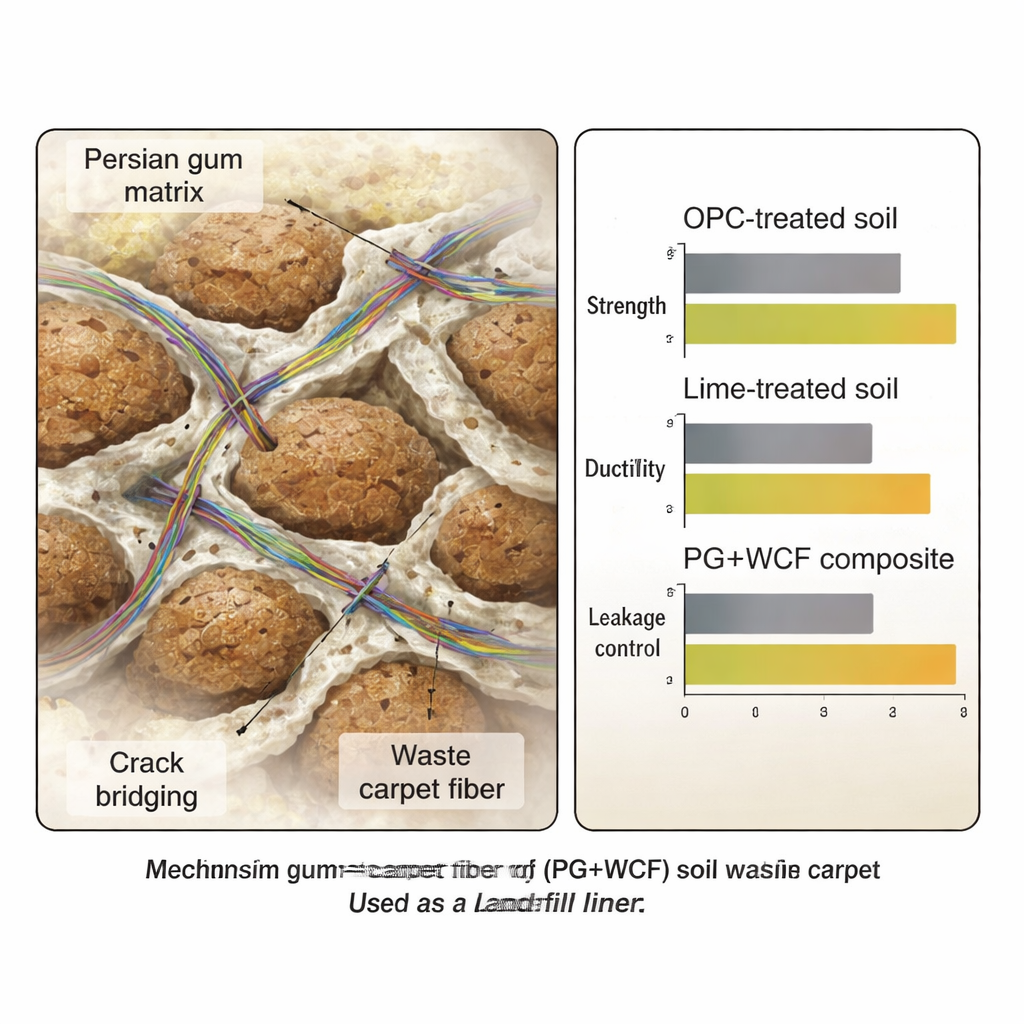
The authors tested a local silty soil mixed with Persian gum, a natural resin exuded by mountain almond trees, and short fibers cut from discarded carpets. The idea is simple: the gum forms a gel that glues soil grains together and blocks tiny pores where water would flow, while the fibers act like miniature reinforcing bars that hold the soil together when it bends or stretches. In the laboratory, the team compared this new composite with the same soil treated in the conventional way using ordinary Portland cement or hydrated lime. They compacted the mixtures into test specimens, cured them for up to 28 days, and then measured how much pressure they could withstand, how they behaved in tension and bending, and how easily water could seep through them.
Strength, Flexibility, and Water Tightness
The best-performing new blend contained 3 percent Persian gum and 3 percent carpet fibers by dry weight, with fibers about 0.6 times the sample diameter. After 28 days, this composite reached a compressive strength of 708 kilopascals—more than three times stronger than untreated soil and comfortably above the 200 kilopascal guideline for liners, though still below very stiff cement-treated soil. Crucially, the composite deformed more before failure: its peak strain was almost three times that of lime-treated soil and nearly three times that of cement-treated soil, meaning it could stretch and bulge instead of snapping when the ground settles. In bending and in a special “splitting” test that mimics cracking, the gum–fiber mix showed higher toughness and energy absorption than any other treatment, a sign that it can resist the kinds of cracks that often turn a good liner into a leaky one.
Keeping Leachate Out and Emissions Down
For a liner to protect groundwater, it must also be extremely tight. The untreated soil allowed water to pass relatively easily. Adding only carpet fibers made it even leakier, because the fibers disrupted the packing of grains. Persian gum reversed this effect: by coating grains and filling voids, it drove hydraulic conductivity down by more than two orders of magnitude. The optimized gum–fiber composite reached about 9.7 × 10⁻¹⁰ meters per second, better than the usual regulatory limit of 1 × 10⁻⁹, and similar to cement-treated soil. Microscopic imaging confirmed that the gum formed continuous films between particles, while fibers were anchored in this matrix, bridging microcracks. The team also carried out a life cycle assessment, starting from raw material extraction through to liner construction. For each cubic meter of stabilized soil, the Persian gum–fiber composite produced roughly half the climate-warming emissions of cement-treated soil and about 70 percent less than a conventional clay liner hauled in from a distant borrow pit, while also using less water and fossil fuel overall.
From Lab Concept to Real Landfills
To see whether the material could work in practice, the researchers modeled a full-scale landfill serving a city of one million people over 20 years. A 0.6-meter-thick layer of the new composite, placed beneath plastic geomembranes, met both strength and seepage criteria with safety factors above standard targets. Over the entire site, using the composite instead of cement-treated soil would avoid nearly 18,000 metric tons of carbon dioxide emissions and save tens of thousands of cubic meters of water. While longer-term field tests are still needed—especially to check how the plant gum ages and whether synthetic fibers shed microplastics—the study suggests that landfill liners made from a simple blend of local soil, natural gum, and carpet waste could offer communities a safer, more sustainable shield between their trash and their drinking water.
Citation: Mohseninia, M., Ghahremani, M. & Fattahi, S.M. Mechanical performance and life cycle assessment of a Persian gum-waste carpet fiber soil composite for landfill bottom liners. Sci Rep 16, 7147 (2026). https://doi.org/10.1038/s41598-026-37055-3
Keywords: landfill liners, soil stabilization, biopolymer composites, waste carpet fibers, life cycle assessment