Clear Sky Science · en
Metacognitive ability is associated with reduced emotion suppression
Why paying attention to your own mind matters
Most of us have been told to “control your emotions,” but we are rarely taught how. This study explores a simple question with big everyday consequences: are people who are better at noticing and judging their own thoughts also better at choosing how to handle their feelings? The findings suggest that people with sharper self-reflection skills are less likely to bottle up their emotions in harmful ways, even though they do not necessarily use more sophisticated calming techniques.
Two ways we try to manage feelings
Psychologists often focus on two common tactics people use to handle difficult emotions. One is reappraisal: mentally reframing a situation so it feels less upsetting, such as telling yourself a harsh comment says more about the speaker than about you. The other is suppression: keeping a straight face and hiding how you feel, even while strong emotions are still churning inside. Past research links reappraisal to better mood, stronger relationships, and higher life satisfaction, while heavy reliance on suppression is tied to fewer positive feelings, weaker social support, and lower well-being. Yet theories also argue that any strategy can work well or poorly depending on the situation, and that success depends on being able to monitor what we are feeling and whether our chosen tactic is actually helping.
Testing “thinking about thinking” in the lab
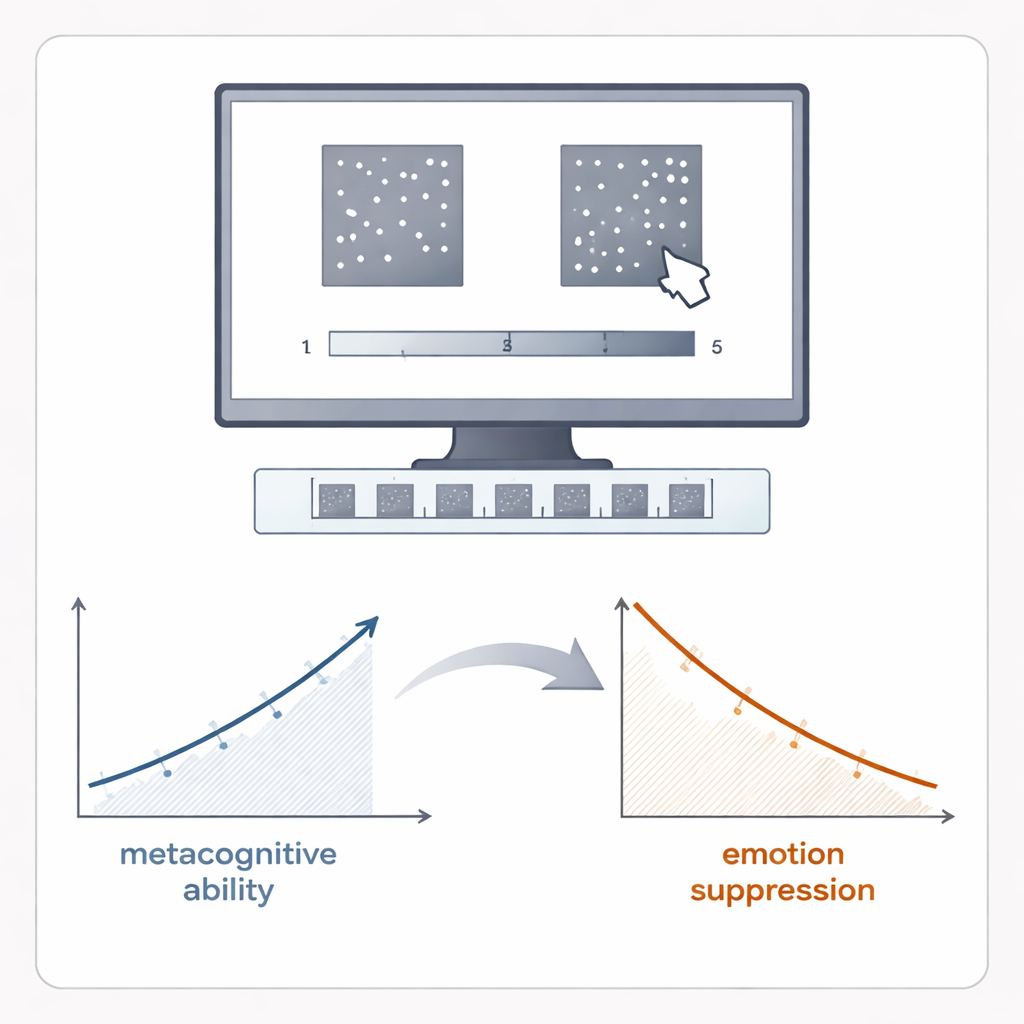
The study focused on metacognition, a technical term for how accurately people can judge their own thinking. Instead of asking people to rate themselves with a questionnaire, the researcher used a performance-based test. Nearly 200 adults recruited online completed a visual task on their own computers. On each trial, they saw two boxes filled with white dots and had to decide which box contained more dots. After choosing, they rated how confident they were in their answer on a six-point scale. By comparing how often people were correct with how confident they felt, the researcher calculated three aspects of metacognitive skill: how well confidence tracked correctness (sensitivity), how efficient this monitoring was relative to basic task performance (efficiency), and people’s overall tendency to feel sure or unsure (bias).
Linking lab skills to real-life emotion habits
To see how these mental-monitoring skills relate to everyday emotional life, participants also filled out questionnaires. They reported how often they use reappraisal and suppression, how emotionally intelligent they believe themselves to be, and how prone they are to rumination—repetitively dwelling on negative thoughts. Statistical analyses examined how the three metacognition measures related to emotion strategies while taking self-rated emotional intelligence into account. The key pattern was clear: people whose confidence more closely tracked reality, and who used information more efficiently, reported using suppression less often. At the same time, none of the metacognitive measures reliably predicted how much people used reappraisal once emotional intelligence was controlled. Interestingly, those who tended to feel generally more confident, regardless of accuracy, reported slightly higher use of both reappraisal and suppression, as well as more rumination.
What the findings suggest about emotional habits
These results paint a nuanced picture. Better metacognitive ability does not simply make people use all “good” strategies more and all “bad” strategies less. Instead, it seems especially related to avoiding one specific habit: routinely pushing emotions down. One interpretation is that accurate self-monitoring helps people notice that suppression often fails to make them feel better and can even strain memory, thinking, and social connection. Recognizing this mismatch between effort and payoff may quietly nudge them away from suppression over time. By contrast, choosing to reframe a situation using reappraisal may require extra ingredients beyond monitoring—like mental flexibility, knowledge of useful perspectives, and the motivation to do demanding cognitive work—which were not captured by the dot task alone.
Why this matters for everyday life
For a lay reader, the take-home message is that paying close, honest attention to how your mind works may help you drop unhelpful habits like constantly hiding how you feel, even if it does not automatically turn you into an expert emotional re-framer. The study supports the idea that self-monitoring is not just an abstract mental skill; it has real links to how we manage our inner lives. It also hints that training people to better notice the match between what they do and how they feel—whether through mindfulness, feedback, or other exercises—might one day become a practical way to help people move away from chronic emotional suppression and toward healthier, more flexible ways of coping.
Citation: Double, K.S. Metacognitive ability is associated with reduced emotion suppression. Sci Rep 16, 6476 (2026). https://doi.org/10.1038/s41598-026-37054-4
Keywords: emotion regulation, metacognition, emotional suppression, self-awareness, emotional intelligence