Clear Sky Science · en
Validation of a fast LC-MS/MS method for the analysis of bisphenol A (BPA) and urethane dimethacrylate (UDMA) in eluates of dental polymer-based materials
Why chemicals in dental plastics matter
Clear braces, mouthguards, and night-time splints are all made from modern plastics that sit in our mouths for hours every day. While these devices are convenient and nearly invisible, they can release tiny amounts of chemical building blocks into saliva. Two such substances, bisphenol A (BPA) and urethane dimethacrylate (UDMA), can affect the hormone and immune systems even at very low levels. This study describes a highly sensitive laboratory method to detect minute traces of BPA and UDMA from dental plastics and uses it to check how much is released from a common thermoformed aligner material and a newer 3D‑printed resin.
The concern behind clear smiles
Resin-based plastics have largely replaced metal fillings and are essential for clear aligners, splints, and temporary crowns. These materials are made from small building blocks called monomers, which link together when the material is hardened. If the curing is incomplete, or if the plastic slowly breaks down, leftover monomers can leak out into the mouth. Some, including UDMA and BPA-related compounds, have been linked to cell damage, allergic reactions, and disruption of hormone signaling. Because even extremely low doses may matter over long-term use, researchers need tools that can measure these chemicals at concentrations far below what older methods could reliably detect.
A faster, sharper chemical detector
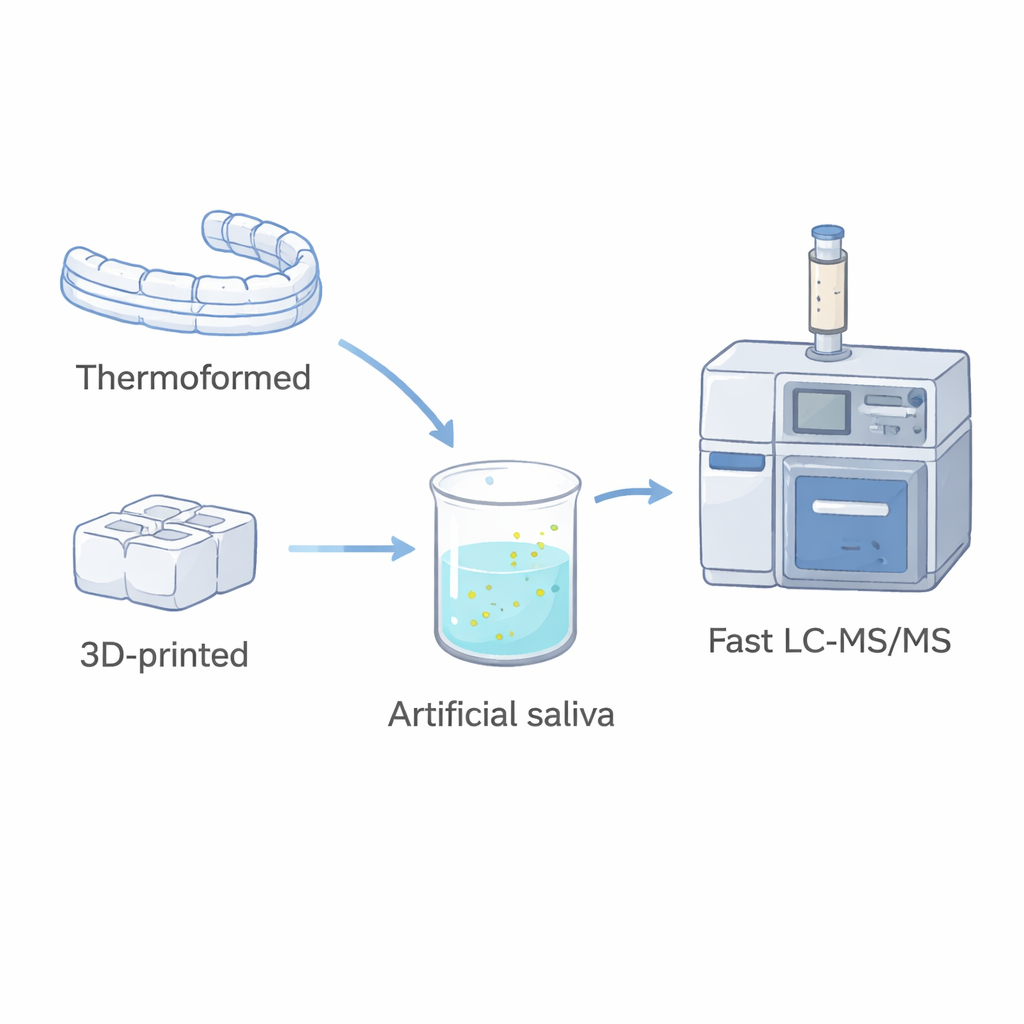
The authors developed a rapid test based on liquid chromatography coupled to tandem mass spectrometry, a technique that separates chemicals and then weighs their charged fragments to identify them. They optimized the setup to measure BPA and UDMA at the same time in artificial saliva, using a short column and switching between positive and negative electrical modes so both molecules could be seen in a single run. By carefully choosing the solvents, adding a small amount of ammonium fluoride to boost the BPA signal, and using internal reference standards to correct for losses, they achieved very high sensitivity. The method could reliably quantify UDMA down to 10 picograms per milliliter and BPA down to 30 picograms per milliliter—thousandths of a billionth of a gram in a milliliter of fluid—which is lower than most previously reported methods.
Putting the method to the test
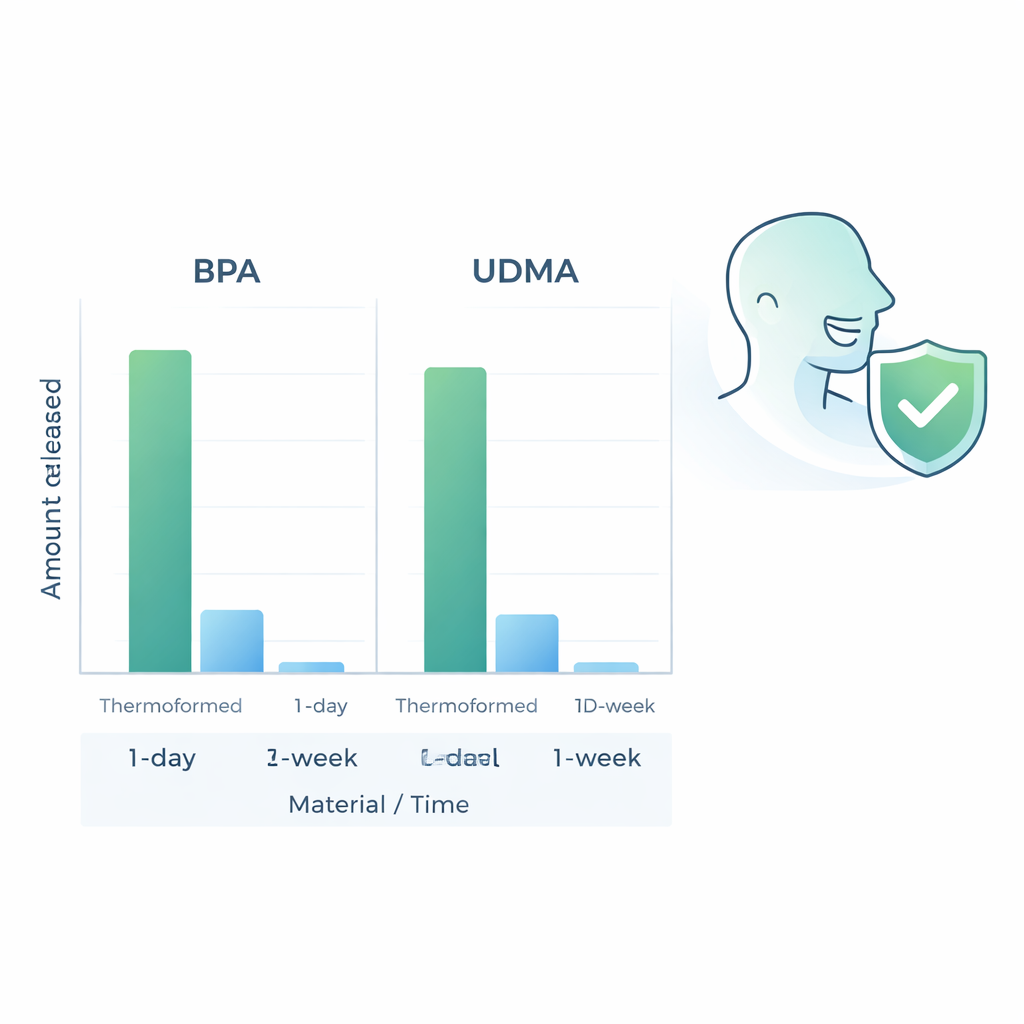
To show that the test works in real-world conditions, the team examined two dental materials soaking in artificial saliva at body temperature. One was a layered plastic sheet (DURAN+) commonly thermoformed into clear aligners and splints; earlier work suggested it can release UDMA. The other was a 3D‑printed resin (KeySplint Soft) intended for splints and palatal plates and advertised as free of BPA and UDMA. After one day in artificial saliva, the thermoformed material released measurable but very low amounts of both chemicals: on average about 155 picograms per milliliter of BPA and a similar level of UDMA. The 3D‑printed resin released far less—around 31 picograms per milliliter of BPA and UDMA mostly below the detection limit. After a full week, concentrations from both materials dropped below the method’s quantification limit.
What this means for safety
Using the measured values, the authors estimated how much BPA a full set of thermoformed aligners might release. Their rough calculation suggests that the amount released on the very first day could approach the extremely strict daily limit recently proposed by European food safety authorities for a 75‑kilogram adult and could more easily exceed that limit for lighter adolescents. However, the release quickly falls to levels the method can barely detect, and real-life exposure will also depend on factors like chewing forces, temperature changes, and the frequent replacement of aligners. For the tested 3D‑printed resin, BPA and UDMA release appeared negligible, although other ingredients in the material still need separate evaluation.
Take‑home message for patients and clinicians
To a non-specialist, the key result is that the researchers have created a very sensitive, reliable way to measure two controversial chemicals from dental plastics in saliva-like fluids. When they applied this method to a commonly used thermoformed aligner material and a modern 3D‑printed resin, they found that both released only minute amounts of BPA and UDMA, mostly during the first day, with levels falling below detection after a week. While these low doses still deserve attention in light of tightening safety limits and repeated aligner use, the study mainly equips scientists and regulators with a precise tool to monitor and compare dental materials, helping ensure that future clear aligners and splints are as safe as they are discreet.
Citation: Vitku, J., Skodova, T., Tak, Y. et al. Validation of a fast LC-MS/MS method for the analysis of bisphenol A (BPA) and urethane dimethacrylate (UDMA) in eluates of dental polymer-based materials. Sci Rep 16, 6439 (2026). https://doi.org/10.1038/s41598-026-37053-5
Keywords: dental plastics, bisphenol A, UDMA, clear aligners, LC-MS/MS