Clear Sky Science · en
Mechanical and microstructural assessment of conventional carbon and stainless steel shear stud welded connections
Why the Hidden Parts of Bridges Matter
Every day, millions of people cross highway bridges without realizing that their safety depends on small metal pins called shear studs. These studs tie the concrete deck to the steel beams below, helping the structure act as a single, stiff unit. As highway agencies move toward new, rust‑resistant steels to cut maintenance costs, they must be sure that these invisible connectors still work reliably. This study asks a simple but crucial question: when bridges use modern stainless steels, should the studs also change—from ordinary carbon steel to stainless steel—to keep those bridges both strong and durable?
From Rusty Girders to Rust‑Resistant Steel
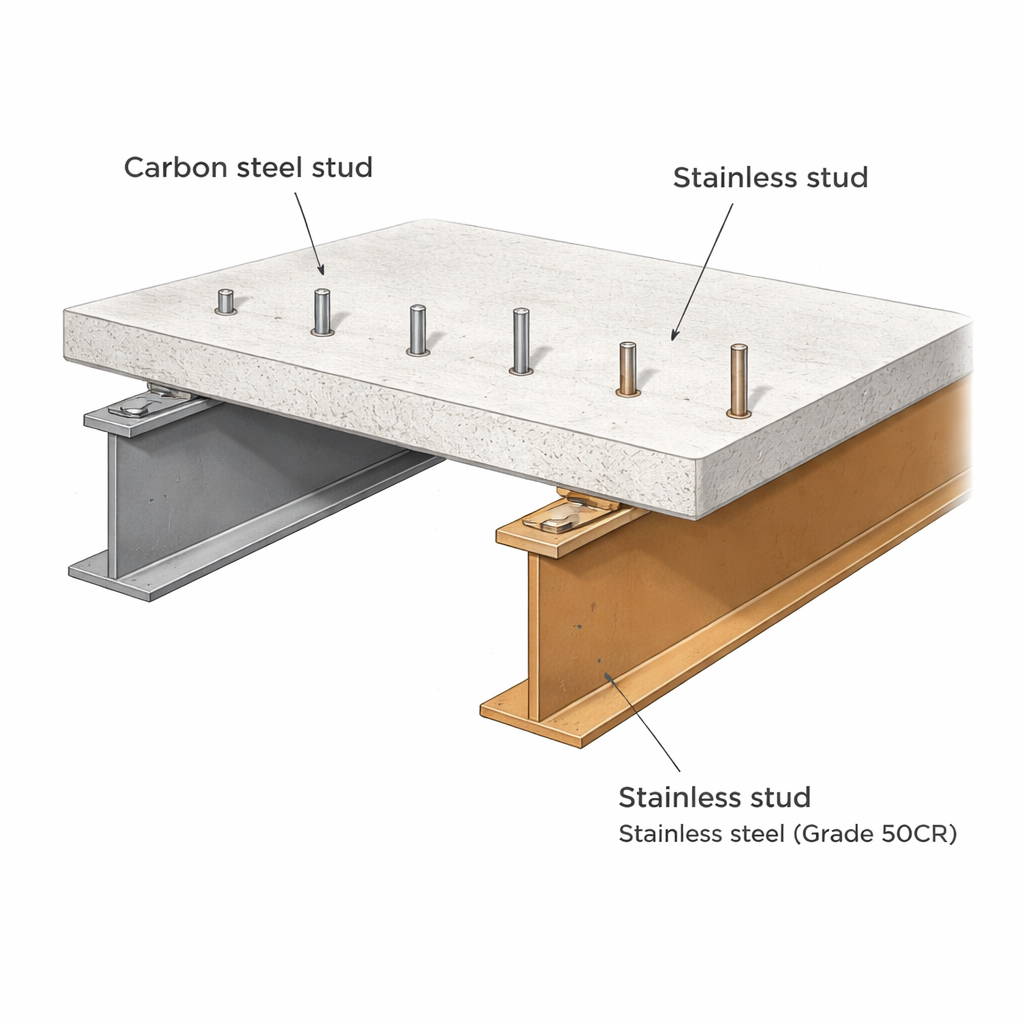
Traditional bridge girders are made from carbon steel that is strong but vulnerable to corrosion, especially in regions that see road salt, sea spray, or long periods of wet weather. Agencies have tried weathering steels that form a protective rust layer, but in chloride‑rich environments that layer can fail, leading to unexpected repairs. A newer option, known as Grade 50CR, is a low‑chromium stainless steel designed to resist corrosion for decades with little maintenance. Many bridge owners want to pair this steel with equally durable details, but that raises a concern: if a regular carbon‑steel stud is welded onto a stainless steel girder, the two dissimilar metals can form tiny electrical cells in the presence of salt and moisture, accelerating rust in the less noble metal. One obvious workaround is to switch the studs themselves to stainless steel, but codes give little guidance on how those stainless studs actually behave when welded into real bridge components.
Testing How Different Studs Handle Force
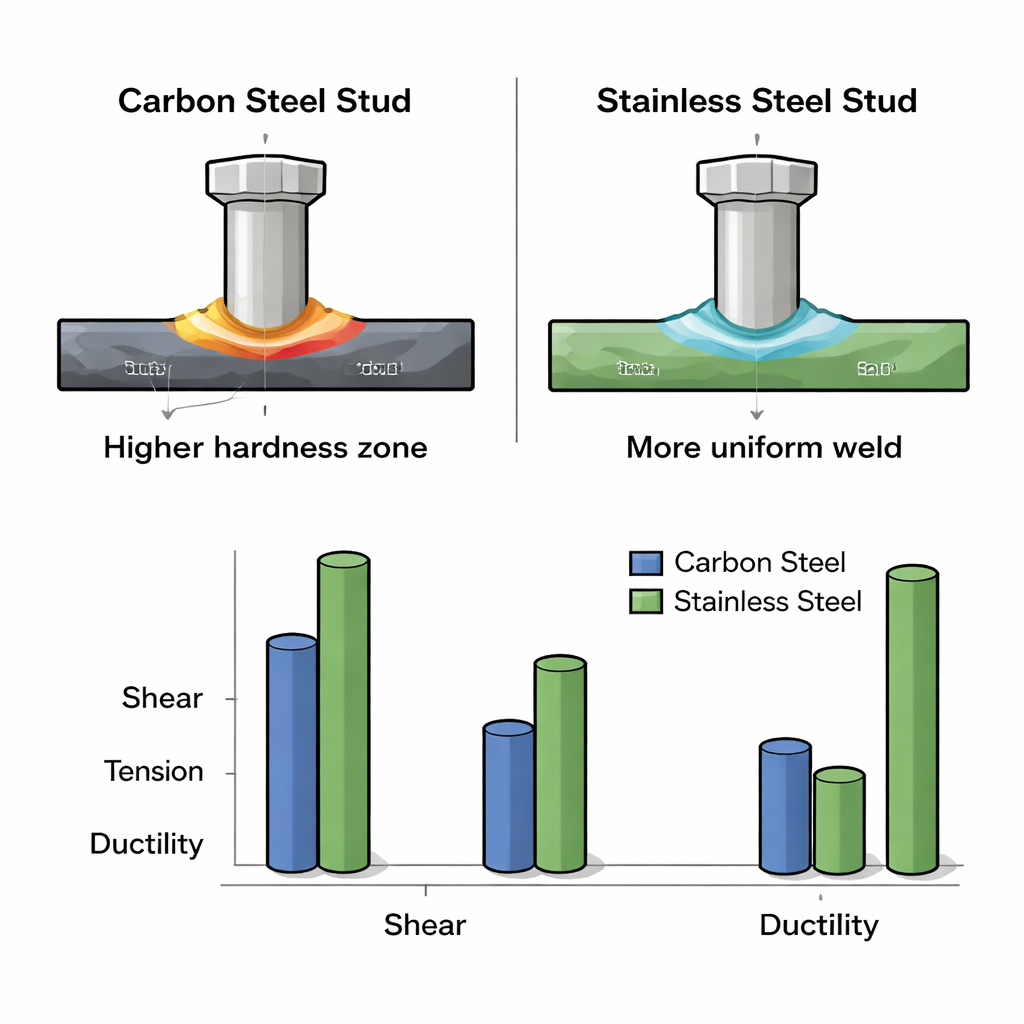
The researchers built and tested three types of stud‑and‑plate assemblies that mirror what is used in bridges. One group used the conventional pairing of a mild carbon‑steel stud on a carbon‑steel plate. A second group welded the same mild stud onto a Grade 50CR stainless plate, creating an intentionally “mismatched” joint. The third group used 316L stainless‑steel studs on Grade 50CR plates, representing an all‑stainless, corrosion‑resistant system. Using custom fixtures in a universal testing machine, they pulled individual studs in tension and pushed paired studs in shear, measuring how much load each assembly carried and how far it stretched or slipped before failing. Across all three configurations, the overall shear and tensile strengths were broadly similar, but the stainless‑steel studs stood out for their ability to stretch significantly more before fracture, showing greater ductility and energy absorption.
Peering into the Welds at the Microscopic Scale
Strength alone does not tell the whole story, so the team sectioned welded joints and examined them under a microscope, then used a fine‑scale hardness test to map how the material changed near the weld. In both carbon‑on‑carbon and carbon‑on‑stainless joints, they found very hard, needle‑like structures called martensite concentrated in the heat‑affected zone around the weld. These regions showed sharply elevated hardness, sometimes exceeding levels that engineers treat as warning flags for brittle behavior. In the mixed carbon‑stud‑on‑50CR configuration, the weld zone became especially hard, implying a higher fraction of brittle phases that could crack under demanding service conditions. By contrast, the stainless‑stud‑on‑stainless‑plate joints still developed hard areas, but the peak hardness was lower and spread more smoothly, suggesting a more forgiving weld. Importantly, the team did not detect a troublesome phase called sigma, which can degrade corrosion resistance in some stainless welds.
What the Failures Reveal About Safety Margins
Most specimens failed in the stud itself with classic ductile tearing, which is what designers prefer: it means the basic steel bar gives way before the weld suddenly snaps. However, a handful of samples, especially among the stainless‑on‑stainless group, fractured in or near the weld. The authors tie these exceptions to local weld defects or pockets of extremely hard microstructure, emphasizing that even in a generally robust system, poor weld quality can shift failure from the stud into the joint. Their measurements show that weld size, fusion area, and local hardness spikes all help determine whether a connection fails gradually and visibly or in a more brittle manner. That insight reinforces existing welding rules that stress proper heat input, stud seating, and cleanliness, and it hints that fine‑tuning the welding parameters for stainless systems could further reduce the risk of brittle zones.
Why Stainless‑on‑Stainless Studs Are Promising
For bridge owners, the main takeaway is reassuring. Using 316L stainless steel studs on Grade 50CR girders provides shear and tensile performance that matches or exceeds that of traditional carbon‑steel studs, while also avoiding the galvanic corrosion issues that arise when dissimilar metals are combined. Although welds in any material can develop hard spots or defects if not properly controlled, the study indicates that Grade 50CR plates can be welded successfully without forming especially dangerous phases, and that stainless studs can exploit their high ductility to deliver tough, reliable connections. In simple terms, switching to stainless‑on‑stainless studs appears to be a practical path toward longer‑lasting, lower‑maintenance bridges—provided that welding procedures are carefully qualified and monitored.
Citation: Sajid, H.U., Slein, R. Mechanical and microstructural assessment of conventional carbon and stainless steel shear stud welded connections. Sci Rep 16, 7049 (2026). https://doi.org/10.1038/s41598-026-37051-7
Keywords: bridge corrosion, stainless steel studs, composite bridges, weld microstructure, Grade 50CR