Clear Sky Science · en
Preparation and thermal properties study of HMX/RDX composites
Safer Power from Military Explosives
Modern weapons demand explosives that pack tremendous power yet remain stable enough to store and transport without disaster. This study explores a new way to combine two well‑known military explosives—HMX and RDX—into a single material that aims to deliver high destructive energy while lowering the risk of accidental detonation. By reshaping how the two substances sit together at the microscopic level, the researchers show it is possible to tune both the strength and the safety of the charge.
Why Mix Two Famous Explosives?
HMX and RDX are widely used in warheads and propellants because they release large amounts of energy in a very short time. HMX is the more powerful and more thermally stable of the two, but it is also more expensive to produce. RDX is somewhat less energetic but cheaper and already used on a large scale. Combining them offers a way to balance cost, power, and safety—if the two can be blended in a controlled, uniform fashion. Traditional methods simply grind and stir the crystals together, which leaves weak contact between particles, uneven burning, and less predictable behavior under heat or shock.
Building a Core–Shell Crystal
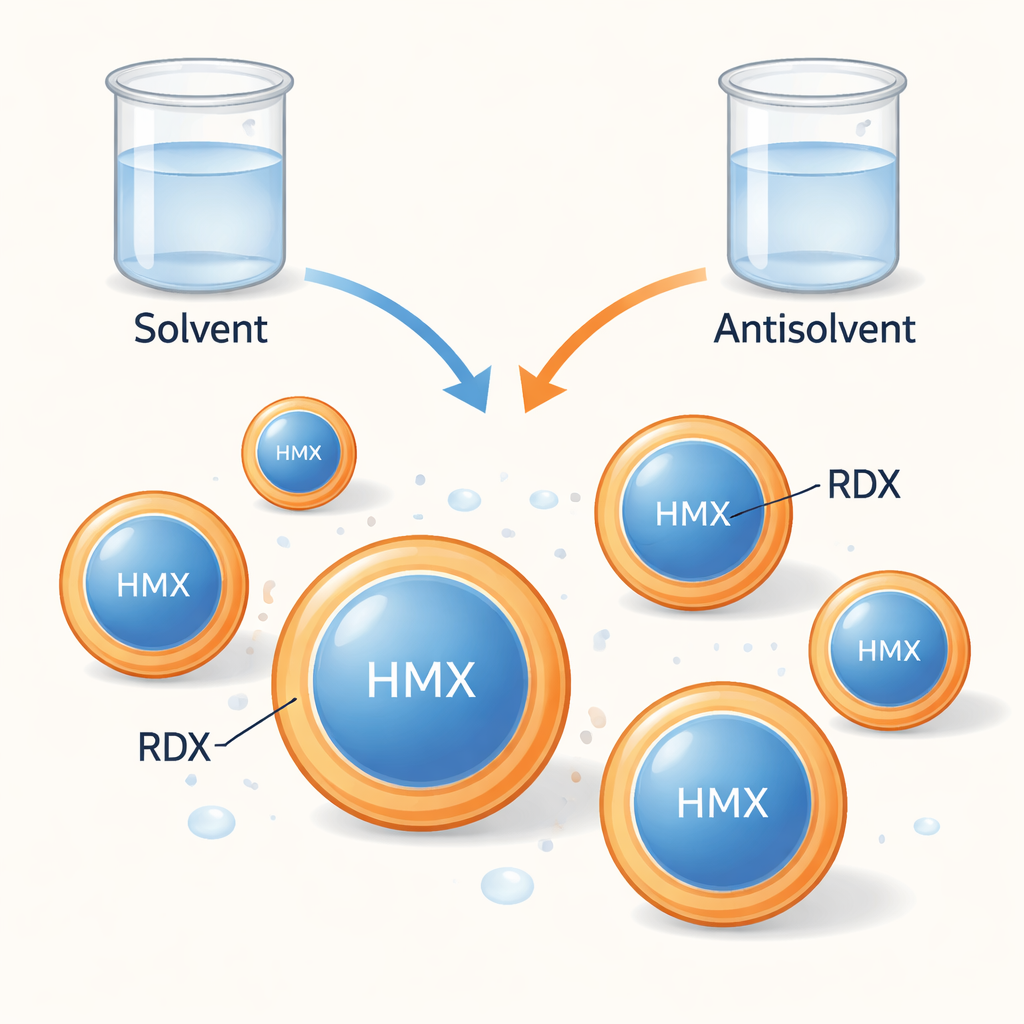
The team developed a gentler, liquid‑based method to assemble the two explosives into a single, well‑organized particle. Both HMX and RDX were first dissolved in a solvent and then slowly introduced into water, which forces them to crystallize out. By carefully controlling the order and rate of mixing, they created particles about one‑tenth of a millimeter across with HMX forming the inner core and RDX forming a thin outer coating. Microscopy showed that the particles were uniform in size, and chemical tests confirmed that the intended 40:60 mass ratio of HMX to RDX was reached with very small error and no detectable impurities.
Checking the Inner Structure
To see what was happening inside the crystals, the researchers used techniques that read how molecules vibrate and how X‑rays bounce off the crystal lattice. These measurements revealed that HMX settled into a particularly stable crystal form, known as the beta phase, and that both explosives kept their basic chemical identities. At the same time, tiny shifts in the measured signals showed that the molecules of HMX and RDX were interacting with each other across the core–shell boundary. In everyday terms, the two ingredients are not just sitting next to each other; they are “talking” through subtle forces that slightly adjust how tightly they hold their atoms.
How the Composite Behaves When Heated
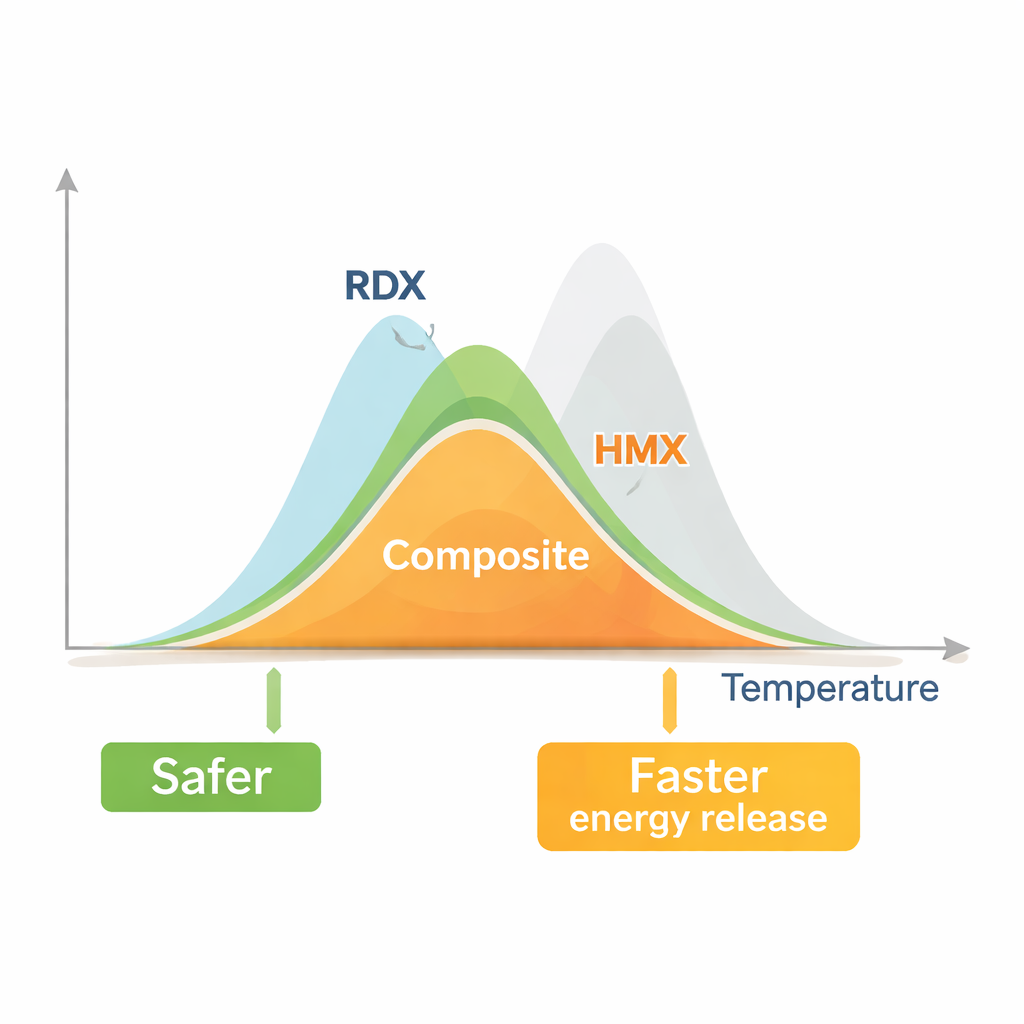
The key question for any explosive is how it behaves as temperature rises. Using sensitive scales and heat sensors, the team tracked how pure HMX, pure RDX, a simple physical mixture, and the new core–shell composite broke down when heated. All showed two main heat‑releasing steps: first RDX decomposes, then HMX follows. In the composite, however, the RDX layer decomposed at a somewhat higher temperature while HMX began to decompose at a lower temperature than usual. This “push‑and‑pull” indicates a synergistic effect: the burning RDX shell helps trigger the HMX core more easily, while the structured pairing makes RDX slightly harder to overheat in the first place.
Balancing Fast Energy Release with Safety
By analyzing how quickly the first decomposition step proceeds, the researchers found that the composite needs less energy to get its reaction going than either pure RDX or a simple blend. That means it can release energy more rapidly when deliberately ignited. At the same time, the temperatures at which the material would run away into a thermal explosion, or begin to decompose on its own, were higher for the composite than for the physical mixture. In practical terms, the core–shell design creates a material that is easier to initiate when desired, yet more resistant to unintended heating during storage or transport.
What This Means for Future Munitions
For a non‑specialist, the takeaway is that the way explosive molecules are arranged inside each grain matters as much as which molecules are used. This work shows that by using a controlled crystallization process to wrap a powerful explosive core with a tailored shell, engineers can fine‑tune both the punch and the safety margins of military charges. The HMX/RDX composite developed here offers a promising path toward weapons that are more effective on target yet less vulnerable to accidental ignition, and the same design ideas may guide future high‑energy materials far beyond this specific pair of explosives.
Citation: Tao, Yt., Jin, S., Li, L. et al. Preparation and thermal properties study of HMX/RDX composites. Sci Rep 16, 6225 (2026). https://doi.org/10.1038/s41598-026-37049-1
Keywords: HMX RDX composite, high energy explosives, thermal stability, core shell particles, insensitive munitions