Clear Sky Science · en
Green-Synthesized titanium dioxide Nanoparticle–Modified glass ionomer cement: in vitro and in Silico assessment of Mechanical, Physical, and safety properties performance
Stronger, Longer-Lasting Tooth Fillings from Orange Seeds
Anyone who has had a cavity filled worries that the repair might not last forever. Fillings can crack, wear down, or let new decay sneak in around the edges. This study explores an inventive idea: using tiny particles made with bitter orange seeds to strengthen a common dental filling material, aiming to make everyday fillings tougher, more stable in the mouth, and potentially safer for long-term use.
Why Current Tooth Fillings Need an Upgrade
Glass ionomer cements are widely used in dentistry because they stick well to teeth, release fluoride, and are generally gentle on the body. Yet they have weaknesses: they can be brittle, take up water, slowly dissolve, and wear down under chewing forces. These issues can shorten the life of a filling and contribute to recurrent cavities. Dentists and researchers have tried adding antimicrobial chemicals to these materials, but those additives can sometimes weaken the filling. At the same time, interest has grown in “green” approaches that rely on plant-based ingredients and environmentally friendly manufacturing to improve medical materials.
Turning Orange Seeds into Helpful Nanoparticles
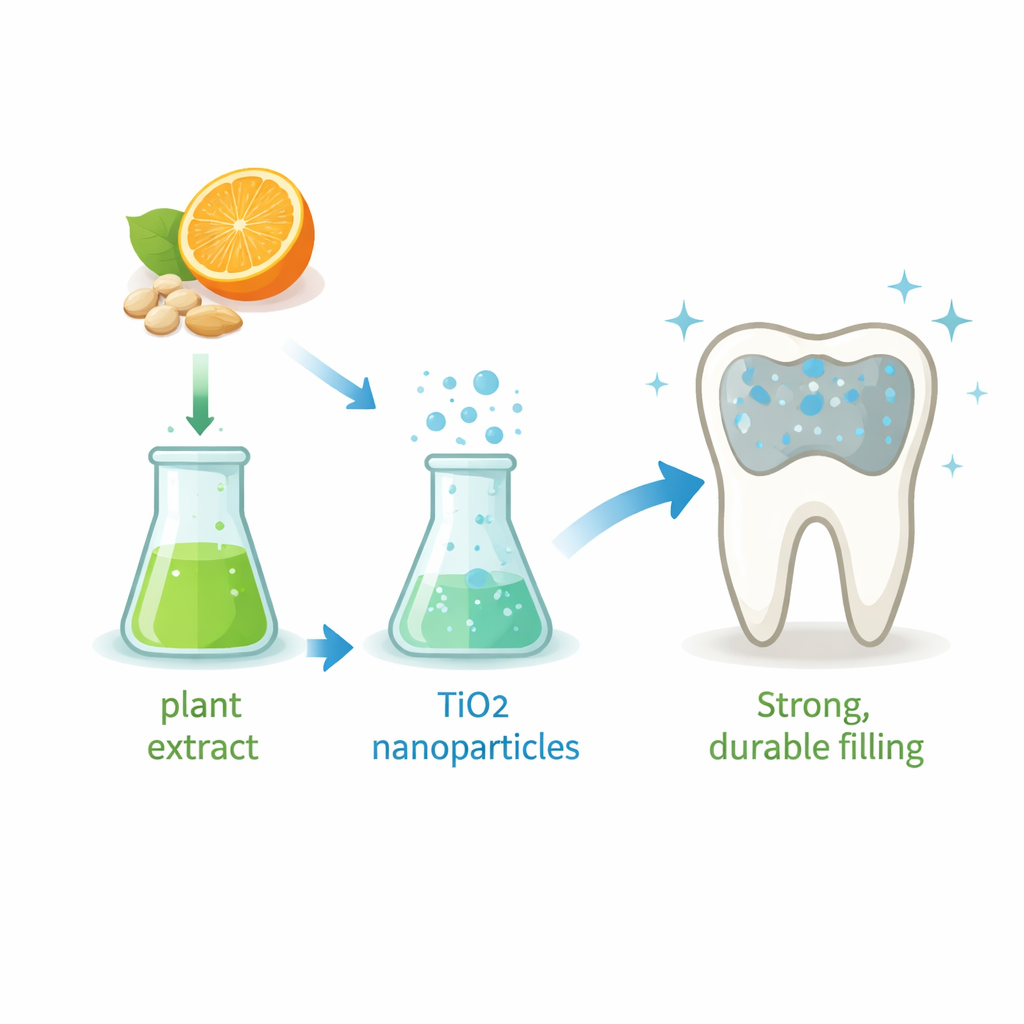
In this work, the researchers used seeds from Citrus aurantium, or bitter orange, to make ultra-small particles of titanium dioxide, a well-known white mineral. Instead of using harsh chemicals, they boiled powdered seeds in water to pull out natural plant compounds, then slowly added a titanium-containing liquid so those compounds could help form and stabilize the nanoparticles. Careful testing showed that the resulting particles were tiny (around 10–15 nanometers), mostly spherical, and had a stable crystal structure. These green-made particles were then blended into a standard glass ionomer cement powder at two levels: 5% and 10% by weight, creating experimental versions of the filling material to compare with the unmodified cement.
Testing Strength, Hardness, and Water Resistance
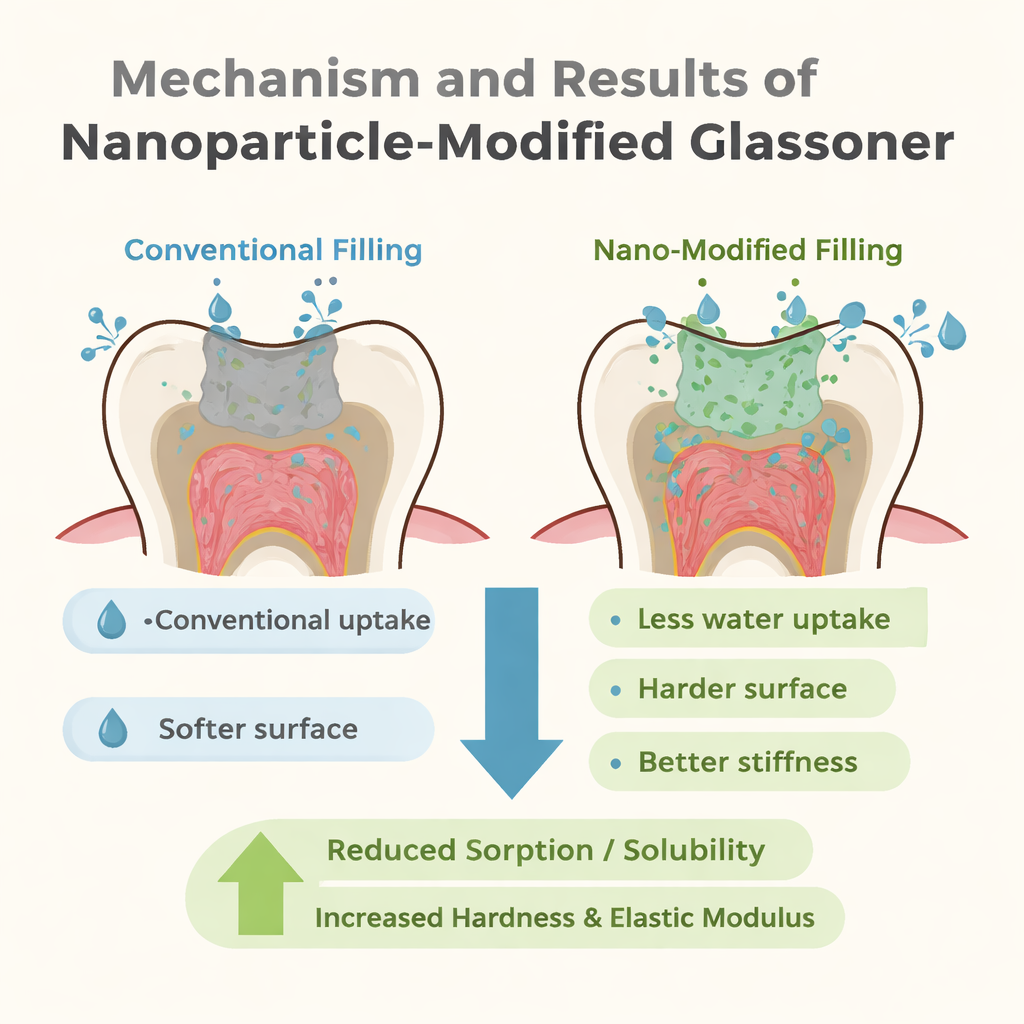
The team molded and cured small bars and discs from each material and measured how they behaved under different kinds of stress. They looked at flexural strength (how much bending force it can withstand before breaking), stiffness, surface hardness (resistance to indentation and wear), and how much water the material absorbs and releases. While the bending strength itself did not change significantly, the cement containing 10% nanoparticles became noticeably stiffer and harder than the regular version. It also took up less water and showed lower apparent solubility, meaning it was less prone to swelling or slowly washing away. These changes suggest a denser, more tightly packed structure, where the tiny particles help fill gaps between larger glass particles and give the surface extra resistance to everyday chewing and abrasion.
Checking Safety on the Computer Before the Clinic
Because the plant extract contains many natural chemicals, the researchers also asked a key question: if tiny amounts of these substances ever leached out of a filling, would they be likely to cause harm? Instead of jumping straight to animal tests, they first used online prediction tools, originally built for drug development, to estimate how these molecules might behave in the body. For the ten main plant-derived compounds identified, the models suggested good breakdown and clearance, generally low acute toxicity, and no major red flags for heart, liver, or immune damage at the small doses that might plausibly be released. A few theoretical risks, such as possible mutagenicity or environmental impact for certain molecules, were flagged for future lab testing, but overall the pattern supported a low inherent hazard when embedded in the hardened material.
What This Could Mean for Future Dental Care
To a non-specialist, the bottom line is that adding green-synthesized titanium dioxide nanoparticles made with bitter orange seeds made this dental cement harder, stiffer, and more resistant to water without obvious new safety concerns at this early stage. That combination could help fillings last longer in high-stress areas of the mouth and better resist wear and breakdown. The work is still a proof-of-concept: it does not yet prove clinical performance or full safety in patients. However, it shows how plant-based chemistry, nanotechnology, and computer safety screening can work together to design the next generation of more durable and environmentally conscious dental materials.
Citation: Abozaid, D., Ayad, A., Ibrahim, Y. et al. Green-Synthesized titanium dioxide Nanoparticle–Modified glass ionomer cement: in vitro and in Silico assessment of Mechanical, Physical, and safety properties performance. Sci Rep 16, 5890 (2026). https://doi.org/10.1038/s41598-026-37048-2
Keywords: dental fillings, glass ionomer cement, green nanotechnology, titanium dioxide nanoparticles, Citrus aurantium