Clear Sky Science · en
New biphenylvinylanthracene-based polymers for organic electronics applications: effect of the acceptor group on optoelectronic properties
Why bendy plastics matter for bright screens
From rollable TVs to wearable gadgets, the next generation of electronics needs light sources that are thin, flexible, and cheap to make. This article explores two newly designed light-emitting plastics that could help power such devices. By making a subtle change in the chemical “decoration” of these plastics, the researchers show how to tune their color, stability, and ability to move electrical charges—key ingredients for better organic light-emitting diodes (OLEDs) and polymer LEDs (PLEDs). 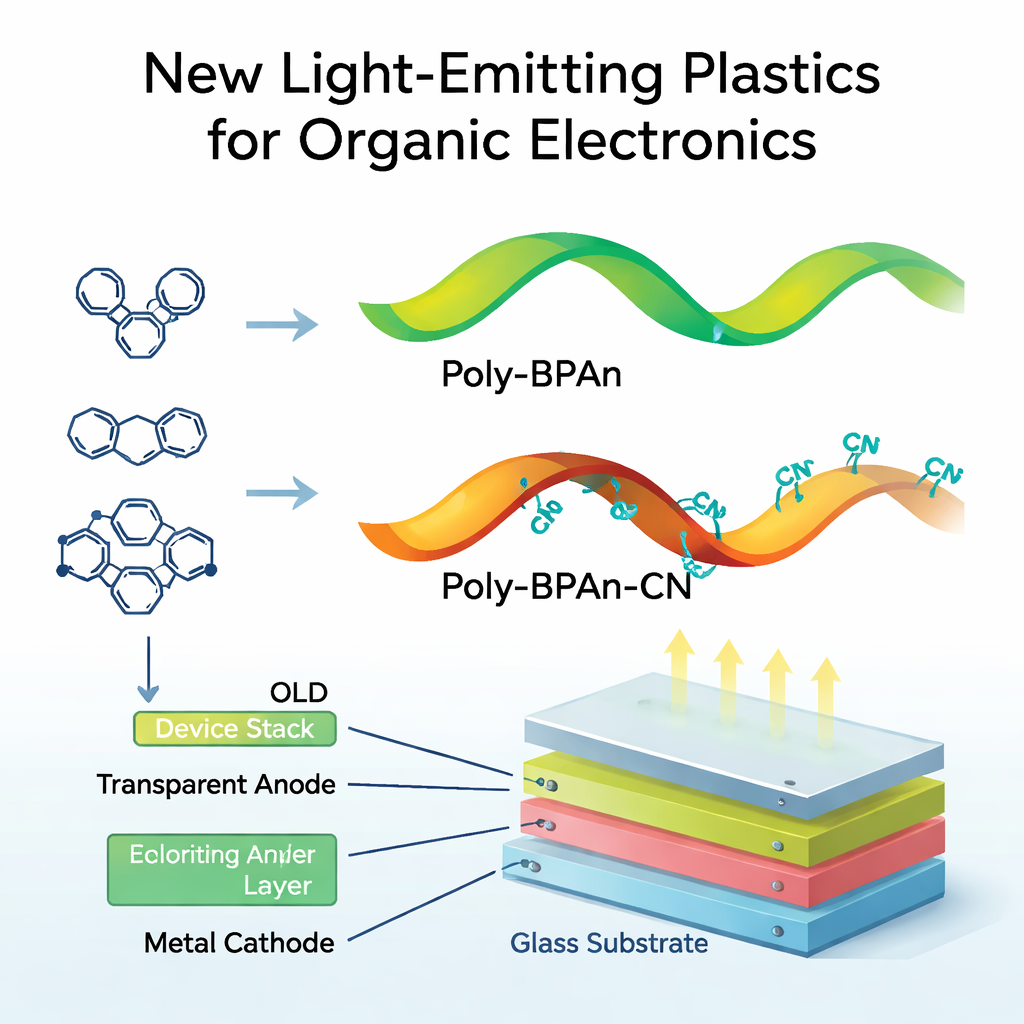
Building new light-emitting chains
The team focused on long-chain molecules, or polymers, built around an anthracene core—a ring-shaped unit known for glowing brightly—linked to biphenyl groups, which help keep the chains soluble and film-forming. They made two versions: Poly-BPAn, the “plain” polymer, and Poly-BPAn-CN, in which each repeating unit carries a cyano (CN) group that strongly attracts electrons. Both materials were synthesized in several steps from simple starting chemicals, then linked into polymers using classic carbon–carbon bond-forming reactions. Laboratory tests using techniques such as NMR and infrared spectroscopy confirmed the intended structures, while thermal analyses showed that the polymers remain stable to temperatures well above those encountered in typical device operation.
How a tiny group changes light and shape
When the researchers shone light on dilute solutions of the two polymers, they found that both absorbed in almost the same region of the spectrum and had nearly identical optical “gaps”—the energy needed to excite an electron. This was somewhat surprising, because cyano groups often narrow this gap. Computer modeling using density functional theory revealed why: adding CN twists parts of the polymer backbone out of plane, disrupting how far electrons can spread along the chain. This geometric distortion counteracts the usual electron-withdrawing effect of CN, so the basic light-absorption energy barely shifts. However, the emission behavior changes dramatically. The CN-free polymer Poly-BPAn glows with strong blue light and a high fluorescence efficiency, while Poly-BPAn-CN emits broader cyan-blue to orange shades and is much less efficient because the CN groups promote internal charge-transfer states that compete with light emission.
From glowing solutions to working devices
In thin solid films—the form needed for displays—the polymers behave like organic semiconductors. Their absorption bands broaden as neighboring chains interact, and their emission shifts to longer wavelengths, signaling the formation of excited dimers known as excimers. Electrochemical measurements showed that adding CN lowers the energies of the key electronic levels, especially the one associated with pulling in electrons, increasing the material’s electron affinity. The authors then built simple single-layer diodes with a transparent conducting bottom contact, a polymer film, and an aluminum top electrode. Both devices turned on at only a few volts, but those made from Poly-BPAn-CN carried much higher current and exhibited charge carrier mobilities roughly 35 times larger than those of Poly-BPAn. 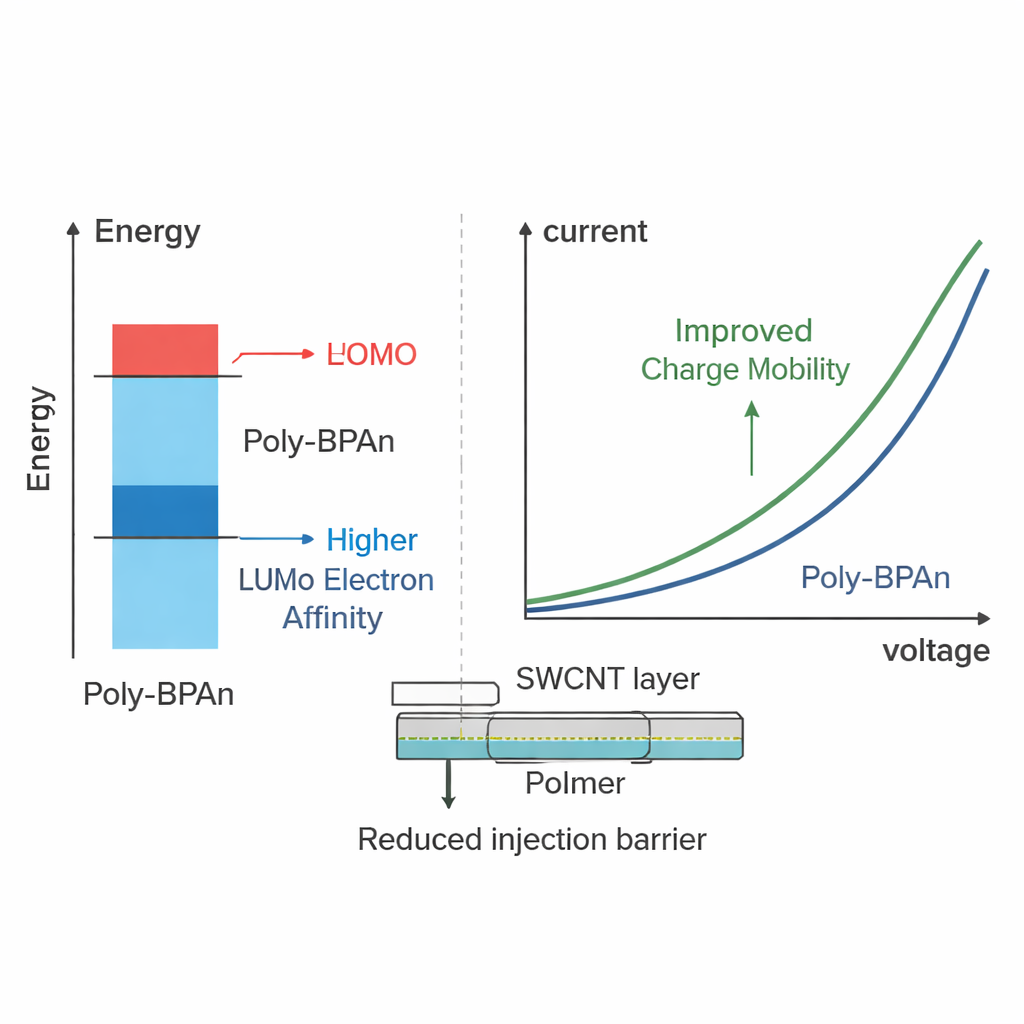
Designing smarter OLED stacks with nanotubes
To push performance further, the team explored a theoretical redesign of the device stack. Using quantum chemical calculations, they modeled single-walled carbon nanotubes inserted as an ultrathin interlayer between the metal cathode and the polymer film. Because the nanotube energy levels sit between those of the metal and the polymer, this extra layer reduces the barrier that electrons must cross to enter the light-emitting plastic—from about 1 electron volt down to roughly 0.3 electron volt. In practical terms, that easier injection should lower operating voltage and increase efficiency, especially for the CN-containing polymer that already transports charge so well through its bulk.
What this means for future flexible lights
For a general reader, the key message is that swapping in a tiny chemical group along a plastic chain can reshape not only the color of the light it emits, but also how easily it conducts electricity and how it fits into a device. Poly-BPAn offers bright, efficient blue emission, while Poly-BPAn-CN behaves as a stronger semiconductor with higher current flow, though dimmer light. By carefully balancing these trade-offs and pairing the polymers with smart interlayers such as carbon nanotubes, engineers can design flexible, low-cost OLEDs and PLEDs that may one day light up foldable screens, smart labels, or even medical patches that conform to the skin.
Citation: Zrida, H., Hriz, K., Hassine, K. et al. New biphenylvinylanthracene-based polymers for organic electronics applications: effect of the acceptor group on optoelectronic properties. Sci Rep 16, 7148 (2026). https://doi.org/10.1038/s41598-026-37042-8
Keywords: organic electronics, light emitting polymers, OLED materials, conjugated polymers, carbon nanotubes