Clear Sky Science · en
Maternal technoference decreases brain-to-brain synchrony during mother-infant interaction
When Phones Come Between Parent and Child
Smartphones are woven into nearly every moment of modern life, including time spent with our children. Parents often glance at messages during playtime or while feeding their baby, assuming these quick check-ins are harmless. This study asks a deeper question: when a mother turns to her phone, does it change not just what she and her infant do, but how their brains connect with each other in real time?
Two Brains in Conversation
From the very beginning of life, babies and caregivers form a kind of hidden duet. When they make eye contact, smile, or coo back and forth, their bodies and brains tend to fall into sync. This “brain-to-brain synchrony” is thought to support bonding, emotional regulation, and later social skills. Using a technique called dual-EEG, researchers can record brain activity from both mother and infant at the same time, tracking how closely their brain rhythms align while they interact naturally.
A Phone-Based Twist on a Classic Test
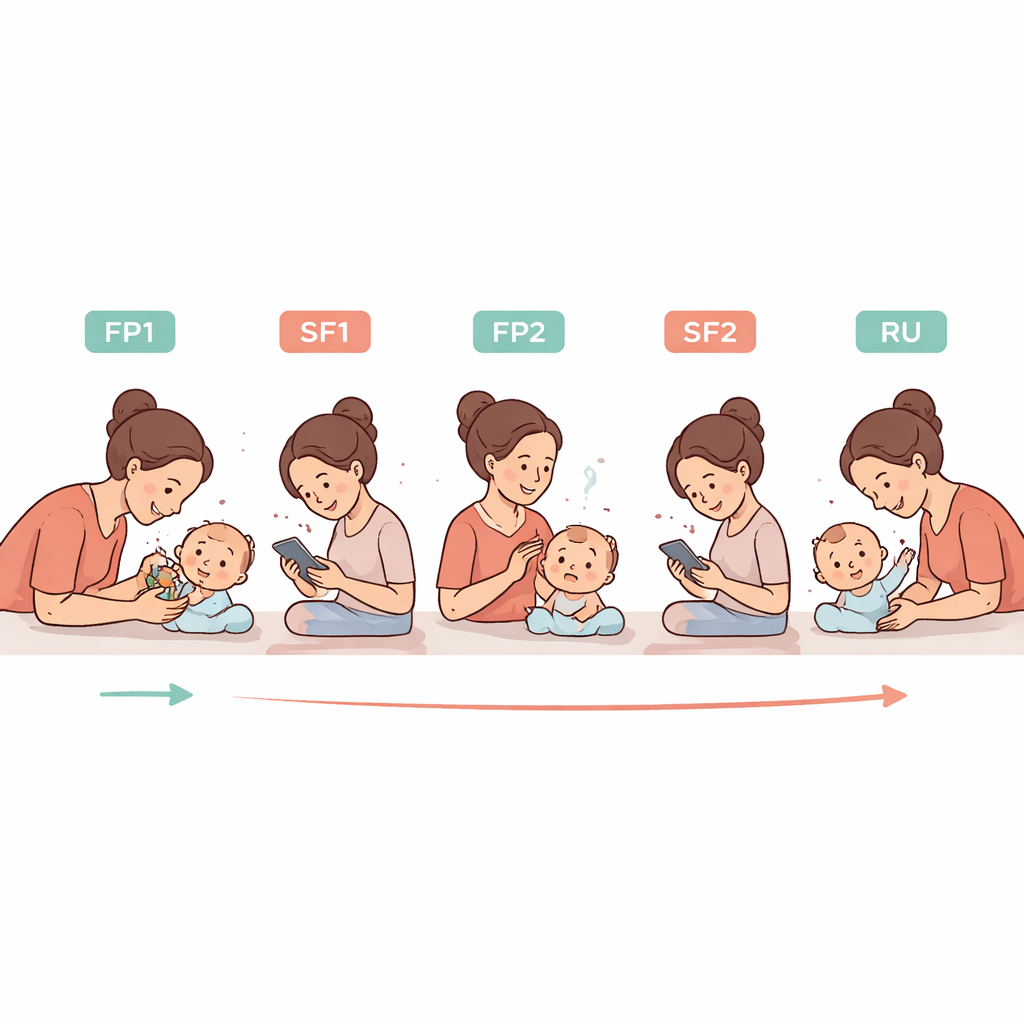
To explore how phone use affects this brain duet, the researchers adapted a classic experiment known as the Still-Face Paradigm. In the original version, a mother first plays freely with her baby, then suddenly becomes expressionless and unresponsive for a short period before reconnecting. Here, 33 mothers and their 5- to 12‑month‑old infants completed a smartphone-based version: free play (FP1), followed by a first unresponsive phase where the mother looked at her phone (SF1), then another free play period (FP2), a second phone-distraction phase (SF2), and finally a reunion phase (RU) where the mother put the phone away and re-engaged. Throughout, both wore soft caps with electrodes so the team could measure how synchronized their brain activity was.
What Happens When Mom Looks at Her Phone
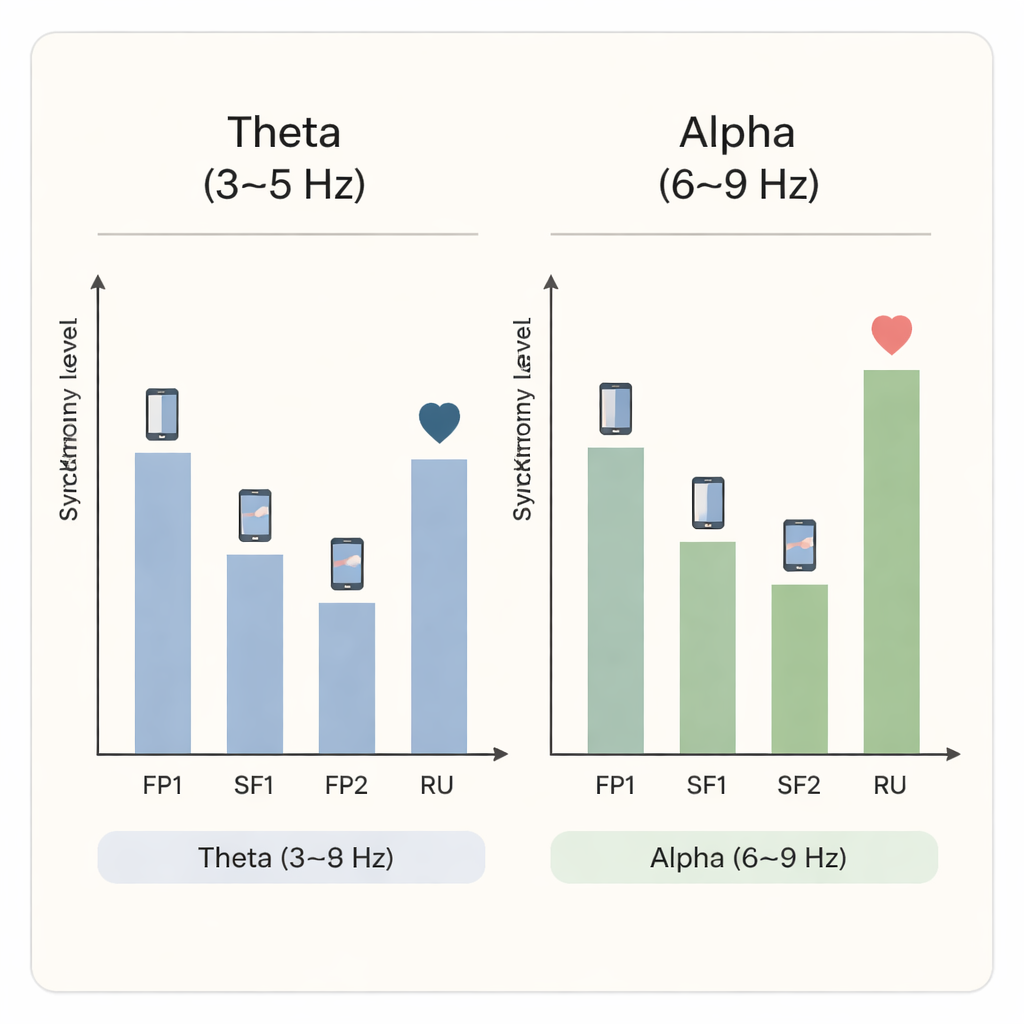
The scientists focused on two types of slow brain rhythms in infants, known as theta (3–5 cycles per second) and alpha (6–9 cycles per second), which are important for attention and social engagement. They calculated how tightly these rhythms in the baby’s brain lined up with those in the mother’s brain across all phases. During the phone-use periods (SF1 and SF2), mother–infant brain synchrony clearly dropped compared with the play and reunion phases. In the alpha rhythm in particular, synchrony was lower in both still-face-with-phone periods than in any of the play periods, and lowest compared with the final reunion. In the theta rhythm, the first phone distraction (SF1) showed a clear drop relative to the first free-play and reunion phases. Detailed mapping across the scalp showed that this loss of synchrony was not confined to a single “social” area, but was widespread across frontal, temporal, parietal, and occipital regions of both brains.
Reconnecting After Distraction
Just as important as the disruption was what happened when the phone disappeared. During the reunion phase, brain-to-brain synchrony not only returned to baseline but sometimes rose above it, especially in the alpha band. This suggests that when the mother puts the device away and actively reconnects, the two brains can quickly fall back into step—and may even “work harder” to re-establish their connection. Interestingly, this neural recovery can occur even when an infant’s outward behavior or mood does not fully return to its original state, hinting that the brain-level reconnection may precede visible emotional repair.
What This Means for Everyday Parenting
For parents, the study offers a clear, practical message. Brief episodes of smartphone distraction during playtime appear to weaken the invisible, moment-to-moment alignment between a mother’s and infant’s brains that supports bonding and development. At the same time, the findings are hopeful: when mothers put their phones away and re-engage, this neural synchrony can recover quickly. In simple terms, your brain and your baby’s really do get on the same wavelength during warm, attentive interactions—and while phones can disturb that shared rhythm, turning your full attention back to your child helps your brains, not just your behavior, to reconnect.
Citation: van den Heuvel, M.I., Mosińska, A., Turk, E. et al. Maternal technoference decreases brain-to-brain synchrony during mother-infant interaction. Sci Rep 16, 6421 (2026). https://doi.org/10.1038/s41598-026-37037-5
Keywords: parenting and smartphones, mother infant bonding, brain to brain synchrony, early child development, technoference