Clear Sky Science · en
A deep residual 1D-CNN with self-attention for fraud transaction detection in virtual economies
Why virtual worlds need real-world protection
From virtual concerts to digital shopping malls, more of our money is starting to flow through online worlds often called the metaverse. Wherever money moves, fraudsters soon follow. This paper explores how a new kind of artificial intelligence model can watch these fast-moving, hard-to-track transactions and flag risky behavior in real time, helping keep people’s virtual wallets safer.

Money moves in the metaverse
In the metaverse, users buy and sell digital goods, trade virtual land, and move cryptocurrencies between wallets scattered across the globe. These transactions leave complex trails: timestamps, amounts, locations, device details, behavior patterns, and more. Unlike traditional banking, this data is high-volume, partly anonymous, and constantly streaming. Old-style fraud systems, which usually make a simple yes-or-no decision about whether a transaction is fraudulent, struggle with this new environment. They are not built to handle shifting behavior, hidden identities, and the need to score every transaction within milliseconds.
Turning messy data into usable signals
The authors build on a public metaverse transaction dataset with nearly 80,000 records, each labeled as low, moderate, or high risk. Each transaction includes 14 different pieces of information, such as the time of day, the type of transaction (for example, purchase, transfer, or scam), the user’s region, how often they log in, and a computed risk score. Many of these pieces are words, not numbers, so the team first converts them into numerical form using simple coding schemes. They also correct a major real-world problem: most transactions are safe, while high-risk ones are rare. To keep the model from “learning” that everything is safe, they duplicate minority high- and moderate-risk cases until all three risk levels are equally represented.
A layered AI model that pays attention
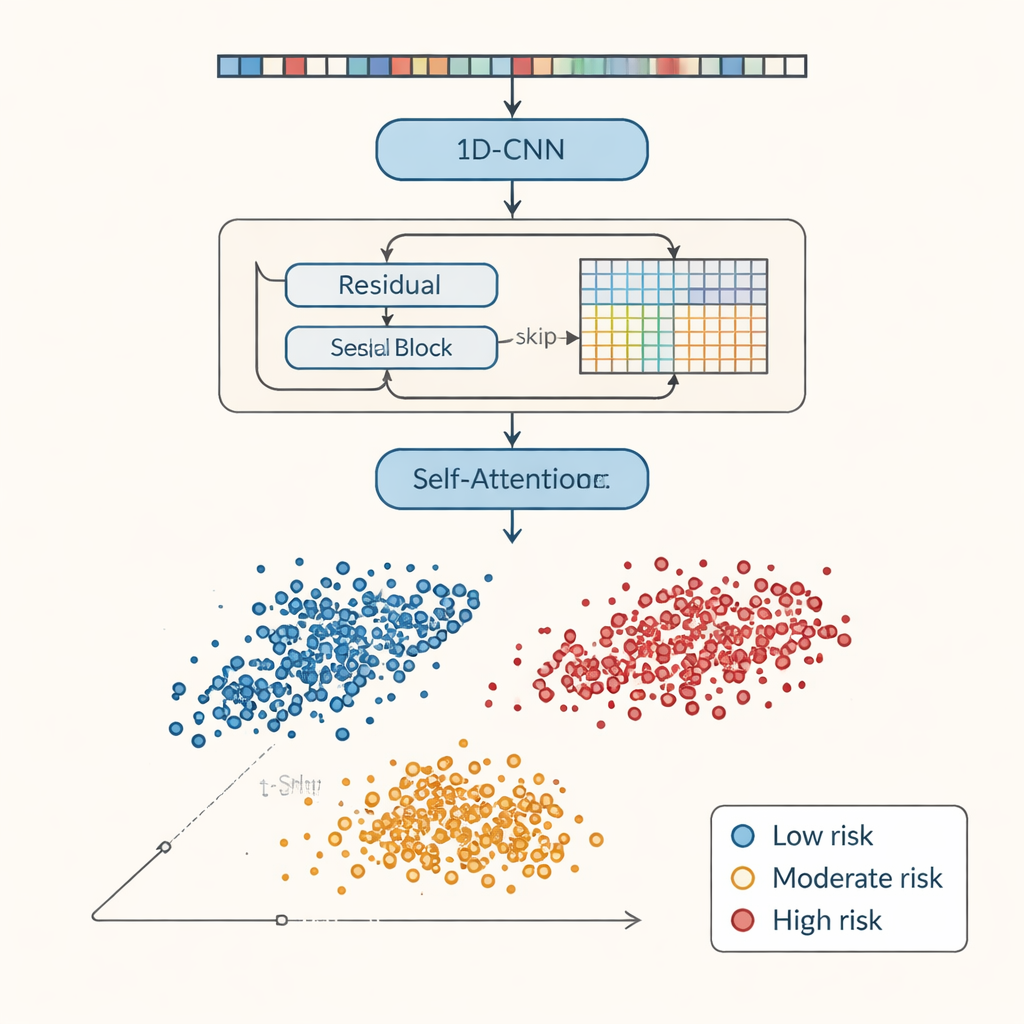
At the heart of the work is a deep learning model based on a one-dimensional convolutional neural network, or 1D-CNN. This kind of network is designed for sequences, so it can treat a transaction’s features more like a short time-series than a static snapshot, catching subtle local patterns in how attributes line up. On top of this, the authors add two modern twists. Residual connections act like shortcuts that help information flow more smoothly through the layers, making it easier to train deeper networks without getting stuck. A self-attention mechanism then learns which parts of each transaction matter most for deciding its risk level, assigning higher weight to clues such as unusually high risk scores or suspicious purchase patterns.
Putting the system to the test
Once trained, the model is evaluated in several ways. On the balanced metaverse dataset, it classifies low, moderate, and high-risk transactions with perfect scores across standard measures: every risky case in the test split is found and correctly labeled. Cross-validation, which repeatedly shuffles and splits the data, confirms that this performance is stable rather than a lucky fluke on one split. The authors also compare variations of their architecture—using only the 1D-CNN, adding just residual connections, adding just attention, or combining both—and find that all reach similar top-line accuracy on this clean dataset, though the full version is slower to train. To probe robustness, they deliberately add different kinds of noise and distortions; performance drops under heavy corruption but remains strong when features are simply missing at random. Visual tools such as t-SNE plots show that, after processing, transactions cluster neatly into three groups corresponding to the risk levels, suggesting the model has genuinely separated the underlying behaviors.
Beyond the metaverse: traditional fraud too
To see if their approach generalizes, the team applies the same enhanced 1D-CNN to a widely used credit card fraud dataset from Europe, which also suffers from severe class imbalance. After balancing only the training portion and leaving the test set untouched, the model reaches about 94% accuracy and similarly strong precision and recall on fraud cases. This indicates that the architecture is not only tailored to metaverse data, but can also handle more familiar card transactions, offering a unified way to score risk across both virtual and traditional financial systems.
What this means for everyday users
For a layperson, the key message is straightforward: as we spend more time and money inside digital worlds, we need smarter guards at the gates. This study shows that a carefully designed AI model can sift through the noisy, fast-changing streams of metaverse transactions and separate routine activity from truly suspicious behavior, while also working well on ordinary credit card data. Although the authors acknowledge that perfect performance on clean, synthetic-like datasets is unlikely to hold in all real-world settings, their noise and stress tests suggest a solid foundation. In practice, such systems could help platforms and banks spot dangerous patterns early, cut down on fraud losses, and give users greater confidence that their virtual assets are being watched over in real time.
Citation: Mohammed, K.K., Abdo, A.S., Darwish, A. et al. A deep residual 1D-CNN with self-attention for fraud transaction detection in virtual economies. Sci Rep 16, 6150 (2026). https://doi.org/10.1038/s41598-026-37032-w
Keywords: metaverse finance, fraud detection, deep learning, risk classification, virtual transactions