Clear Sky Science · en
Effect and microscopic mechanism of nano-oxide modified cement solidified silty soft soil
Stronger Ground for Coastal Cities
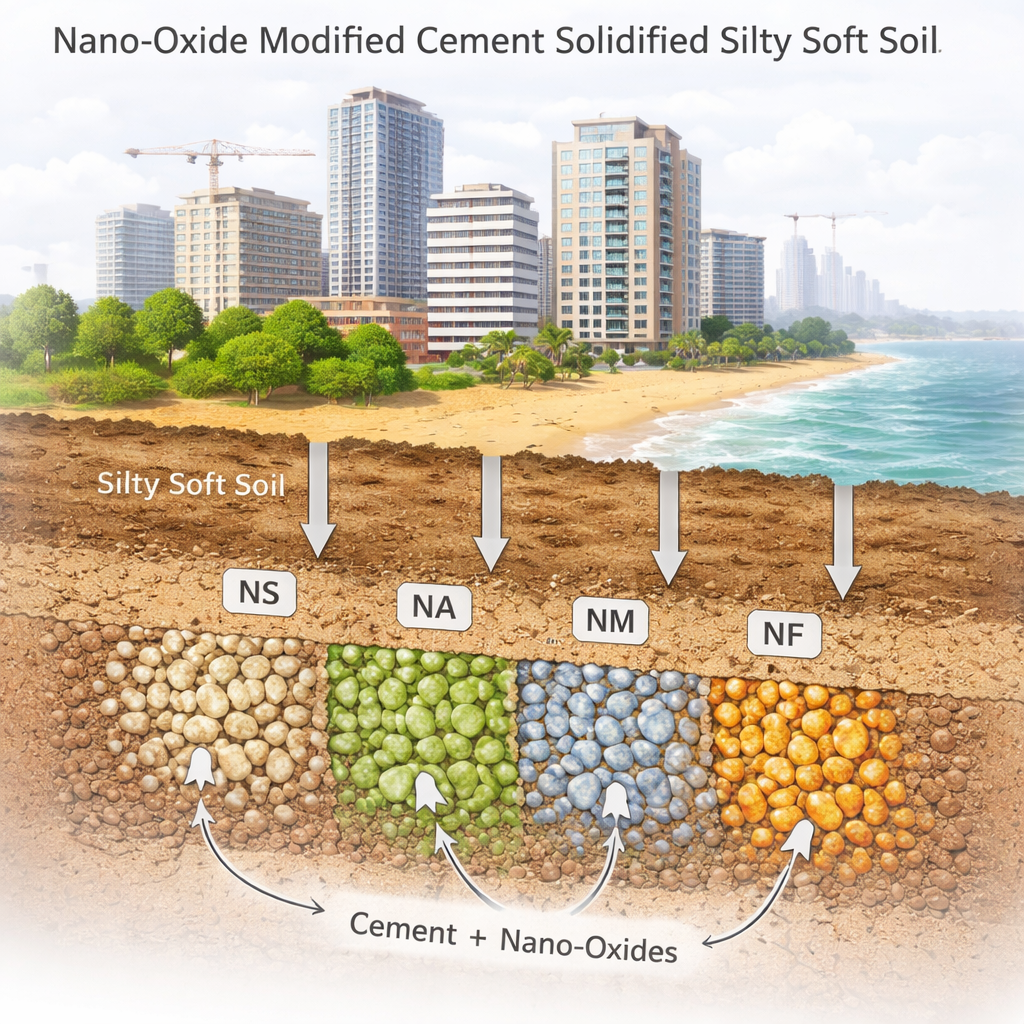
Along many coasts and riverbanks, buildings and roads sit on soft, watery ground that can’t easily carry their weight. Engineers often “solidify” this weak soil with cement, but in silty, organic-rich ground the cement does not work as well as hoped. This study explores a new twist: mixing in tiny particles called nano-oxides with the cement to make the soil beneath our infrastructure stronger, less squishy, and more resistant to water damage.
Tiny Additives with a Big Job
The researchers worked with a silty soft soil from Guangzhou, China, a type of ground that naturally holds almost half its weight in water and has low strength. They added ordinary Portland cement—already a standard method for stabilizing soft foundations—and then further mixed in four different nano-sized metal oxides: nano-silica (NS), nano-alumina (NA), nano-magnesia (NM), and nano-iron oxide (NF). These particles are tens of thousands of times smaller than a grain of sand and have very large surface areas, which lets them react quickly and cling to soil and cement particles. The team varied how much of each nano-oxide they added and tested the soil over time to see how strong, stiff, and water-resistant it became.
How Much Stronger the Soil Becomes
To measure strength, the team squeezed cylindrical samples of treated soil until they failed. After 28 days of curing, even a modest dose (1.5% by the wet soil mass) of each nano-oxide more than doubled the strength compared with cement alone. For example, samples with nano-silica or nano-magnesia reached almost three times the original strength, while those with nano-alumina and nano-iron also showed large gains. In most cases, adding more nano-oxide kept increasing strength. The main exception was nano-magnesia: it had an optimal content around 1.5%, above which strength began to drop, likely because too much expansion from its reaction products created new tiny flaws in the soil-cement skeleton.
Less Squish, Better under Water
Buildings don’t just need strong ground; they also need soil that doesn’t compress too much when loaded or soften dramatically when wet. Compression tests showed that with nano-oxides, the treated soil behaved as a low-compressibility material, even at early ages. As curing time and nano-oxide content increased, the soil became stiffer and could sustain higher pressures before yielding. Water immersion tests—simulating rainfall or long-term wet conditions—revealed that strength always declined with soaking time, but samples containing nano-oxides kept much more of their strength than cement-only soil. Among the four additives, nano-silica generally gave the best combination of stiffness and water resistance, followed by nano-alumina, nano-iron, and then nano-magnesia.
What Happens Inside the Soil
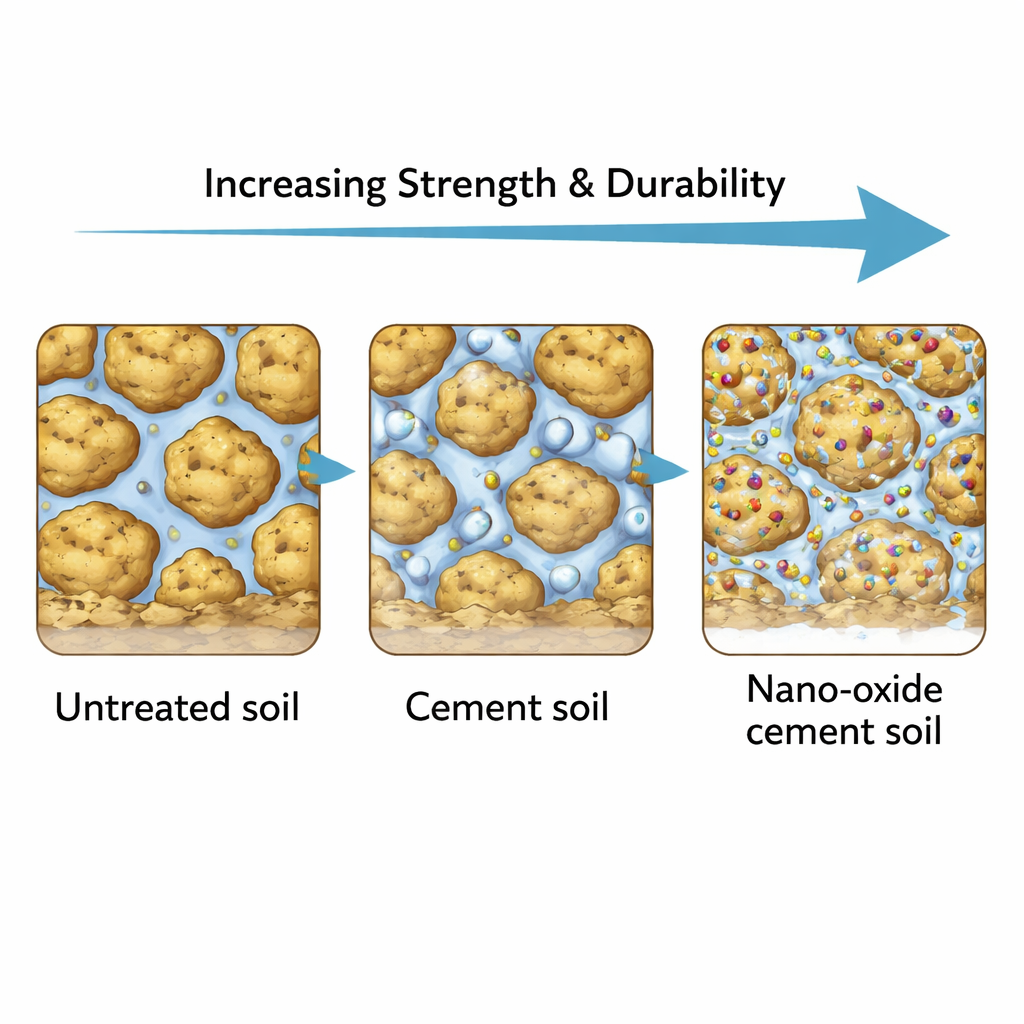
To understand why these tiny particles help so much, the researchers looked inside the soil with X-ray diffraction, electron microscopes, and measurements of pore size. They found that adding nano-oxides changes what kinds of cement-like gels form and how they arrange themselves around soil grains. Nano-silica and nano-alumina in particular spur extra formation of dense, glue-like gels that wrap individual soil particles and bridge them together. Nano-iron mainly fills gaps and helps manage troublesome organic matter, while nano-magnesia forms special magnesium-based gels and crystals that can tighten the soil structure at the right dosage. Overall, the pores between grains become smaller and more evenly distributed, with many large gaps turning into fine internal pores, resulting in a more solid, stone-like mass.
From Lab Findings to Safer Foundations
In plain terms, the study shows that sprinkling a small amount of carefully chosen nano-oxides into cement-stabilized silty soil can transform weak, muddy ground into a much stronger and more reliable base for construction. The soil carries greater loads, compresses less, and holds up better when soaked, because the nano-particles help the cement form more glue and fill more gaps. While the work was done under controlled conditions and for a specific soil type, it points toward practical ways to build safer foundations, embankments, and roads in soft coastal areas by engineering the ground from the microscopic level up.
Citation: Deng, X., Liu, X., Xiao, Z. et al. Effect and microscopic mechanism of nano-oxide modified cement solidified silty soft soil. Sci Rep 16, 5870 (2026). https://doi.org/10.1038/s41598-026-37024-w
Keywords: soil stabilization, nano-oxides, cement-treated ground, soft clay foundations, geotechnical engineering