Clear Sky Science · en
Transmission ratio-efficiency coupled modeling and high-efficiency zone design for multi-row planetary gear transmission of hybrid electric vehicles
Why smarter gearboxes matter for cleaner cars
Hybrid electric vehicles promise better fuel economy and lower emissions, but they can only deliver if their hardware uses energy wisely. A key player is the automatic transmission, which decides how power flows from engine and motors to the wheels. This study shows how rethinking the design of the compact "planetary" gear sets used in many hybrids can squeeze out more efficiency, using detailed physics-based models and clever optimization rather than trial and error.
From guesswork to a unified digital gearbox
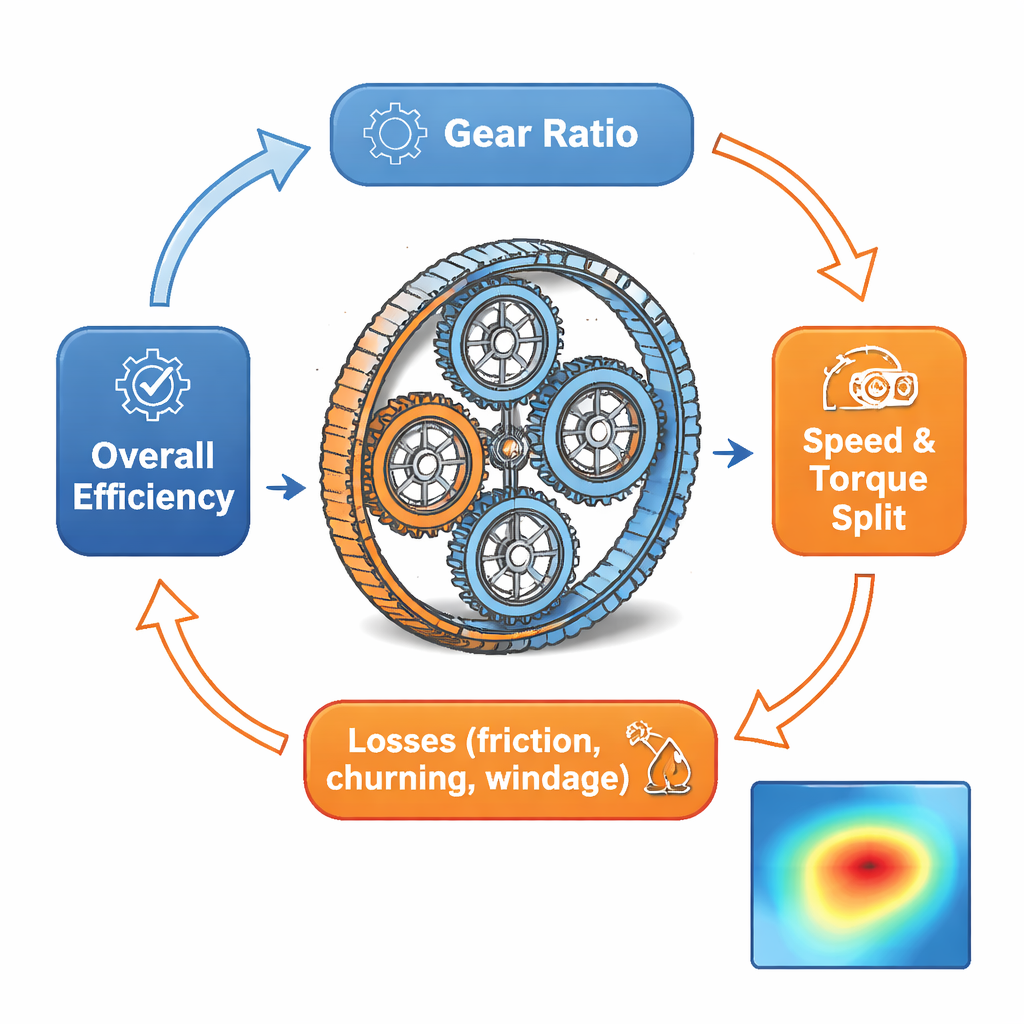
Conventional transmission design often treats two big questions separately: what gear ratios to use, and how much energy is lost to heat, friction, and oil churn at those ratios. That split can leave hidden waste on the table. The authors instead build a single, unified model that links how fast each gear spins, how torque is shared, and where losses occur inside multi-row planetary gear sets. These compact arrangements of sun, planet, and ring gears are common in hybrid power-split systems because they can route power along several paths at once in a small package.
Following power as it splits, circulates, and is lost
To understand where energy goes, the team represents the gear train as a network: nodes stand for gear components, and arrows show how power flows between them. This lets them track how input power from an engine and motor divides and recombines across multiple rows of planetary gears. They then layer on a refined loss model that separately accounts for friction where teeth mesh, drag in bearings, oil churning as gears stir fluid, and windage as fast-moving parts push air. The model even flags harmful "power circulation," where power loops internally without reaching the wheels, a situation that can quietly sap efficiency if not caught early in design.
Letting math search for the sweet spot
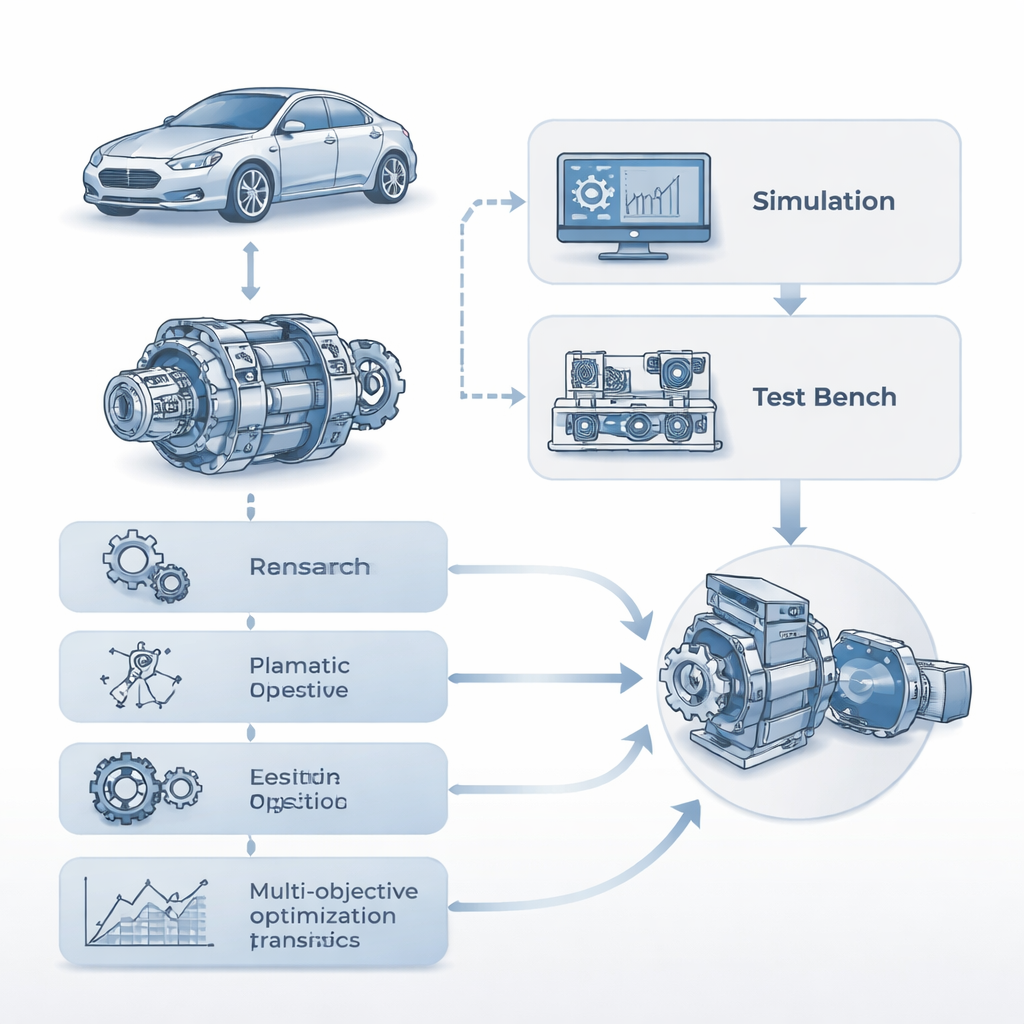
Because gear ratios and losses influence each other in a loop—changing a ratio reshapes speeds and loads, which in turn change losses—the authors solve a set of nonlinear equations that tie everything together. They use an iterative numerical method to find self-consistent values for speeds, torques, and overall efficiency for many operating conditions. On top of this, they run a multi-objective particle swarm optimization, a nature-inspired search algorithm in which many candidate designs "fly" through the design space, nudged by both their own past success and that of their neighbors. The algorithm hunts for designs that jointly maximize efficiency, limit weight, and control manufacturing cost, rather than chasing any single goal in isolation.
Putting the digital design to the test
The framework is applied to a real dual-row planetary transmission from a mainstream hybrid vehicle. The researchers feed in actual geometry, materials, and lubrication details, then compare the model’s predictions to measurements on a high-end test bench. Across six forward gears and a wide range of speeds and loads, the model’s efficiency predictions differ from experiments by only about 1.4 percent on average, and gear ratio calculations stay within a few tenths of a percent of design values. Tests also track temperature rise during a four-hour run and the gearbox’s response to sudden changes in torque and speed, confirming that the optimized design stays cool enough and responds quickly and smoothly.
Expanding the island of high efficiency
Armed with this validated model, the optimization step suggests modest but coordinated design tweaks: slightly adjusting key geometric ratios inside the planetary sets, trimming gear size where strength allows, and lowering oil level and viscosity enough to cut fluid drag without hurting lubrication. These changes expand the portion of the operating map where the transmission is highly efficient from about two-thirds to nearly four-fifths, and raise the overall average efficiency from roughly 93 to 96 percent. In practical terms, that means more of the engine’s and motor’s energy reaches the wheels instead of being lost as heat, helping hybrids use less fuel and emit less CO₂ without requiring radical new hardware.
Citation: Zhang, Q., Ren, C. & Niu, H. Transmission ratio-efficiency coupled modeling and high-efficiency zone design for multi-row planetary gear transmission of hybrid electric vehicles. Sci Rep 16, 6455 (2026). https://doi.org/10.1038/s41598-026-37023-x
Keywords: hybrid electric vehicles, planetary gear transmission, powertrain efficiency, gearbox optimization, multi-objective design