Clear Sky Science · en
Efficient target detection method based on wavelet transform and progressive feature pyramid network: a case study of power grid inspection
Keeping Power Lines Free from Hidden Hazards
Electricity keeps modern life running, but the power lines that carry it are more fragile than they look. Everyday items like balloons, kites, plastic bags, or bird nests can get tangled in high-voltage lines, risking sparks, outages, and costly repairs. Utilities increasingly rely on drones and cameras to patrol long stretches of wire, yet spotting tiny, low-contrast objects in cluttered images is still hard for both humans and standard AI systems. This study presents a faster, more accurate computer-vision method that helps inspection teams automatically detect these hazards in real time.
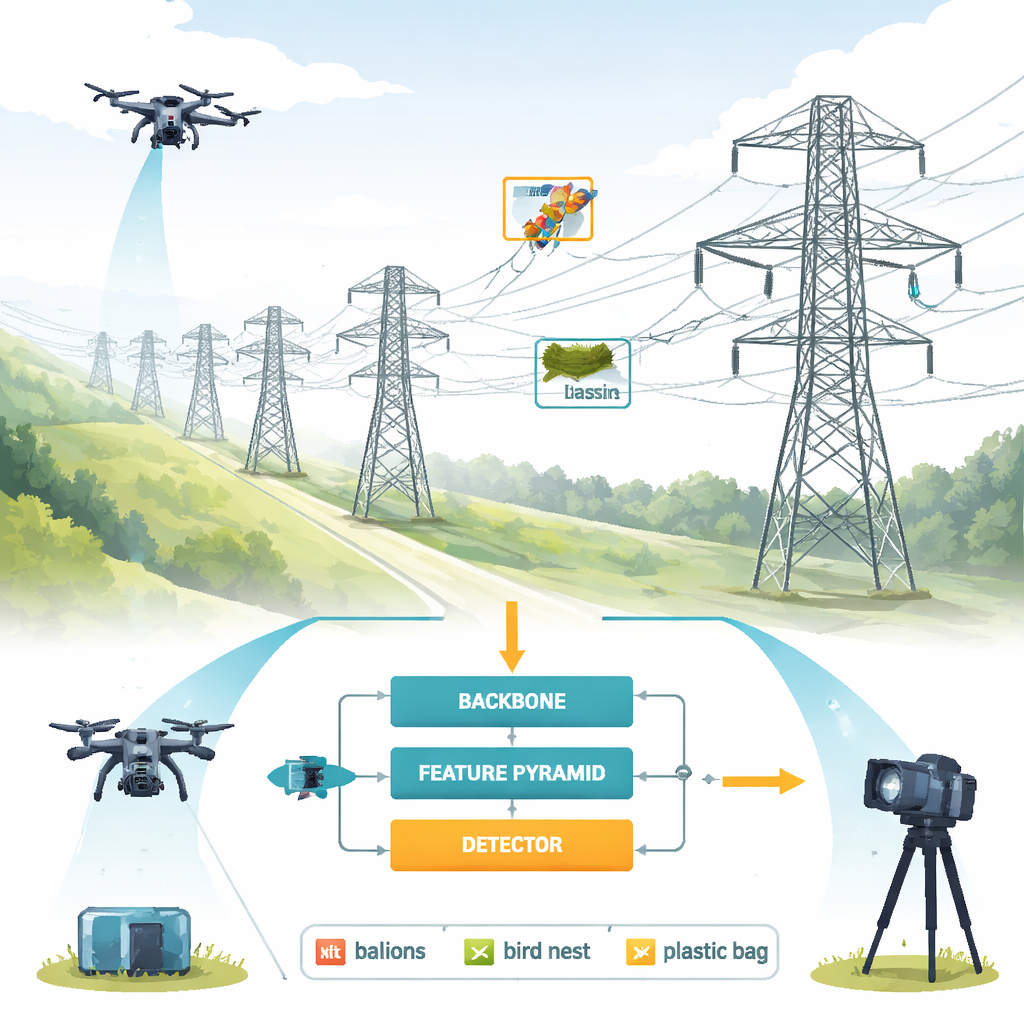
Why Small Objects Are Hard to Spot
Images of power corridors are visually tricky. Most of the scene is made up of broad, smooth areas like sky, fields, or rivers, while the safety-critical parts – cables, insulators, and foreign objects – are thin lines or small blobs. Standard detection systems such as YOLO, a popular family of real-time object detectors, were designed for everyday photos with larger, clearer objects like people or cars. In aerial power-line imagery, however, balloons or scraps of trash may span only a few pixels and often blend into towers or wires. The result is frequent misses, false alarms on background structures, and unstable performance when scenes get busy.
Teaching AI to Read Images by Frequency
The authors tackle this by changing how the neural network “looks” at images. Instead of processing everything in the usual pixel grid alone, they add a wavelet-based convolution layer called WTConv. Wavelets split an image into low-frequency parts that capture smooth background regions and high-frequency parts that highlight edges and fine details. In this design, the network processes these parts separately and then recombines them without losing information. That means it can keep track of the broad corridor context while sharpening structures like wires, towers, and tiny foreign objects – without making the model heavier or slower.
Stacking Features to See Across Scales
Detecting a bird nest perched on a tower arm or a kite tangled across several wires also requires understanding how patterns relate across different sizes in the image. To address this, the study introduces a Progressive Feature Pyramid Network (PFPN). It takes features from shallow and deep layers of the network and fuses them in two passes: first from coarse to fine, then back from fine to coarse. An “adaptive fusion” step learns, for every location, how much to trust each scale. This progressive stacking produces feature maps that line up better with the actual foreign objects, and reduces confusion when small hazards overlap with large metal structures.
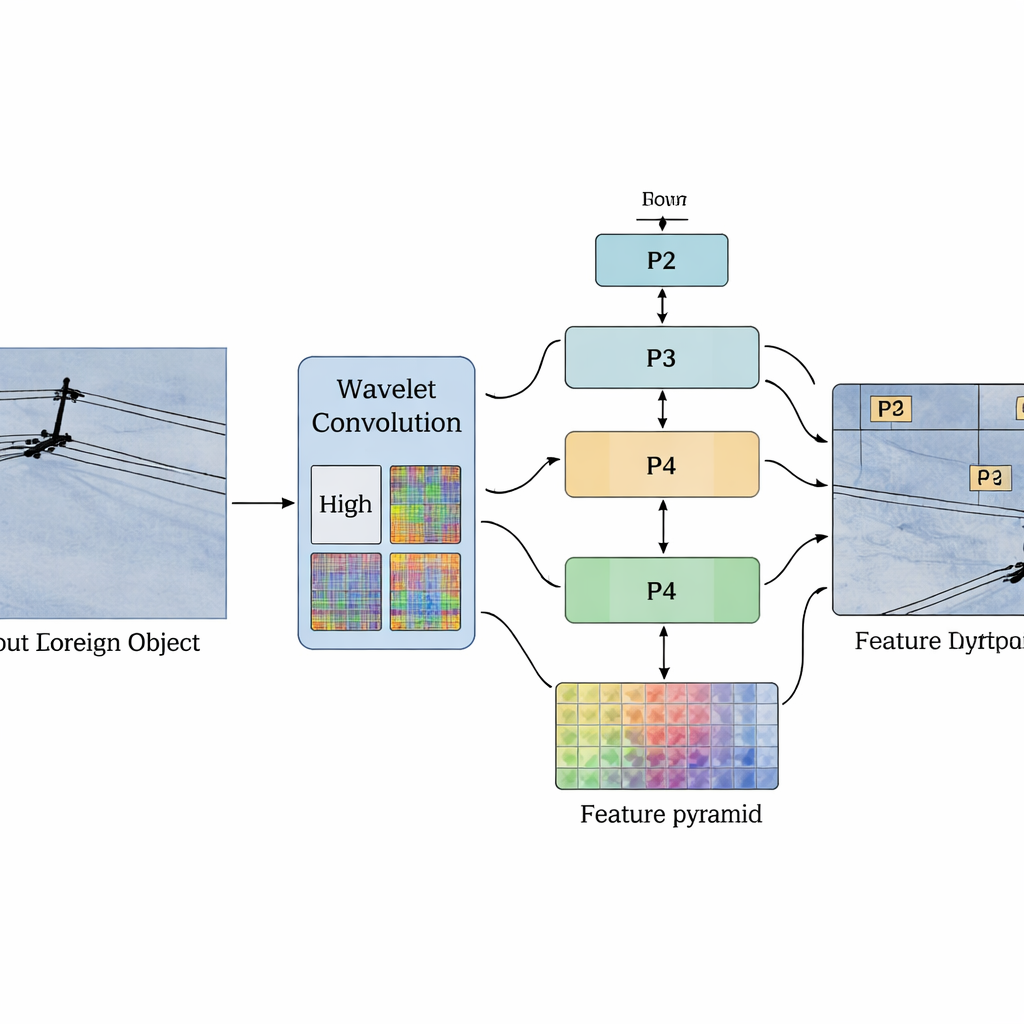
Fine-Tuning How Boxes Are Drawn
Even when a model guesses the right object, it still needs to place a precise box around it. Common training rules focus on how much the predicted and true boxes overlap, but this can be misleading for tiny, faint targets. The researchers refine this step with a new “Inner-EIoU” loss, which pays special attention to how well the central regions of the boxes match. By rewarding tight alignment in the core area, the method helps the model lock onto the true position of small or partly hidden foreign objects, making the final detections more trustworthy.
Proving the Gains in the Real World
To test their design, the team built a specialized dataset of 4,700 images from real high-voltage corridors, covering scenes from cities to countryside and labeling four common hazard types: garbage, balloons, bird nests, and kites. Compared with a standard YOLOv11 baseline, the improved model detects more of these objects while making fewer mistakes, raising both precision and overall detection scores. At the same time, it uses about one-fifth fewer parameters and runs roughly 18% faster, making it well suited for drones or edge devices that must work in real time. Tests on a broad public benchmark (MS COCO) show similar improvements, suggesting the ideas generalize beyond power lines. In practical terms, this means utilities can deploy smarter, lighter inspection systems that better spot small hazards before they cause big problems.
Citation: Ye, J., Yuqi, B., Wendi, W. et al. Efficient target detection method based on wavelet transform and progressive feature pyramid network: a case study of power grid inspection. Sci Rep 16, 7318 (2026). https://doi.org/10.1038/s41598-026-37017-9
Keywords: power grid inspection, foreign object detection, drone imaging, real-time computer vision, high-voltage transmission lines