Clear Sky Science · en
Improving spectral efficiency in distributed massive MIMO in multi-user downlink millimeter wave
Why packing more antennas matters for your phone
Every year we ask our wireless networks to carry more video, games, and data with less delay. Simply turning up the power or adding a few extra antennas is no longer enough. This paper explores a smarter way to arrange and control many antennas and small cell towers so that the same slice of radio spectrum can carry far more information. The work focuses on millimeter-wave signals, which can move huge amounts of data but are tricky to manage, and shows how to get close to “best possible” speeds without building impossibly complex and expensive hardware.
Breaking one big tower into many small helpers
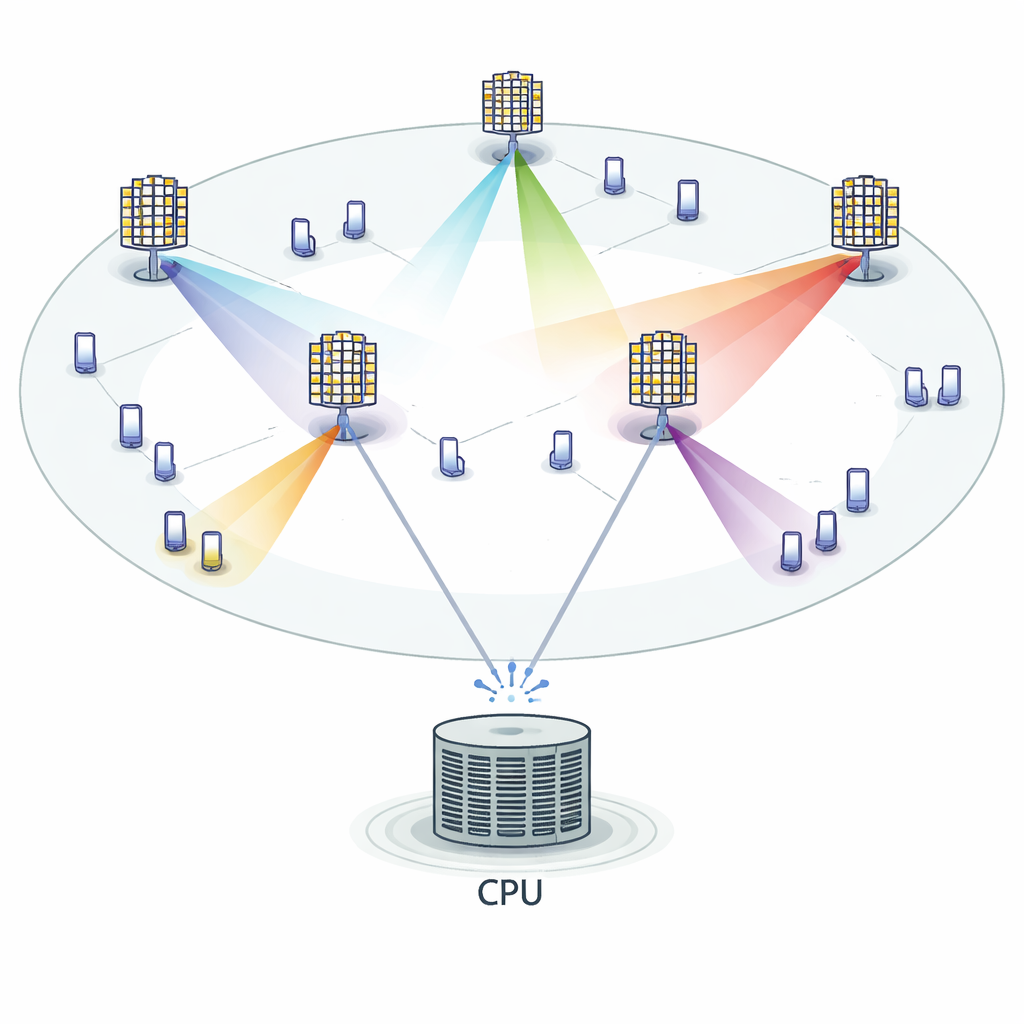
Traditional cellular systems picture a single tall base station with a large array of antennas serving many users at once. In a distributed massive MIMO setup, that big tower is replaced by several smaller base stations, each with its own group of antennas, spread around the area and coordinated by a central controller. Because each small station sits closer to the users it serves, signals arrive stronger and cleaner, and the system can react better to heavy traffic in crowded spots like stadiums or city centers. The study confirms through analysis and simulations that this distributed layout can deliver higher data rates than a single, co-located antenna array using the same total hardware.
Using both analog knobs and digital brains
At millimeter-wave frequencies, antennas are tiny, so it is possible to install dozens or even hundreds of them. The catch is that giving each antenna its own full set of digital electronics would be extremely costly and power-hungry. The authors address this by combining two types of control. Analog precoding uses simple hardware, such as phase shifters, to steer beams in desired directions. Digital precoding, done in baseband processors, fine-tunes the signals to different users. This “hybrid precoding” shares the work: analog parts provide coarse steering at low cost, while digital parts handle precise adjustments. The research focuses on a fully connected design, where each digital path can reach all antennas through analog circuitry, offering great flexibility with far fewer electronics than an all-digital solution.
Turning interference into near silence
When many users are served at once, their signals can interfere with each other and lower everyone’s speed. The paper shows that in a system with a large number of antennas arranged in a simple line, and carefully chosen beam directions, the channels to different users become almost mathematically independent. In plain terms, the antennas can shape beams so narrowly that each user “hears” mostly their own signal and very little from others. This result lets the authors treat interference as negligible when they compute how much information the system can carry, and it explains why adding more antennas in this architecture can keep boosting performance instead of creating chaos.
A two-step tuning method for faster data
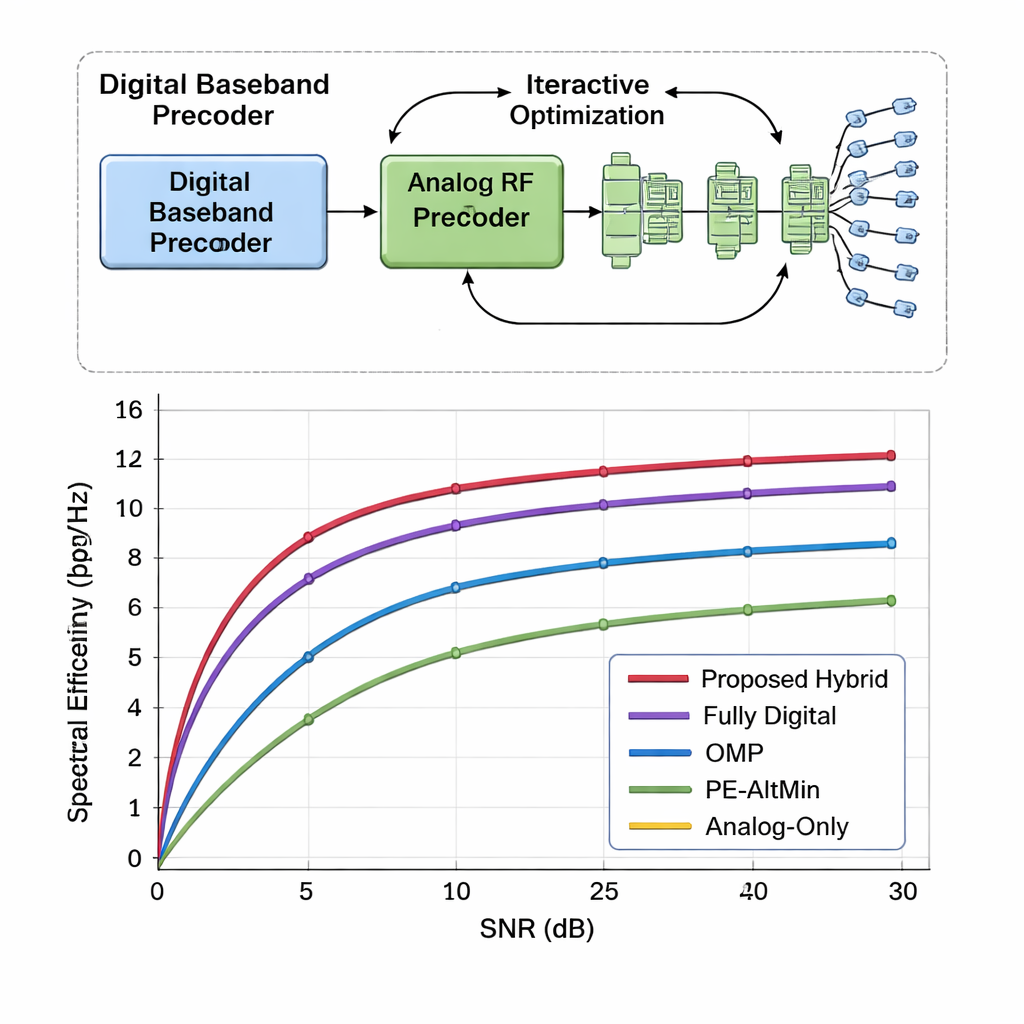
Designing the best possible hybrid precoder is a tough mathematical problem, because the analog and digital parts are tightly coupled and there are strict limits on total transmit power. The authors propose a two-stage iterative algorithm to tackle this. In the first stage, they assume the analog beam-steering network is fixed and compute the best digital settings that maximize total data rate under the power limit. In the second stage, they treat those digital settings as given and update the analog steering matrix. By repeatedly alternating between these two steps, and by using standard optimization tools known as Karush–Kuhn–Tucker (KKT) conditions, the method converges to a design that delivers very high spectral efficiency—meaning many bits per second per hertz of spectrum.
Bringing near-ideal speeds with less hardware
Computer simulations under realistic millimeter-wave channel models show that the proposed scheme consistently outperforms several well-known hybrid and analog beamforming methods, and even closes in on the performance of a theoretical fully digital system. The gains are especially strong when the number of radio-frequency chains (the expensive part of the hardware) is about twice the number of data streams, a practical ratio for future base stations. At the same time, splitting the base station into coordinated small cells cuts the processing burden at each site and improves coverage. For non-specialists, the key takeaway is that by cleverly sharing work between simple analog beam-steering and smarter digital processing, and by distributing antennas across many small base stations, it is possible to squeeze much more capacity out of the same spectrum without exploding cost and power use.
Citation: Rajaganapathi, R., Senthilkumar, S., Alabdulkreem, E. et al. Improving spectral efficiency in distributed massive MIMO in multi-user downlink millimeter wave. Sci Rep 16, 6325 (2026). https://doi.org/10.1038/s41598-026-37016-w
Keywords: millimeter wave, massive MIMO, hybrid precoding, distributed antennas, spectral efficiency