Clear Sky Science · en
Dynamics of soliton propagation: bifurcation, chaos, and quantitative insights into the modified Camassa–Holm equation
Waves That Refuse to Break
Imagine an ocean wave that travels for miles without losing its shape, slipping past other waves as if nothing happened. These stubborn waves, called solitons, show up not only in water but also in plasmas, optical fibers, and even mechanical systems. This paper explores how such waves move and sometimes become chaotic in a widely used mathematical water‑wave model, revealing patterns that could help engineers better predict and control complex wave behavior in nature and technology.
A Modern Blueprint for Shallow-Water Waves
The study focuses on the modified Camassa–Holm (MCH) equation, a powerful model for waves in shallow water channels and related physical settings. Earlier versions of this family of equations helped explain surprising “peakons” – solitary waves with a sharp, pointed crest that mimic real breaking waves more closely than classic textbook models. Over the years, researchers have tweaked these equations to capture richer behaviors, from smooth bell-shaped pulses to waves that steepen and break. Yet, getting many exact, mathematically clean solutions has remained difficult, limiting our ability to understand all the possible wave shapes and their stability.
A New Tool for Building Exact Wave Shapes
To tackle this challenge, the authors use a refined analytical scheme called the modified (G′/G)-expansion (MG′/GE) method. In simple terms, they convert the original equation for waves in space and time into a single “traveling coordinate” that moves with the wave. This turns a complicated partial differential equation into a more manageable ordinary differential equation. The MG′/GE method then assumes a flexible series form for the wave and determines the coefficients by balancing terms and solving a set of algebraic equations. This framework is versatile: by adjusting a few parameters, it can generate many different types of solutions within one unified recipe, rather than needing a new trick for each new wave shape.
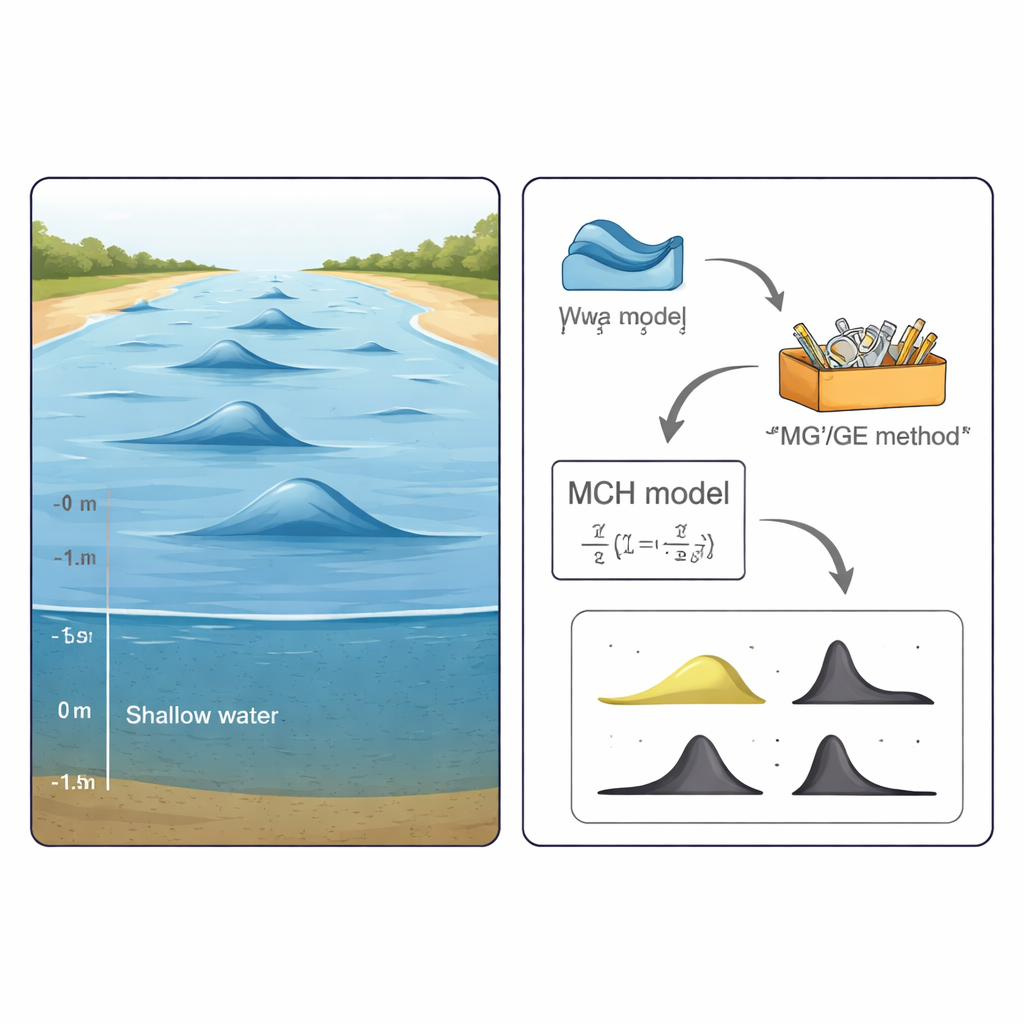
A Zoo of Solitons: From Smooth Pulses to Singular Spikes
Using this method, the paper uncovers about thirty distinct traveling-wave solutions of the MCH equation. These include bright solitons (isolated peaks above a flat background), dark solitons (localized dips in an otherwise uniform level), and more exotic “singular” solitons in which the wave height becomes extremely steep or effectively unbounded at a point. There are single and double singular solitons, as well as multiple bright, dark, and singular configurations. Some solutions are expressed through hyperbolic functions (waves that look like isolated humps), others through trigonometric functions (more oscillatory waves), and still others through rational forms (featuring sharper transitions). Detailed 3D surfaces, contour maps, density plots, and time‑evolution graphs show how these structures travel, interact, and concentrate energy in space and time.
When Order Turns to Chaos
Beyond listing wave shapes, the authors ask how stable these patterns are and how the system behaves when it is gently disturbed. They recast the traveling-wave equation as a two‑variable dynamical system and analyze its fixed points, or equilibrium states, using tools like Jacobian matrices and eigenvalues. As a key speed parameter changes, the system undergoes a pitchfork bifurcation: a single equilibrium splits into three, some stable and others unstable. Phase‑plane portraits map out the possible paths the system can follow, while bifurcation diagrams show how long‑term behavior shifts with parameters. The team then adds different types of time‑dependent “forcing” – such as sine, cosine, Gaussian, and hyperbolic terms – and tracks the resulting motion using phase portraits, Poincaré sections, time series, and Lyapunov‑style ideas. Depending on the forcing, the system can settle into regular cycles, drift into quasi‑periodic torus‑like motion, or become unstable and unbounded, offering a clear visual guide to how structured wave trains can tip toward complex or chaotic behavior.
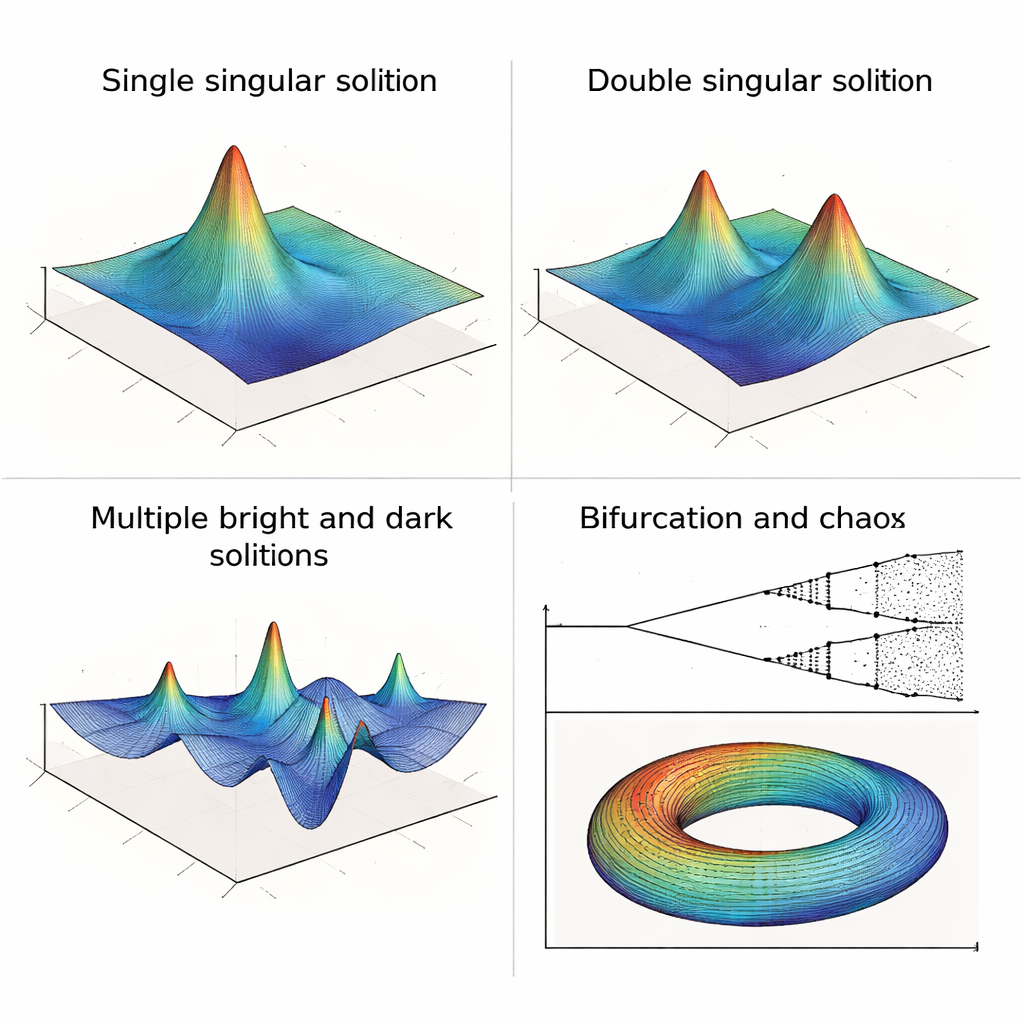
Why These Findings Matter
For non‑specialists, the takeaway is that this study provides a kind of “map and toolkit” for a widely used wave equation. The authors show how a single analytical method can produce a rich catalog of exact soliton shapes, confirm that many of them are stable to small disturbances, and pinpoint when the underlying dynamics are likely to become irregular or chaotic. Because the same mathematical structures appear in coastal engineering, fiber‑optic communication, plasma devices, and other technologies, these insights can help researchers design systems that either harness robust solitary waves for carrying energy and information or avoid destructive wave regimes. The work also sets the stage for future extensions to more realistic situations, such as materials with memory, random influences, or higher dimensions.
Citation: Alam, M.N., Ahmed, S.F., Ismael, H.F. et al. Dynamics of soliton propagation: bifurcation, chaos, and quantitative insights into the modified Camassa–Holm equation. Sci Rep 16, 7588 (2026). https://doi.org/10.1038/s41598-026-37010-2
Keywords: solitons, shallow water waves, nonlinear dynamics, chaos and bifurcation, Camassa–Holm equation