Clear Sky Science · en
Comparative evaluation of QuEChERS and the ‘dilute and shoot’ QuPPe extraction methods coupled with LC-MS/MS for the analysis of mepiquat residue in sweet potatoes: addressing residual soil impact on recovery efficiency
Why this matters for your dinner plate
Sweet potatoes are often seen as a wholesome, safe staple, but tiny traces of farming chemicals can still hitch a ride from field to fork. This study asks a simple but important question: when inspectors test sweet potatoes for a growth‑controlling chemical called mepiquat, are they actually measuring what is in the food, or are soil smears on the skin quietly distorting the results? The answer affects both consumer safety in Europe and the livelihoods of Egyptian farmers who export this crop.
Growth helper with a safety question
Mepiquat is a plant growth regulator that helps keep crops from growing too tall and top‑heavy, improving yield and harvestability. Because it dissolves very easily in water and carries an electrical charge, it behaves differently from many common pesticides. The European Union sets strict maximum residue limits—very low allowed amounts on foods—and in 2023 a European reference laboratory reported mepiquat levels in Egyptian sweet potatoes that were twice the EU limit. To respond, Egyptian scientists needed a fast, trustworthy way to measure this chemical so that exports could be monitored and, if needed, cleaned up.
Two lab routines, one tricky tuber
Food safety labs use standard preparation steps before a sample goes into a sensitive instrument. One popular routine, nicknamed QuEChERS, is quick and cost‑effective and can extract hundreds of pesticides at once. Another, called QuPPe, is a simpler “dilute and shoot” approach designed especially for very water‑loving chemicals like mepiquat. The team compared these two approaches on sweet potato samples using the same high‑end measuring device (LC‑MS/MS), asking which method gave accurate and repeatable mepiquat readings.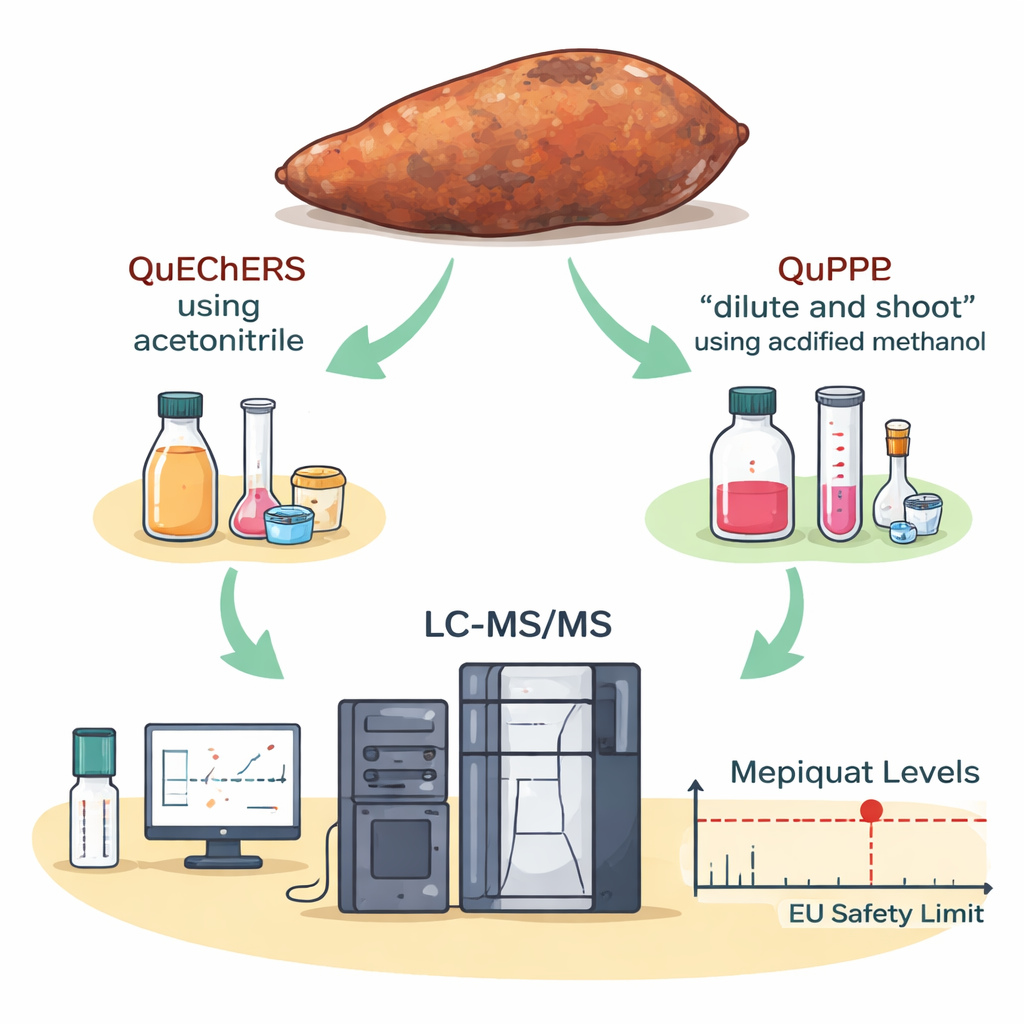
Soil that sticks—and steals the signal
Early tests using the QuEChERS method produced wobbly results, with recovery of added mepiquat swinging from about one‑third to just under three‑quarters of what was expected. The scientists suspected that the thin film of soil that clings to sweet potatoes was trapping mepiquat and throwing off the measurements. They modeled how washing under running water removes soil and found that, even after ten minutes, a notable fraction remains. Worse, washing real contaminated sweet potatoes for that long washed away about 30% of the pesticide itself, meaning the test would underestimate what consumers might actually eat. Experiments that deliberately added measured amounts of two common Egyptian soil types—sandy loam and clay loam—confirmed that recovery fell as more soil was present, especially for sticky clay loam.
Finding the more reliable test
When the same soil‑spiked sweet potatoes were processed with the QuPPe method, the measurements were much less disturbed by soil. Across a range of soil amounts, QuPPe gave higher and more stable recoveries than QuEChERS, and clay soils had a milder effect. The researchers then put QuPPe through a full set of performance checks: they showed that the method clearly separated mepiquat from other substances in the sweet potato, gave nearly identical results when repeated across days, and stayed accurate down to very low levels that match or beat EU regulatory limits. Any small interference from the natural sweet potato matrix was controlled by calibrating with treated sweet potato extracts rather than pure solvent.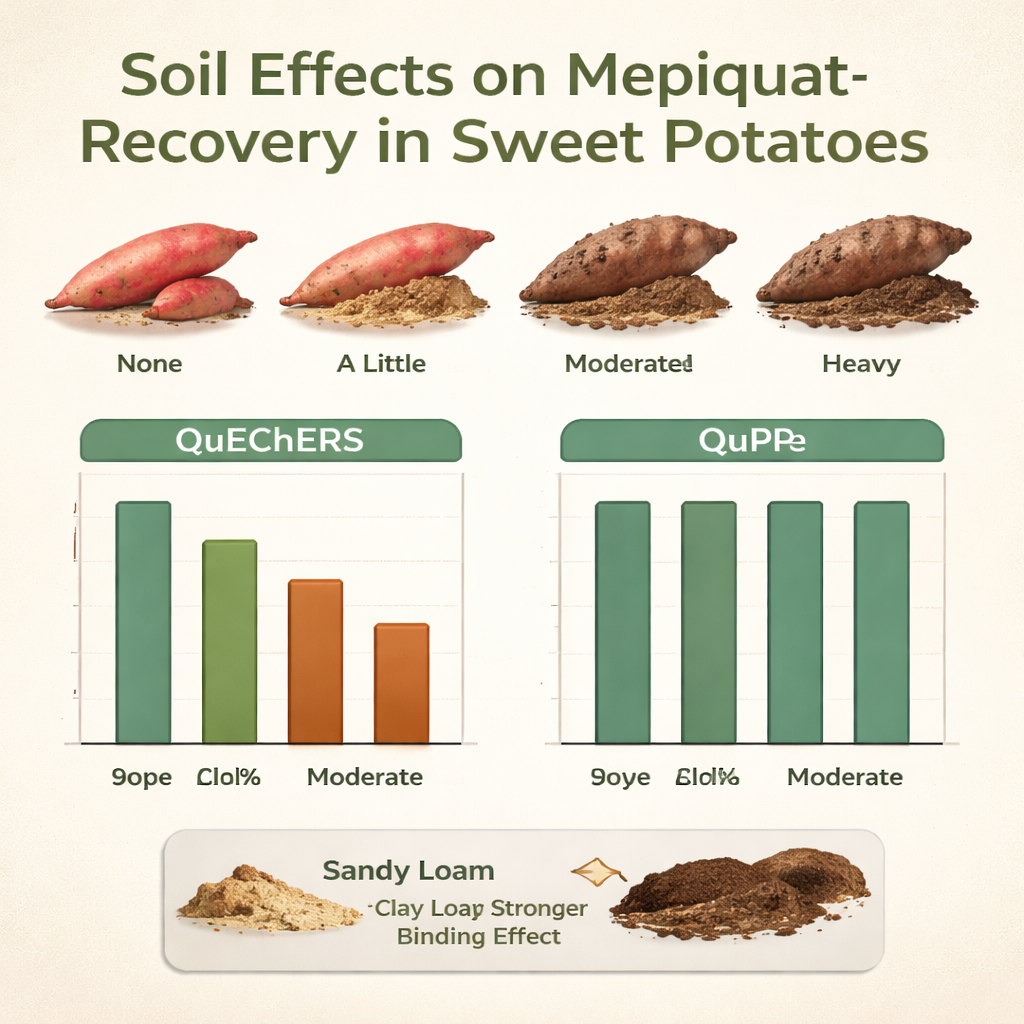
What they found in real market samples
Armed with this validated method, the team tested thirty sweet potato samples from markets in Giza, Egypt. Only four contained detectable mepiquat. Of these, three were at or near the European legal limit once normal uncertainty in measurement was taken into account, while one sample clearly exceeded the limit. While this small survey cannot represent all Egyptian production, it suggests that most tested sweet potatoes were either clean or only lightly contaminated, but that occasional problem lots do occur and should be identified.
What it means for consumers and farmers
For non‑specialists, the main message is that how a food sample is prepared in the lab can change the apparent amount of pesticide many times over, especially when soil clings to root crops. This study shows that for the particular case of mepiquat in sweet potatoes, gentle dry brushing to remove soil, followed by the QuPPe “dilute and shoot” method, gives a more honest picture than heavy washing and standard multi‑pesticide routines. That, in turn, helps regulators protect consumers with realistic numbers and helps exporting farmers demonstrate that their crops meet strict international standards without being penalized by misleading tests.
Citation: Wageed, M., Mahmoud, H.A., Abdel-Megeed, M.I. et al. Comparative evaluation of QuEChERS and the ‘dilute and shoot’ QuPPe extraction methods coupled with LC-MS/MS for the analysis of mepiquat residue in sweet potatoes: addressing residual soil impact on recovery efficiency. Sci Rep 16, 6352 (2026). https://doi.org/10.1038/s41598-026-37007-x
Keywords: mepiquat, sweet potatoes, pesticide residues, soil effects, LC-MS/MS