Clear Sky Science · en
Weighted average algorithm adjusted a novel (1 + FOPI)-FOPI-TID controller structure for AGC with integration of non-linearities and cyber-attack
Keeping the Lights Steady in a Changing Grid
As our electricity grids absorb more diverse power sources and more digital technology, keeping the lights on becomes a delicate balancing act. This paper explores how to keep grid frequency stable—a key measure of grid health—when power comes from a mix of thermal, hydro, gas, and nuclear plants, all connected by long transmission lines and controlled over vulnerable communication networks. The authors propose a smarter automatic control method that not only smooths out everyday swings in demand but also resists sophisticated cyber-attacks aimed at destabilizing the grid.
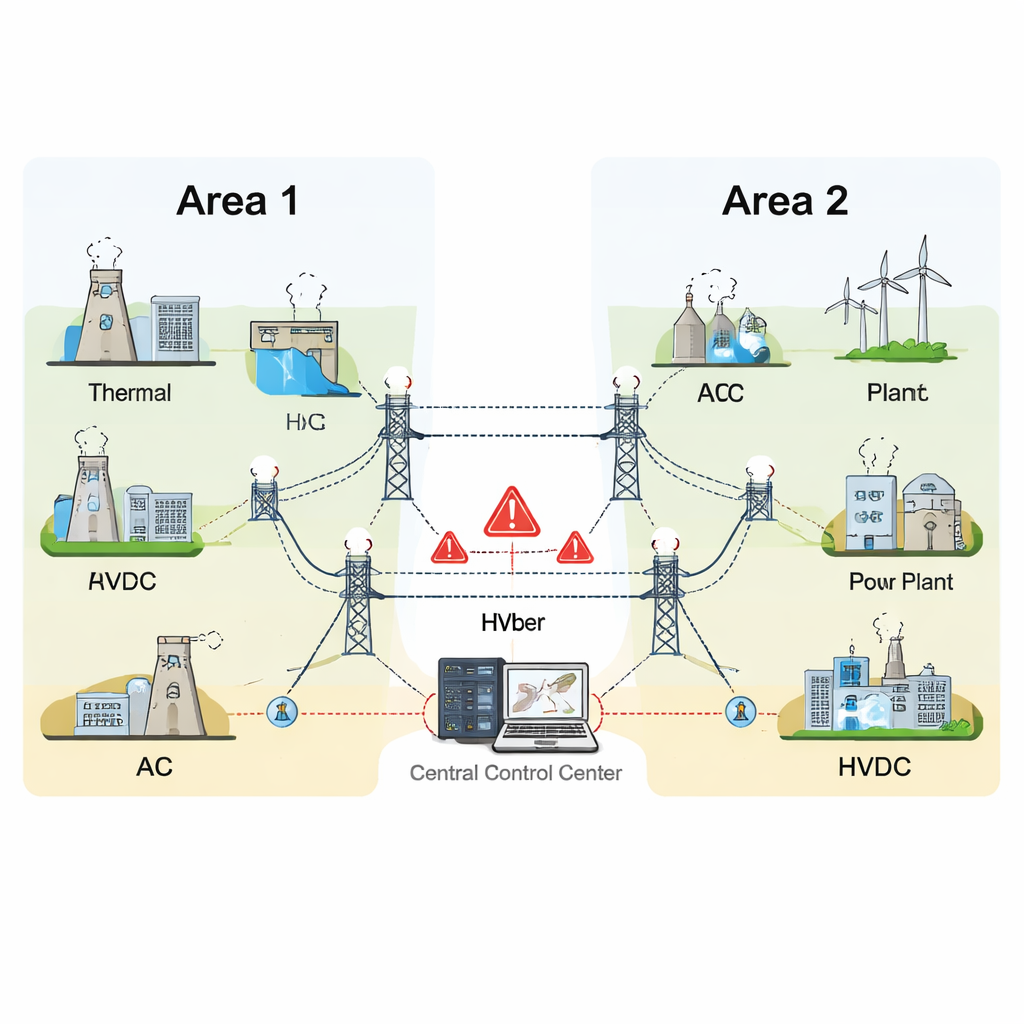
Why Grid Frequency Matters
Electric power systems must constantly balance how much electricity is generated with how much is used. If demand suddenly rises or a generator trips offline, the grid frequency (typically 50 or 60 hertz) starts to drift. Even small, prolonged deviations can stress equipment and, in extreme cases, cause cascading blackouts. Traditionally, this balancing job—known as automatic generation control—relies on relatively simple controllers that adjust power plant outputs based on measured frequency and power flows between regions. But today’s grids are more complex: they mix different kinds of plants, include high-voltage direct current (HVDC) links, and exhibit many nonlinear behaviors like slow boiler responses and limits on how fast generators can ramp up or down.
Real-World Complications and Cyber Threats
The authors build a detailed computer model of a two-region power system that mirrors these real-world complications. Each region combines reheat thermal units, hydropower, gas turbines, and nuclear plants, all tied together through both AC and HVDC lines. The model explicitly includes technical quirks that many studies simplify away: “governor dead bands” that ignore tiny frequency changes, physical limits on ramping power up or down, sluggish boiler dynamics, and inevitable communication delays. On top of these physical issues, the team introduces a resonance-based cyber-attack. In this scenario, an attacker subtly manipulates load signals in a way that aligns with the grid’s natural oscillations, creating dangerous frequency swings while staying within ranges that might slip past conventional alarms. This dual focus on physical nonlinearities and cyber-physical attacks aims to test controllers under conditions much closer to those of a future smart grid.
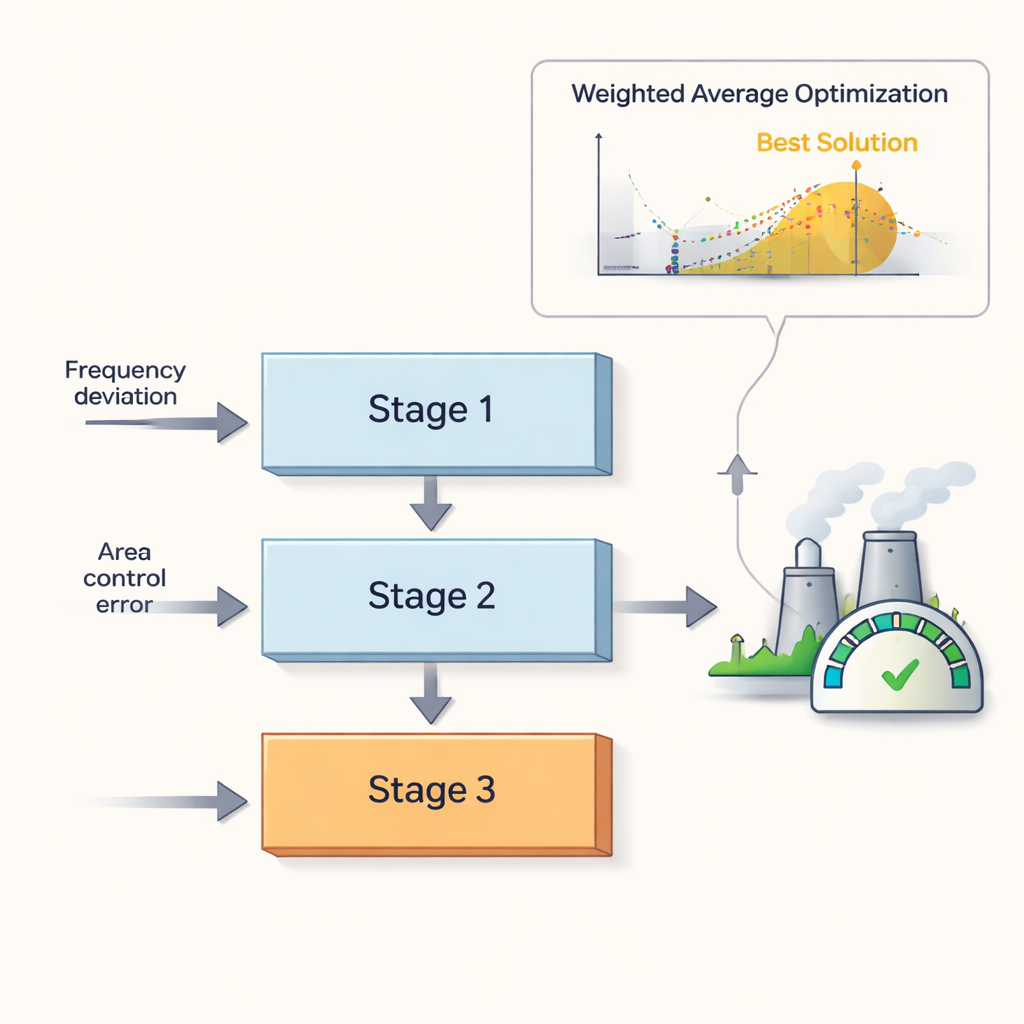
A New Multi-Stage Digital "Guardian"
To handle these challenges, the paper proposes a new three-stage control scheme that acts like a digital guardian for grid stability. Instead of a single, one-size-fits-all feedback loop, the design separates fast local reactions from slower, system-wide corrections. One input tracks quick frequency deviations in each region, while another—called the area control error—tracks both frequency and power flows between regions. These signals feed three cascaded stages that work together to damp oscillations, remove long-lasting errors, and shape the overall response. The controller uses fractional-order mathematics, which allows more flexible tuning than standard proportional–integral–derivative (PID) designs, and includes a special “tilt” component to spread damping over a wide range of frequencies.
Letting an Algorithm Do the Fine-Tuning
Because this controller has many adjustable parameters, hand-tuning it would be impractical. Instead, the authors rely on a recently developed optimization method called the weighted average algorithm. This metaheuristic works with a population of trial settings and repeatedly nudges them toward better performance, guided by a weighted average of the best candidates rather than complex random rules. The quality measure it seeks to minimize penalizes both the size and the duration of frequency and tie-line power deviations after a disturbance. In extensive simulations—covering small and large load changes, random step-like variations, and cyber-attacks—the optimized three-stage controller consistently outperforms several advanced alternatives drawn from recent literature.
What the Improvements Mean in Practice
The results show marked gains in how quickly and smoothly the system recovers from disturbances. Compared with leading existing designs, the new controller reduces a standard error measure by about 45 percent and shortens frequency settling times in the two regions by nearly half and one-third, respectively. It remains effective even when key system parameters are shifted by 25 percent, suggesting it could handle changing operating conditions and modeling errors. Under cyber-attack, it limits the rate at which frequency changes better than all other tested schemes, an important marker for preventing automatic protection devices from triggering unnecessary, potentially harmful shutdowns. For a layperson, this means the proposed method could help future smart grids ride through both everyday demand swings and malicious digital interference with fewer flickers, less stress on equipment, and a lower risk of large-scale blackouts.
Citation: Awal, M., Atim, M.R., Wanzala, J.N. et al. Weighted average algorithm adjusted a novel (1 + FOPI)-FOPI-TID controller structure for AGC with integration of non-linearities and cyber-attack. Sci Rep 16, 6953 (2026). https://doi.org/10.1038/s41598-026-37004-0
Keywords: power grid stability, load frequency control, smart grid cybersecurity, automatic generation control, optimization algorithms