Clear Sky Science · en
A genetic algorithm-based ensemble framework for wind speed forecasting
Why predicting the wind matters
Wind power is one of the fastest-growing sources of clean energy, but the wind itself is famously fickle. Power plant operators must constantly decide how hard to run each turbine, when to schedule maintenance, and how much backup power to keep on standby. Doing this well depends on knowing how wind speed will change from one minute to the next. This paper presents a new way to combine several forecasting methods so that, together, they make more accurate and reliable short-term wind predictions.
Turning many simple forecasts into one strong guide
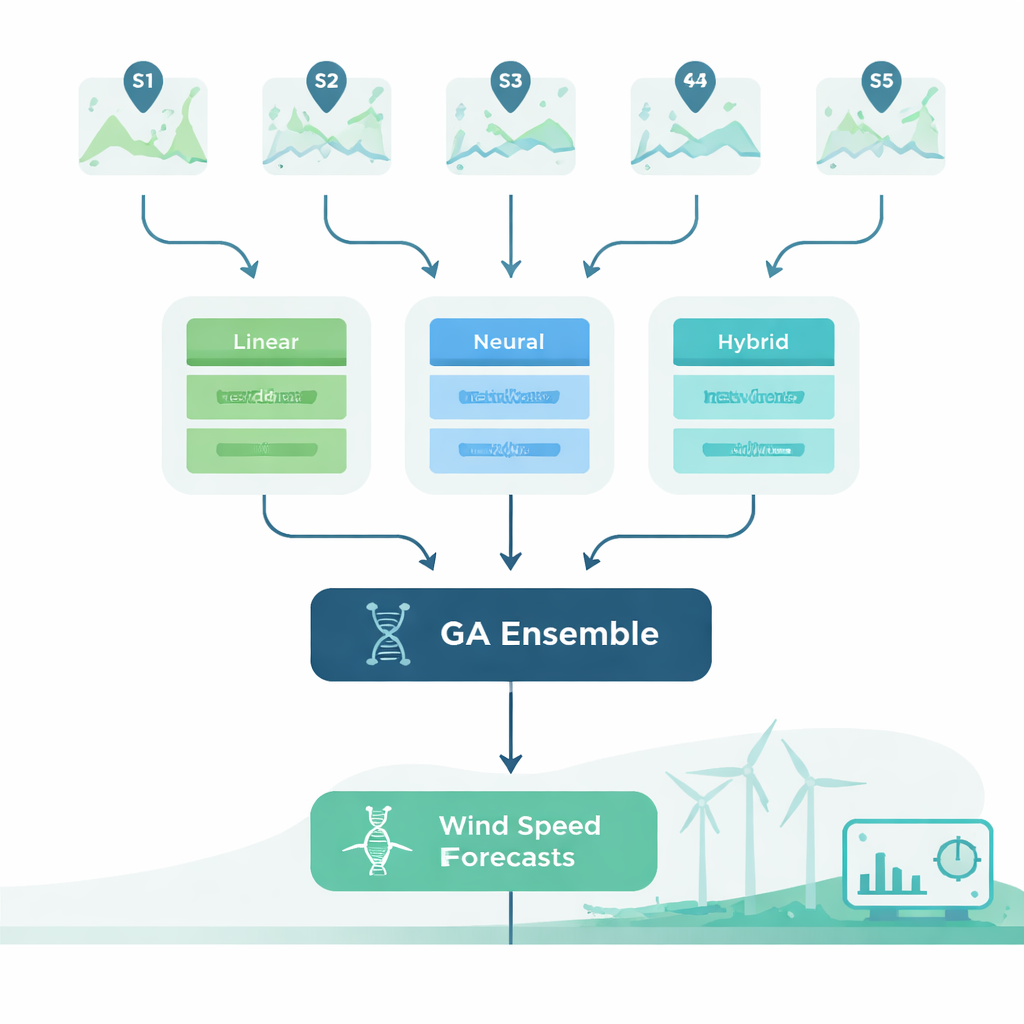
Instead of betting on a single forecasting method, the authors build an “ensemble” that blends the strengths of different approaches. They include classic statistical tools that are good at capturing smooth trends, several types of neural networks that can recognize complex patterns, and hybrid methods that try to correct remaining errors. Each method looks at minute‑by‑minute wind speed data from five Brazilian cities and produces its own prediction. The central idea is that while each model has weaknesses, their errors are not identical; if combined wisely, they can cancel out one another’s mistakes and give a clearer view of what the wind will do next.
Borrowing ideas from evolution
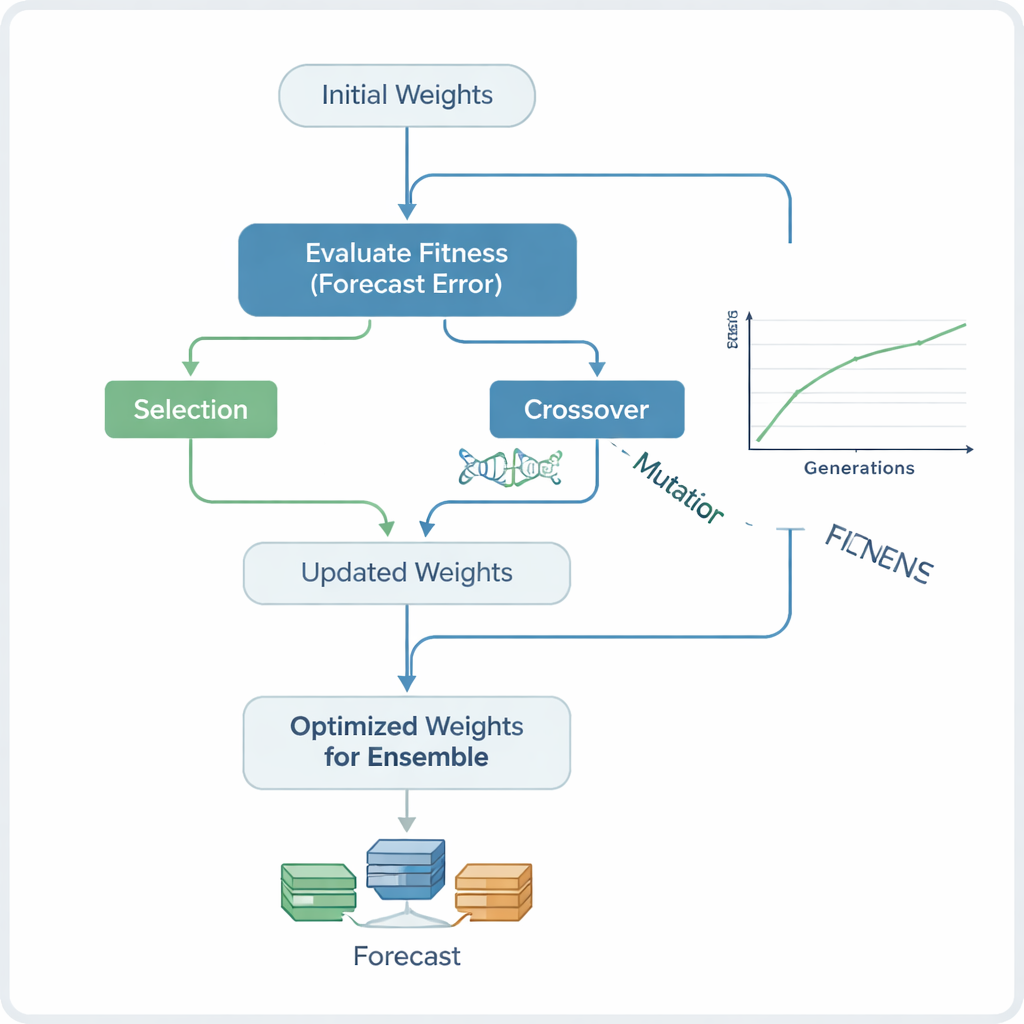
The key challenge is how to decide how much trust to place in each forecasting method at any moment. To tackle this, the authors turn to a genetic algorithm, a search technique inspired by natural evolution. In this system, every possible way of weighting the models is like a candidate “organism” with its own DNA. The algorithm evaluates how well each weighting strategy predicts past wind speeds, favors the best candidates, mixes them, and introduces small random changes. Over many generations, the population of solutions “evolves” toward a set of weights that makes the combined forecast as accurate as possible, without requiring detailed mathematical assumptions about how the models interact.
Testing across Brazil’s diverse winds
To see if this strategy works in realistic conditions, the team used one month of minute‑by‑minute measurements from five locations that span Brazil’s varied climate: inland highlands, flat interior regions, riverfront, and ocean coasts. They compared 14 forecasting setups: pure statistical models, different neural networks, hybrids, and several ways of combining them. For each city, they trained the methods on most of the data, set aside a portion to fine‑tune settings, and then tested performance on unseen records. They measured accuracy using common yardsticks: how large the typical error was, how strongly predictions matched actual data, and whether any observed advantages might be due to chance.
Small numerical gains, big practical impact
The genetic‑algorithm ensemble delivered the most accurate predictions across all five cities. Its error levels were slightly but consistently lower than those of every rival method, and it explained a larger share of the ups and downs in wind speed. Statistical tests confirmed that these improvements are unlikely to be random. Although the numerical gains may appear modest—often on the order of one percent—they matter because forecasts are updated every minute. Over thousands of decisions, even small reductions in error help turbine controllers adjust blade angle and generator torque more smoothly, reducing mechanical stress, avoiding unnecessary shutdowns, and improving the amount of usable energy captured from each gust.
Fast enough for real-time control
Another concern with sophisticated forecasting systems is speed: can they keep up with real-world operations? Here the authors report that, once the genetic algorithm has done its off-line training, using the optimized weights to merge model outputs takes a tiny fraction of a millisecond. Most of the computing time is spent in the underlying models, not in the combining step itself. This means their scheme can be plugged into real-time control systems without delaying decisions, even as it draws on a rich mix of forecasting tools.
What this means for clean energy
In plain terms, the study shows that letting different forecasting methods “vote,” and learning how much to trust each one using an evolution-inspired search, can make wind power slightly more predictable and much more dependable. For grid operators and wind farm owners, that translates into better planning, smoother turbine operation, and fewer surprises. While the work focused on five Brazilian sites over one month, the approach is general: the same ensemble framework could be trained for other regions, longer time spans, or even other renewable resources such as sunlight and river flow, helping the broader transition to a cleaner and more stable energy system.
Citation: Barchi, T.M., dos Santos, J.L.F., Alves, T.A. et al. A genetic algorithm-based ensemble framework for wind speed forecasting. Sci Rep 16, 6847 (2026). https://doi.org/10.1038/s41598-026-37003-1
Keywords: wind energy, time series forecasting, genetic algorithms, neural networks, renewable energy prediction