Clear Sky Science · en
Research on the structural parameters of loess based on shear strength
Why the Strength of Wind-Blown Soils Matters
Across northern China and many other parts of the world, towns, roads, and dams are built on thick blankets of wind-blown silt called loess. This soil can stand in near-vertical cliffs when dry, yet weaken dramatically when it gets wet or disturbed, leading to landslides, collapses, and foundation failures. The paper summarized here asks a practical question with big safety implications: can we describe the hidden "structure" of loess in a way that directly tells us how strong it will be under real-world loads, rather than only in idealized lab conditions?
A New Way to Describe Hidden Soil Structure
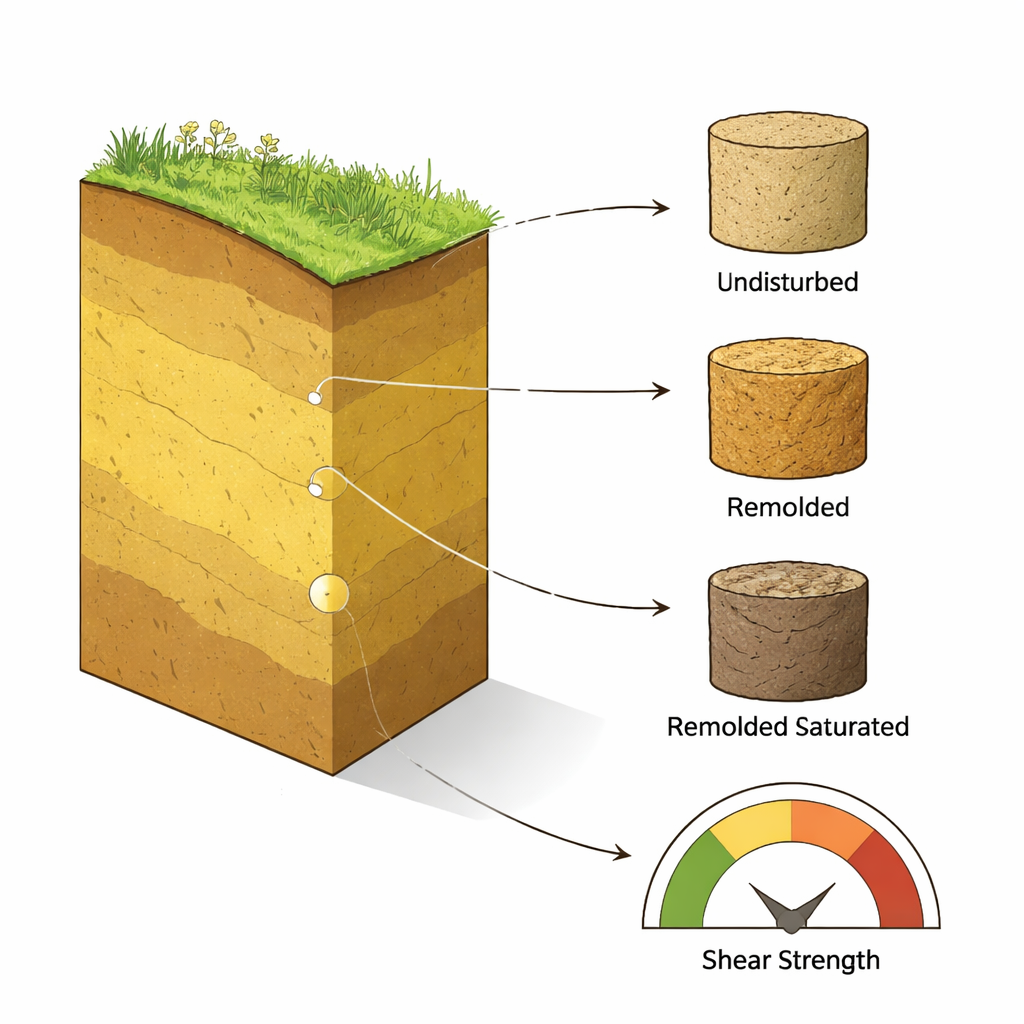
Engineers have long known that the way soil grains are packed and bonded together – its internal structure – strongly influences how it behaves. Traditional measures of loess structure were mostly based on how much a sample squashes or deforms in compression tests. Those methods work in simple loading situations, but they depend heavily on how the test is run and do not match the complicated stress paths that soils experience in the ground. The authors instead focus on shear strength – the resistance of soil to sliding and failure – and define a new “complex stress structural parameter.” This parameter compares the shear strength of intact loess with that of the same soil after it has been thoroughly remolded and saturated with water, capturing how much strength is lost when the original structure is destroyed.
Testing How Water and Packing Change Soil Strength
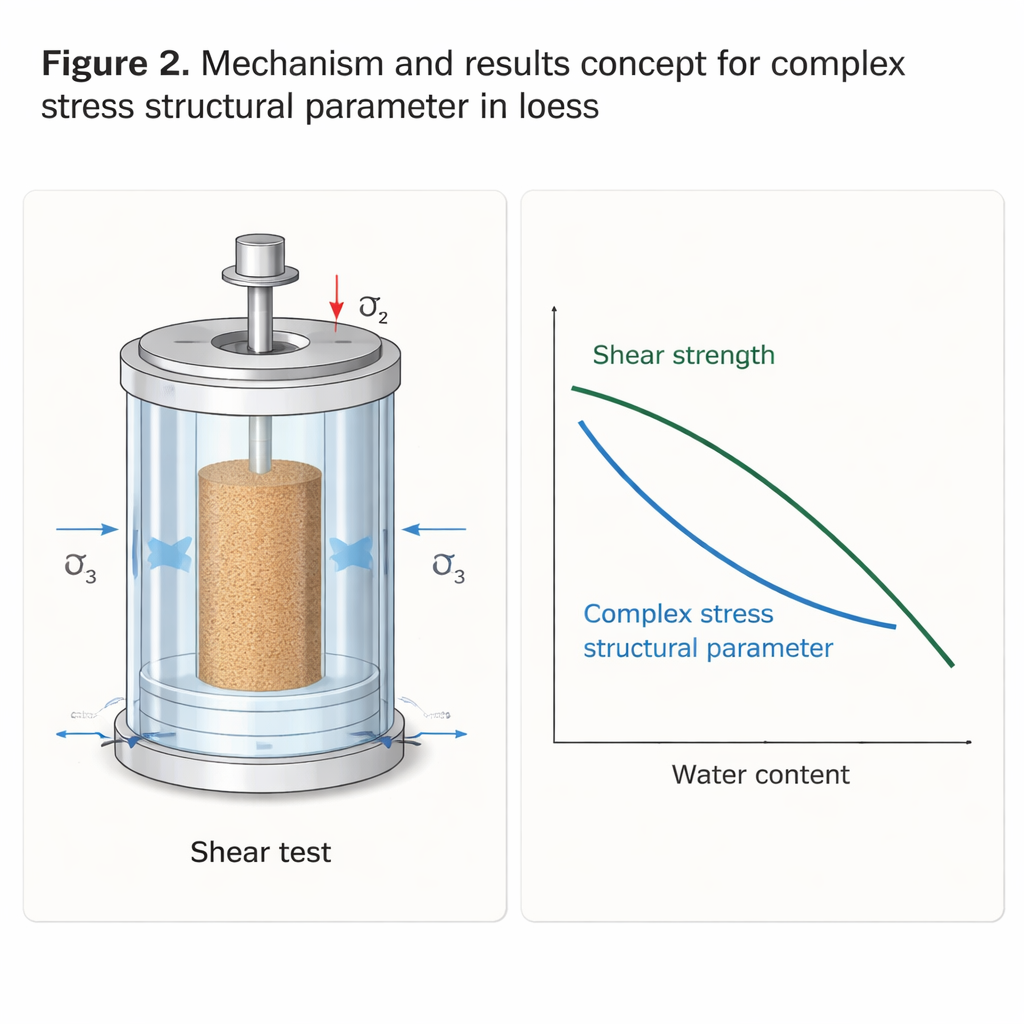
To build and test their new measure, the team collected undisturbed loess samples from several depths in Shaanxi Province, China. They tested intact samples, remolded samples, and remolded saturated samples in a triaxial shear apparatus, which can apply controlled squeezing and shearing similar to what soils experience under foundations or slopes. They varied two key factors: water content (from very dry to fully saturated) and dry density (how tightly the grains are packed). From each test they extracted familiar strength indicators – cohesion and internal friction – and then used these to calculate the new structural parameter for different stress conditions.
What Happens as Loess Gets Wetter or More Compact
The results confirm everyday observations in a quantitative way. As loess becomes wetter, its shear strength falls: cohesion drops sharply, and the friction between grains decreases more gently. At the microscopic level, extra water dissolves the carbonate “glue” between particles and forms thicker water films that act like a lubricant, so grains slide more easily. The new structural parameter declines in step with this process, especially as water content rises from low to moderate levels, showing that the soil’s distinctive structure is rapidly weakened by moisture. In contrast, when the soil is packed more densely, both cohesion and friction increase and the overall shear strength rises. Yet the structural parameter actually decreases with higher density, because loose, porous loess has more “structural potential” to lose when it is disturbed, whereas tightly compacted loess is already closer to a stable, low-variability state.
Checking That the New Measure Is Robust
A key test of any engineering index is whether it behaves consistently under different conditions. The authors show that when they combine shear strength with their structural parameter, the resulting curves for many different water contents and densities fall into narrow bands and follow smooth mathematical trends. In other words, the parameter changes in a stable, predictable way rather than jumping around with each new test setup. They also find that the way the parameter varies mirrors the way peak strength varies: when the intact soil is stronger, the parameter is higher, and when water or compaction reduces the contrast between intact and remolded states, the parameter falls. This suggests that the new measure truly captures an intrinsic material property rather than just an artifact of a particular experiment.
What This Means for Building on Loess
For non-specialists, the takeaway is that the authors have created a simple number that ties the invisible internal fabric of loess directly to the strength engineers care about, even under complex loading. Unlike older indices, it can be applied not only to stiff, intact loess but also to sands and soft clays that cannot be tested in simple compression, and it can be evaluated using common field or laboratory shear tests. In practical terms, this offers designers a more reliable way to estimate how much strength will be lost when loess becomes wet or disturbed, and to incorporate that loss into models of slopes, tunnels, and foundations. By treating structure as a strength-based material property rather than just a deformation pattern, the study brings soil mechanics a step closer to the real behavior of the ground we build on.
Citation: Wu, Xj., Dang, Fn., Wang, Jq. et al. Research on the structural parameters of loess based on shear strength. Sci Rep 16, 6138 (2026). https://doi.org/10.1038/s41598-026-37002-2
Keywords: loess soil, shear strength, soil structure, water content, dry density