Clear Sky Science · en
High- and low-fidelity modal and mechanical analysis of architected strut-based lattice structures with auxetic topologies
Building Materials from Tiny Repeating Patterns
What if the strength, flexibility, and even vibration of a material were set not by what it’s made of, but by the tiny shapes inside it? This study explores exactly that idea, looking at 3D "lattice" materials built from repeating networks of thin struts. Some of these lattices behave in surprising ways – for example, they get fatter instead of thinner when you stretch them. Understanding how these architectures bend, vibrate, and absorb energy could change how we design aircraft parts, medical implants, and impact‑resistant structures.
Why Shape Matters More Than Substance
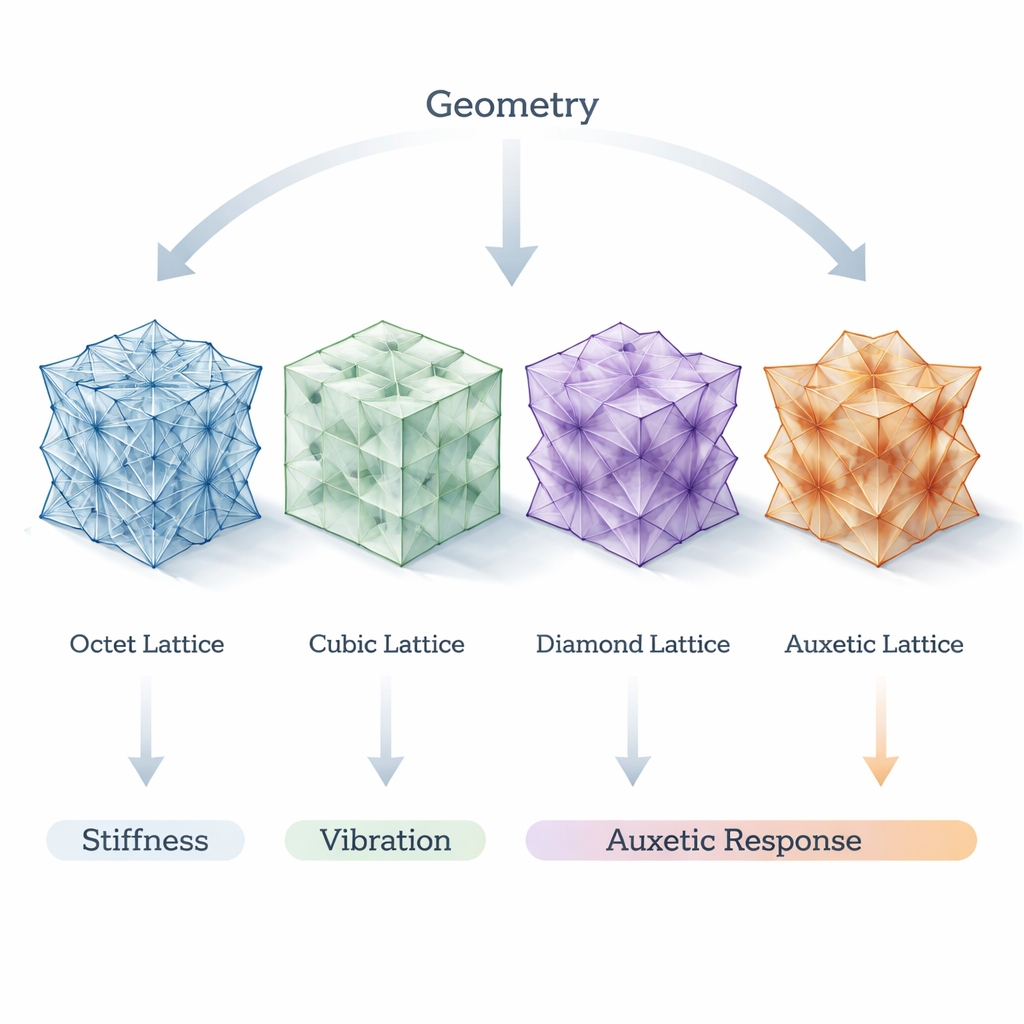
Traditional engineering focuses on picking the right metal, plastic, or ceramic to get the needed strength and stiffness. Architected lattices flip this script: they use ordinary base materials but arrange them into repeating 3D frameworks that can be much lighter, stronger, or more adaptable than solid blocks. In this work, the researchers studied eleven different lattice “unit cells,” including simple cubes, the well‑known octet and diamond patterns, and several double‑pyramid designs that can show auxetic behavior – meaning they expand sideways when stretched or contract sideways when compressed. By changing the internal geometry while keeping the same base material and the same overall amount of solid volume, they could see how shape alone tunes mechanical performance.
Testing Virtual Materials in the Computer
Instead of building and breaking real samples, the team relied on detailed computer simulations using the finite element method. They created high‑fidelity models that explicitly include every strut and joint, and low‑fidelity “homogenized” models that treat the lattice as if it were a smooth, continuous material with equivalent overall properties. To make that simplification trustworthy, they first simulated a single repeating block (a representative volume element) under carefully controlled loading, extracted its effective stiffness and density, and then fed those values into the smooth models. This allowed them to compare how closely the simplified versions could mimic the detailed ones when predicting properties like stiffness, sideways expansion, and natural vibration frequencies.
From Uniform Strength to Directional and Auxetic Behavior
The different lattices fell into two broad categories. Some, like the octet and diamond patterns and several cubic variants, behaved almost the same in every direction: they were effectively isotropic, with similar stiffness and deformation no matter how they were loaded. Others, including modified cubic cells and the double‑pyramid families, were anisotropic, meaning they were stiffer in some directions than others. Certain double‑pyramid designs with cross braces or missing lateral members showed auxetic behavior in the plane: when compressed, they squeezed inward sideways instead of bulging out. The simulations also revealed that gently rounding sharp corners in the joints with small fillets significantly increased stiffness and improved how forces flowed through the structure, without adding noticeable extra mass. In practical terms, tiny geometric tweaks at the junctions can make these lightweight materials both stronger and more reliable.
How These Lattices Vibrate and Why It Matters
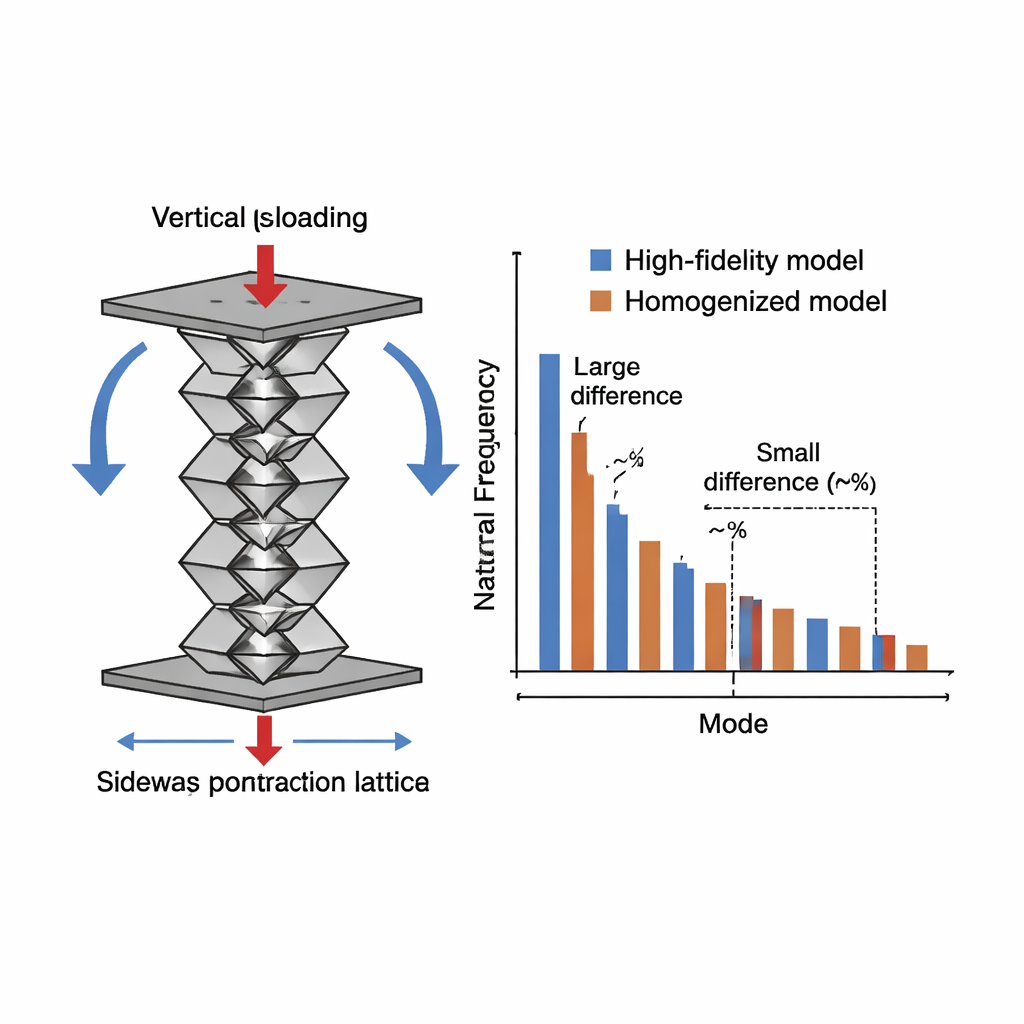
Many real‑world parts, from airplane panels to car bumpers and medical implants, must survive vibration without resonating themselves to failure. The researchers therefore examined how the lattices vibrate by computing their natural frequencies and mode shapes – the preferred ways they like to shake when excited. They compared the detailed strut models with their homogenized counterparts across different sizes, from a single unit cell up to 5×5×5 arrays. For simple, highly symmetric lattices like the octet, the simplified models tracked the detailed ones extremely well, even for small structures, and certain pairs of vibration modes merged into identical frequencies because of geometric symmetry. In more complex or auxetic designs, however, the homogenized models consistently predicted higher frequencies, especially for the lowest modes that control overall bending and rocking. The study found that for these anisotropic or auxetic lattices you need at least a 3×3×3 block before the simplified description becomes reliably accurate.
Design Rules for Future Lightweight Structures
For engineers, the key takeaway is that clever geometry can give ordinary materials extraordinary behavior – from uniform, easily modeled stiffness to highly directional or auxetic responses tuned for impact resistance and energy absorption. The work also offers practical rules of thumb: use homogenized models with confidence for highly symmetric lattices or for higher‑frequency vibration studies; switch to full, detailed models when dealing with small, anisotropic, or strongly auxetic architectures, especially if low‑frequency resonance is a concern. Simple design tweaks like rounding the joints can further boost stiffness and stabilize vibrations without adding weight. Together, these insights help chart a path toward safer, lighter, and more adaptable components in aerospace, biomedical devices, and other advanced technologies.
Citation: Shingare, K.B., Bochare, S., Schiffer, A. et al. High- and low-fidelity modal and mechanical analysis of architected strut-based lattice structures with auxetic topologies. Sci Rep 16, 7275 (2026). https://doi.org/10.1038/s41598-026-36997-y
Keywords: lattice materials, auxetic structures, mechanical metamaterials, finite element modeling, vibration analysis