Clear Sky Science · en
Machine learning-driven dynamic prognosis for primary colorectal lymphoma
Why this matters for patients and families
Primary colorectal lymphoma is a rare cancer that starts in the large intestine rather than in the lymph nodes. Because it is uncommon and often detected late, patients and families face a great deal of uncertainty about what the future holds. This study asks a simple but crucial question: given how long a person has already lived with this cancer, how do their chances of surviving the next few years change—and can modern computer tools turn that information into clearer, more personal guidance?
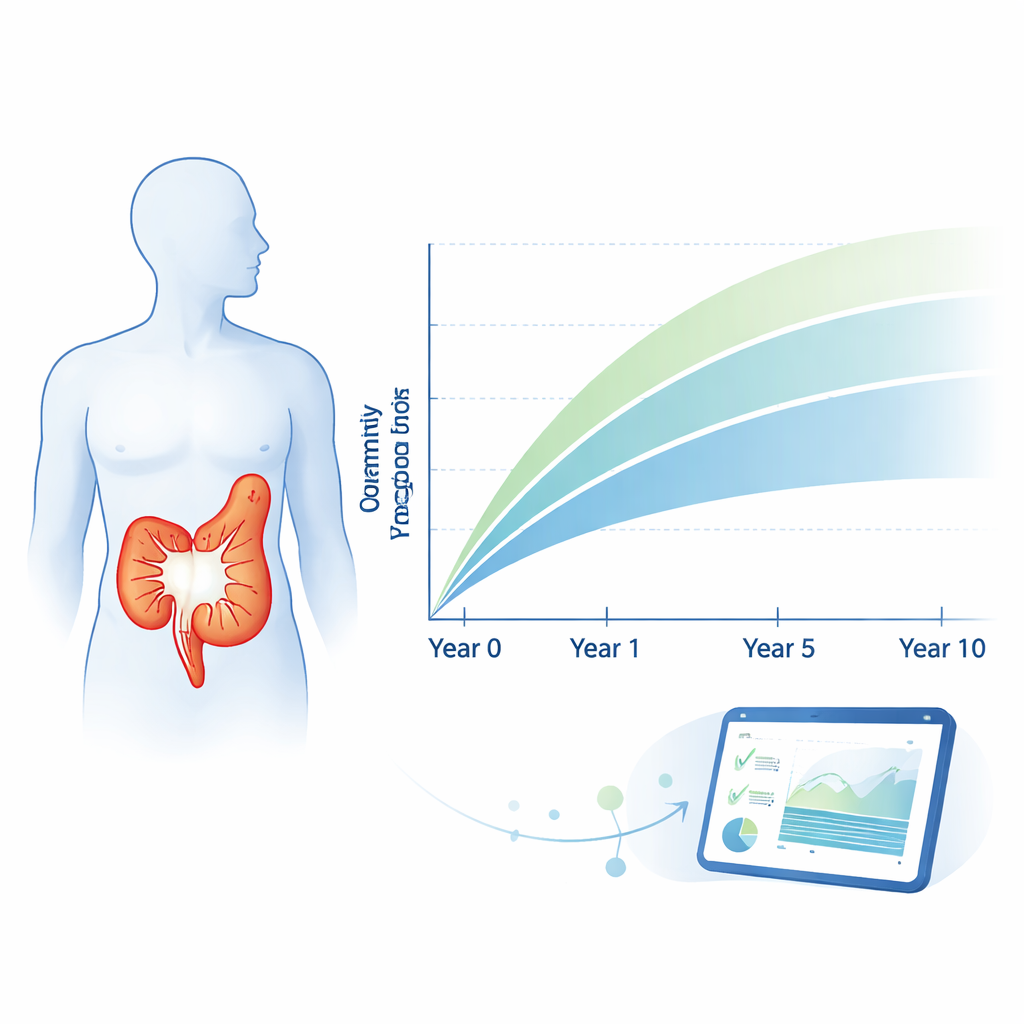
A rare cancer with shifting odds over time
Most survival statistics are fixed snapshots: they tell you the chance of living five or ten years from diagnosis, as if time stood still. But for people who are already several years past diagnosis, those numbers quickly become outdated. The researchers focused on “conditional survival,” which looks at the odds of living additional years given that a patient has already survived a certain amount of time. Using records from 2,743 people with primary colorectal lymphoma in the large U.S. SEER cancer registry between 2004 and 2021, they showed that survival chances improve the longer patients live past the early high-risk period. For example, while the overall chance of being alive ten years after diagnosis was about 54%, patients who had already made it to the five-year mark had roughly an 80% chance of reaching ten years.
Letting the data find what matters most
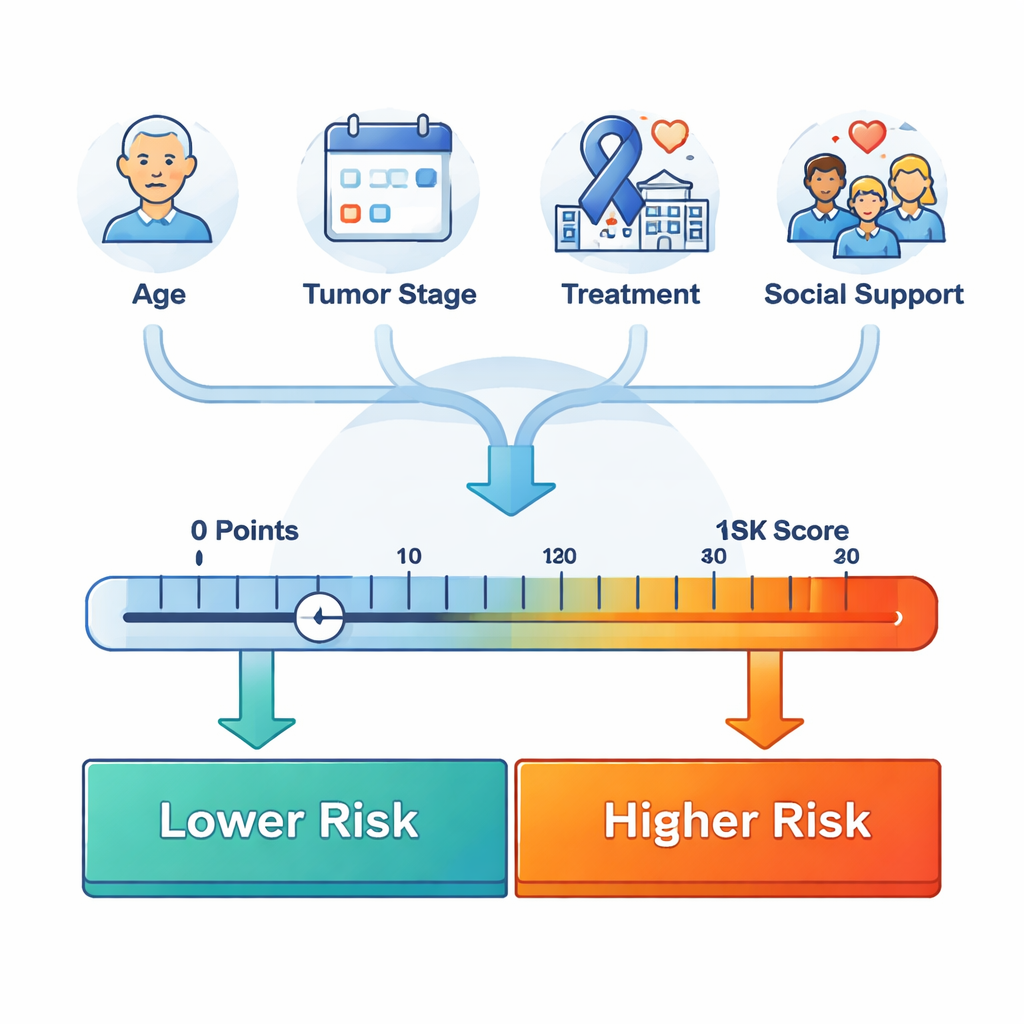
To understand which factors truly shape these changing odds, the team turned to a type of machine learning called a random survival forest. This method can sift through many variables and capture complex, non‑linear patterns that traditional statistical tools may miss. Out of 11 possible predictors, the algorithm highlighted seven as most important for long-term outcome: age, the microscopic type of lymphoma, how far the disease had spread (stage), whether the patient received chemotherapy, where in the colon or rectum the tumor started, and two social markers—household income and marital status. Age emerged as the single strongest predictor, followed by lymphoma type and stage, suggesting that who the patient is and what kind of tumor they have matter at least as much as where it appears.
Turning complex math into a bedside tool
Rather than leaving the results buried in code, the authors translated them into a visual scoring chart known as a nomogram. Doctors can locate a patient’s age group, tumor type, stage, treatment choices, and basic social context on the chart, assign points to each, and add them up to estimate that person’s chance of surviving three, five, or ten years—updated for how long they have already lived since diagnosis. When tested, this tool proved accurate and stable over time: in both the development group and a separate validation group, its ability to correctly distinguish patients with better or worse outcomes remained high over a full decade of follow‑up. It also clearly separated patients into low- and high‑risk groups, with markedly different survival curves.
What this means for care today
The model offers several practical benefits. Because the survival estimates are updated as time passes, doctors can adjust follow‑up plans: high‑risk patients may need closer checks and more aggressive therapy in the first few years, while those whose outlook improves can safely move to less intensive monitoring. Including income and marital status also underscores how support systems and access to care may influence outcomes, encouraging clinicians to consider social as well as medical needs. Although the analysis is limited by missing details on specific drug regimens and modern targeted therapies, and it still needs to be tested in other countries and time periods, it demonstrates how large datasets and machine learning can be combined to help personalize care in a rare disease.
A clearer picture of the future
For people living with primary colorectal lymphoma, prognosis is not a single unchanging number but a moving target that often improves with time. This study shows that by blending advanced computer methods with long‑term population data, it is possible to build a dynamic, patient‑friendly tool that tracks those changing odds. While it does not replace a doctor’s judgment, it can offer patients and families a more realistic and hopeful view of the road ahead—and help guide decisions about treatment and follow‑up that better match each person’s evolving risk.
Citation: Xia, G., Zhang, G., Wang, H. et al. Machine learning-driven dynamic prognosis for primary colorectal lymphoma. Sci Rep 16, 6196 (2026). https://doi.org/10.1038/s41598-026-36995-0
Keywords: primary colorectal lymphoma, conditional survival, machine learning prognosis, random survival forest, cancer risk stratification