Clear Sky Science · en
Emotional–Familiarity processing fluency moderates the Anxiety–Resilience association: evidence from a Chinese Cross-Sectional survey
Why Your Favorite Songs Matter When You Feel Anxious
When life feels overwhelming, many people instinctively reach for music—often the same meaningful, familiar songs again and again. This study asks a surprisingly simple question with big implications: for people living with anxiety, does the way they connect with music help them bounce back from stress more effectively? By surveying adults in China about their anxiety, resilience, and music preferences, the researchers explored whether emotionally important and well-known music acts as a kind of psychological resource rather than just a matter of “taste.”
Music as More Than Just Background Noise
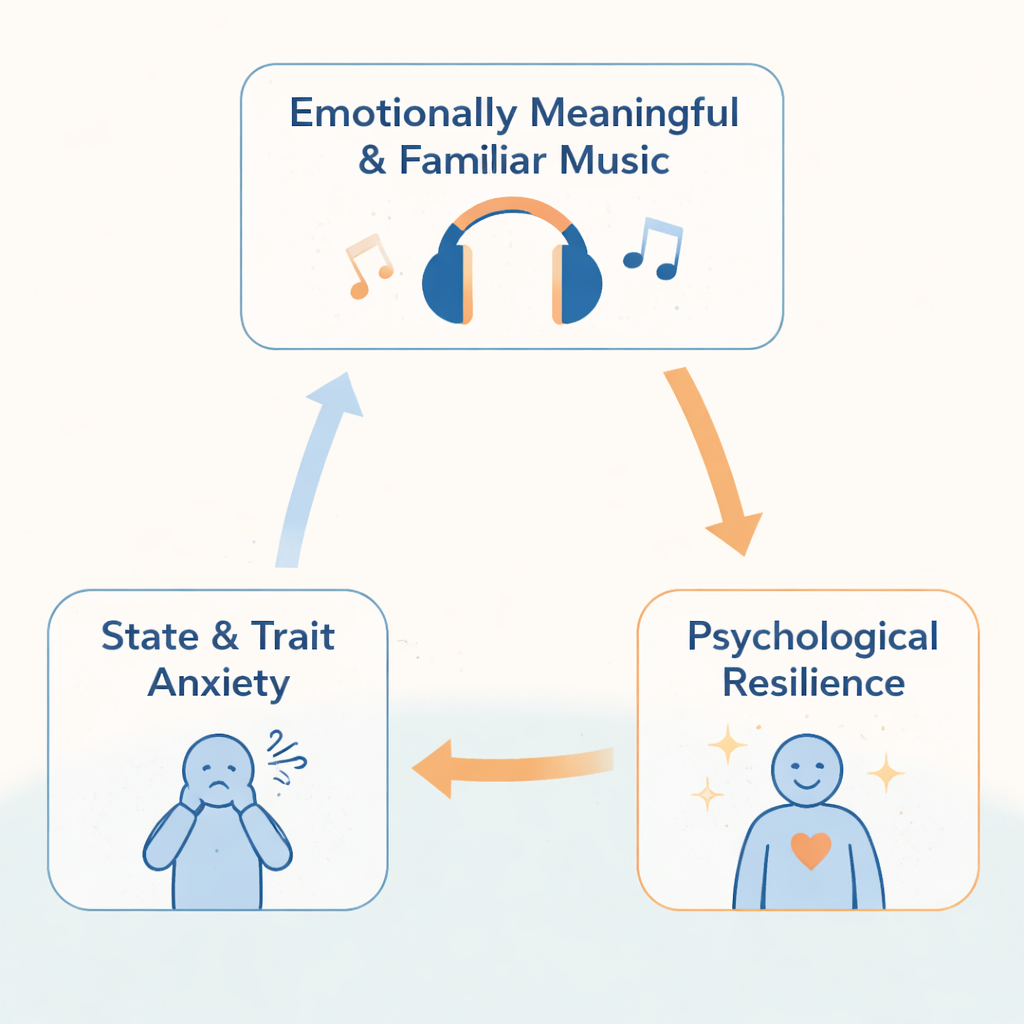
Most of us think of music preference as liking certain artists or genres. The authors argue that what really counts for coping is not style, but how we engage with music in the moment. They focused on two everyday tendencies: choosing music that feels personally meaningful and emotionally rich, and choosing music that feels familiar and easy to follow. Together, these tendencies form what the researchers call an “emotional–familiar” way of listening—using songs that carry memories, make sense to us, and are effortless to process when we are under pressure.
Zooming In on Anxiety and Resilience
The team distinguished between two forms of anxiety. State anxiety is the immediate nervousness or tension you feel in a stressful situation, such as before an exam. Trait anxiety is a more stable tendency to worry across many situations. Resilience, by contrast, is the capacity to recover from setbacks and keep functioning well. Rather than assuming that anxiety always harms resilience, the study asked whether the link between anxiety and resilience changes depending on how strongly someone prefers emotionally meaningful and familiar music.
What the Survey Revealed
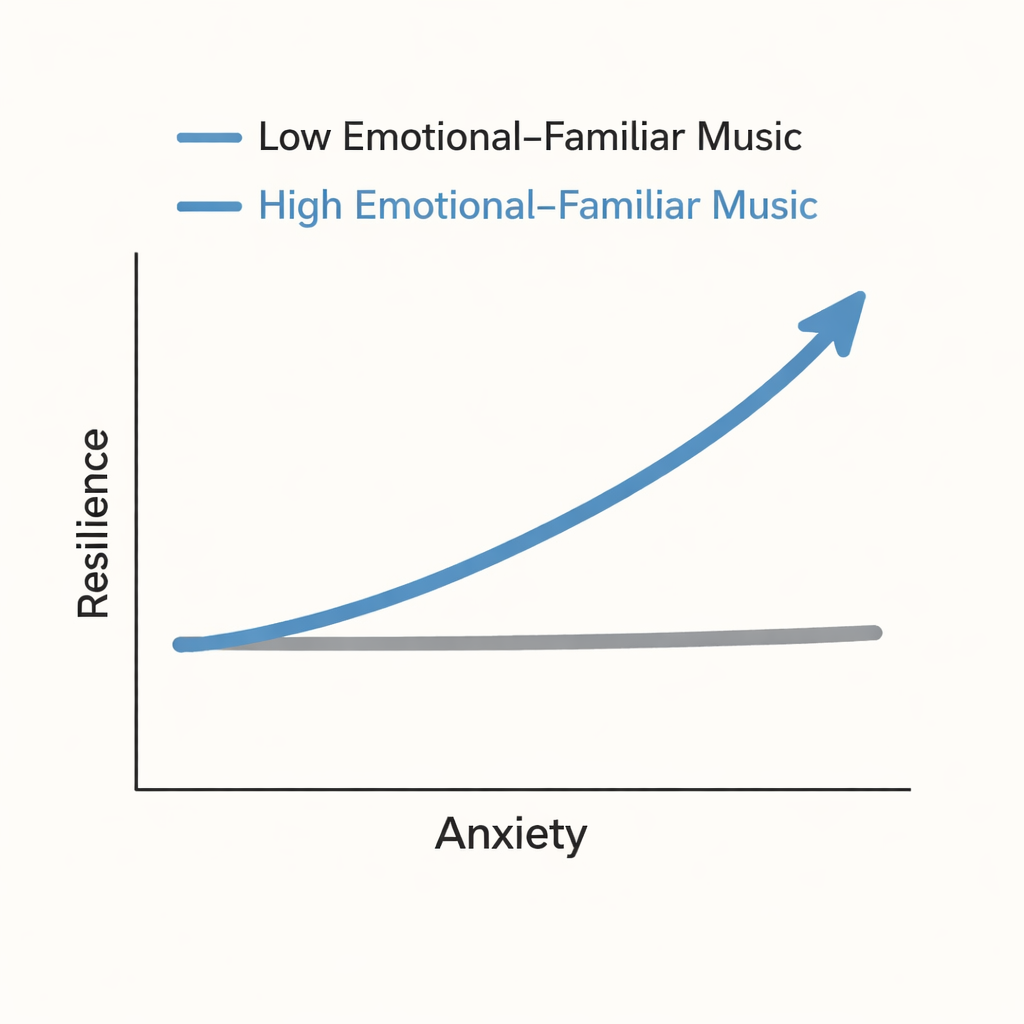
Over 400 adults in mainland China completed questionnaires about their anxiety levels, their ability to bounce back from stress, and how they like their music when they feel stressed. The key result was not that “more music equals less anxiety,” but something subtler. For people who did not strongly favor emotionally meaningful and familiar music, momentary anxiety was not clearly tied to resilience. However, among those with a strong emotional–familiar listening style, higher short-term anxiety went hand in hand with higher resilience. In other words, when people who were feeling tense also tended to reach for emotionally important, well-known music, their anxiety was more likely to be associated with robust coping rather than fragility.
Short-Term Signals vs. Long-Term Tendencies
The pattern was especially pronounced for state anxiety—the here-and-now feeling of being on edge. The moderating role of emotional–familiar music was weaker and less distinct for trait anxiety, the more chronic tendency to worry. This suggests that meaningful and familiar music may be most helpful as a flexible tool during acute stressful moments, rather than as a blanket shield for people who are generally anxious. The researchers also checked whether a simple liking for harmonious, pleasant-sounding music could explain the effect; even after accounting for this more basic musical preference, the special role of emotionally meaningful, familiar music in shaping the state-anxiety–resilience link largely remained.
What This Means for Everyday Life
To a lay reader, the takeaway is that your “comfort songs” may matter most when you are in the middle of a stressful episode. The study does not prove that music causes resilience, and it is based on self-reports from one cultural setting, so more research is needed. Still, the findings support a practical idea: when anxiety spikes, deliberately turning to music that feels both familiar and personally significant may help people transform nervous energy into a springboard for coping, rather than a spiral into distress.
Citation: Liu, H., Jin, Y. & He, H. Emotional–Familiarity processing fluency moderates the Anxiety–Resilience association: evidence from a Chinese Cross-Sectional survey. Sci Rep 16, 6044 (2026). https://doi.org/10.1038/s41598-026-36988-z
Keywords: music and emotion, anxiety, psychological resilience, familiar music, emotion regulation