Clear Sky Science · en
Modelling and metrics for optimal sizing of renewable power plants supplying green hydrogen generation systems
Turning Sun and Wind into Clean Fuel
Hydrogen is often described as a future “universal fuel,” able to power trucks, factories, and even entire neighborhoods without pumping carbon dioxide into the air—provided it is made using clean electricity. This paper explores how to design renewable power plants that can reliably feed hydrogen production systems, answering a very practical question: how much solar, wind, batteries, and backup grid power are really needed to run a green hydrogen station efficiently and affordably?
Building Blocks of a Green Hydrogen Station
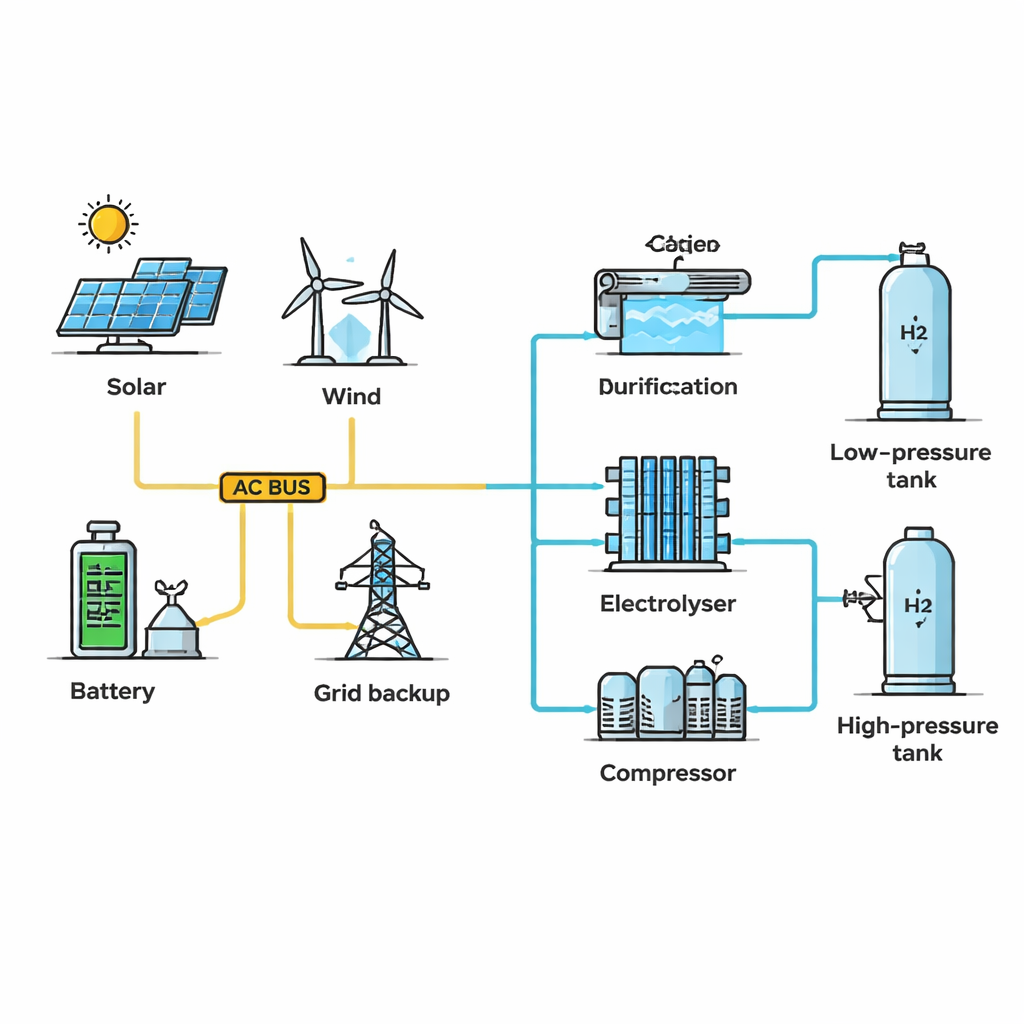
The study looks at a complete, realistic setup: solar panels and wind turbines generate electricity; a large battery smooths out ups and downs; a grid connection acts as a safety net; and, on the demand side, an industrial hydrogen station uses that electricity. The hydrogen station includes a water purification unit, an electrolyser that splits water into hydrogen and oxygen, compressors that raise the hydrogen to storage pressures, and low- and high-pressure tanks. Rather than focusing on one specific site, the authors create a modular “digital twin” of this whole chain that works with hourly data, so it can be adapted to many locations and sizes.
From Weather Data to Energy Flows
To capture real-world behavior, the model turns satellite-based weather data—sunlight on tilted solar panels and wind speeds at turbine height—into electric power over a full year, hour by hour. It then follows where that power goes: directly to the hydrogen system, into the battery, or back and forth through the grid connection. The battery model tracks state of charge and gradual ageing; the electrolyser model accounts for changing efficiency as it ramps up and down and as its stack wears over time; the hydrogen tanks and compressor are modeled so the system can respond smoothly to a constant hydrogen demand. This long-term lens lets the authors see seasonal patterns, like surplus solar energy in summer and extra reliance on wind and grid power in winter nights.
Measuring Performance Beyond Just Cost
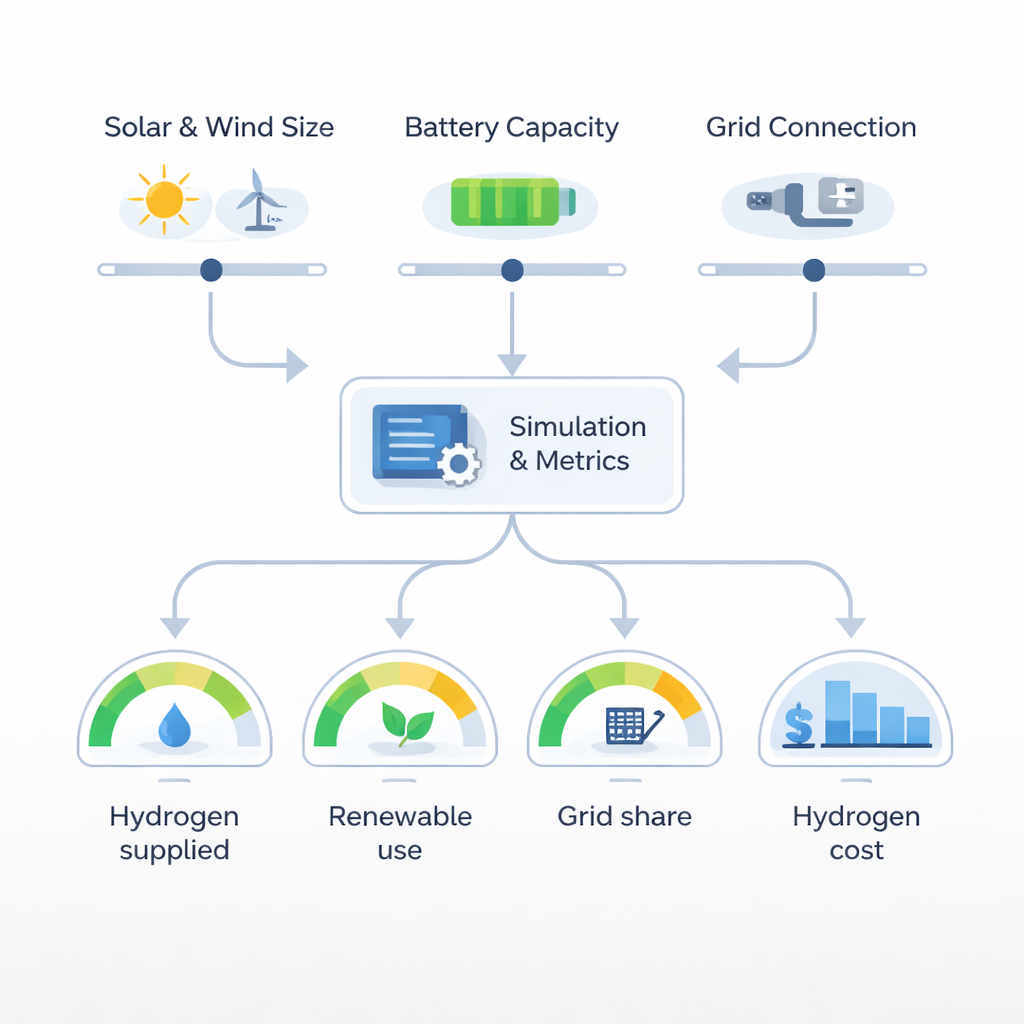
Most design studies focus on a single number such as the average cost of hydrogen. Here, the authors introduce a richer set of yardsticks. They include how much of the hydrogen demand is actually met, how effectively renewable energy is used instead of being wasted, how hard the battery is worked and how healthy it remains, how much energy comes from the grid versus local renewables, and the familiar capital cost and levelised cost of hydrogen. All of these metrics are normalised and combined in a flexible scoring method that allows designers and investors to assign different weights depending on what they care about most: low cost, low carbon, high reliability, or minimal battery wear.
What an “Optimal” Plant Looks Like in Practice
To show how the framework works, the authors test a concrete case in the UK: a hydrogen station built around a 1 megawatt electrolyser that is asked to supply a steady 18 kilograms of hydrogen per hour. They sweep through 1,470 different combinations of solar and wind capacities, battery sizes, and grid-connection strengths. The most balanced design they find uses 1.5 megawatts of wind power, 2.5 megawatts of solar power, a relatively modest 1 megawatt-hour battery, and a 200 kilowatt grid connection. Even with this fairly strong renewable build-out, the plant can only supply about 61% of the desired hydrogen on its own, with roughly one-fifth of its electricity still coming from the grid and around 16% of renewable energy spilled because it cannot be used or stored in time.
Implications for a Real Hydrogen Economy
For a lay reader, the key takeaway is that green hydrogen is possible, but it is not as simple as adding an electrolyser to a wind farm. Achieving reliable output requires carefully balanced capacities of solar, wind, batteries, and backup power, and even then there are trade-offs between cost, the share of demand met, and how “green” the hydrogen really is. The study’s modular model and performance metrics give planners a toolkit to explore these trade-offs transparently before building anything in steel and concrete. In the featured example, the “best” design keeps hydrogen costs to about £3.2 per kilogram while limiting grid dependence, but it still leaves room for improvements—such as using surplus renewable energy for heating or cooling—to make full use of the clean power that nature provides.
Citation: Naderi, M., Stone, D.A. & Ballantyne, E.E.F. Modelling and metrics for optimal sizing of renewable power plants supplying green hydrogen generation systems. Sci Rep 16, 6261 (2026). https://doi.org/10.1038/s41598-026-36987-0
Keywords: green hydrogen, renewable energy, electrolyser systems, energy storage, techno-economic modelling