Clear Sky Science · en
Effect of drying method on the surface properties of cellulose nanofibril films
Why smoother plant-based films matter
From clear food wrappers to flexible electronics, many everyday products depend on thin films that keep out air and moisture. Today these films are usually made from plastics derived from fossil fuels. This study looks at a promising, greener alternative: ultra-thin films made from plant fibers called cellulose nanofibrils. The researchers show that simply changing how these films are dried can dramatically improve how smooth, dense, and water‑resistant they become—qualities that are crucial if bio‑based films are to compete with plastics in real‑world packaging and coating applications.
Tiny fibers from trees
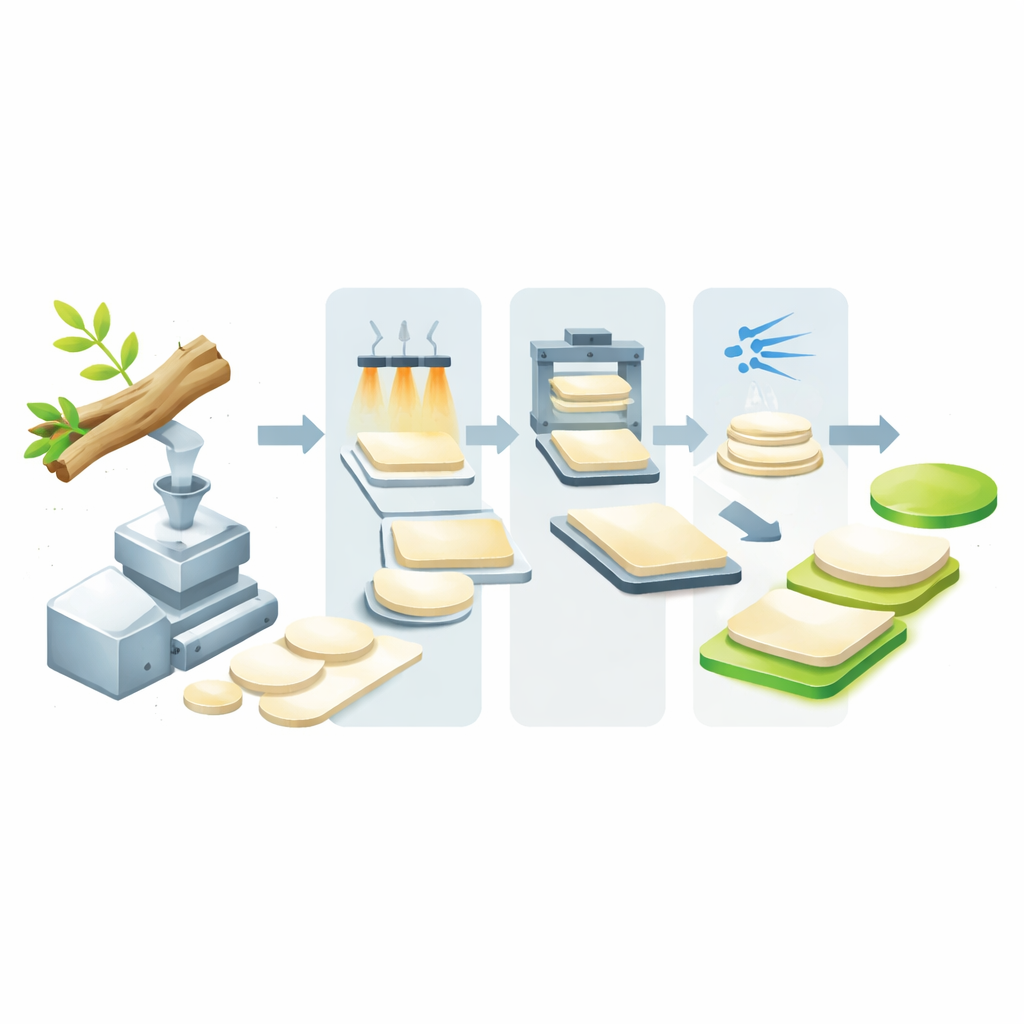
Cellulose nanofibrils are hair‑like strands stripped from wood pulp, in this case from eucalyptus. Each strand is thousands of times thinner than a human hair but several micrometers long, forming a tangled network when dispersed in water. Because they are strong, transparent, and naturally abundant, these nanofibrils can be turned into thin, paper‑like films that block oxygen, transmit light, and expand very little with heat—ideal traits for high‑value uses such as food packaging, flexible displays, and protective coatings. The challenge is that as the water leaves during drying, the surface of the film can wrinkle, crack, or become rough, which weakens barrier performance and makes it harder to bond cleanly to other layers.
Four ways to turn liquid into solid
The team compared four families of drying methods that all start from water‑based nanofibril suspensions. In simple casting, the liquid is poured into a dish and left to dry slowly in air or under vacuum. In filtration‑based methods, water is first pulled out through a membrane, leaving a wet sheet that is then dried under different combinations of heat and pressure. One method uses only a light load in an oven, another uses a single hot pressing step, and the most advanced strategy combines an initial mechanical press with a second, gentler thermal pressing in an oven. Across these options, the researchers varied temperature, pressure, and time to see how each recipe affected surface smoothness, density, internal voids, and how easily water spread on the surface.
What drying does to the film surface
To look beyond what the naked eye can see, the authors used scanning electron microscopy and atomic force microscopy to map the film surfaces in three dimensions at the micro‑ and nanometer scale. The simplest casting method produced many visible wrinkles and required nearly a week to dry, yet its nano‑scale roughness was similar to most other methods. Drying after filtration with only a modest load in an oven created pronounced roughness and even large cracks. In contrast, films that went through a carefully controlled two‑step pressing sequence were much more uniform. The best condition—pressing followed by heating at 110 °C under a low additional pressure for two hours—gave the lowest average roughness, with a finely ordered network of nanofibrils and very few surface defects.
Packing the fibers closer together
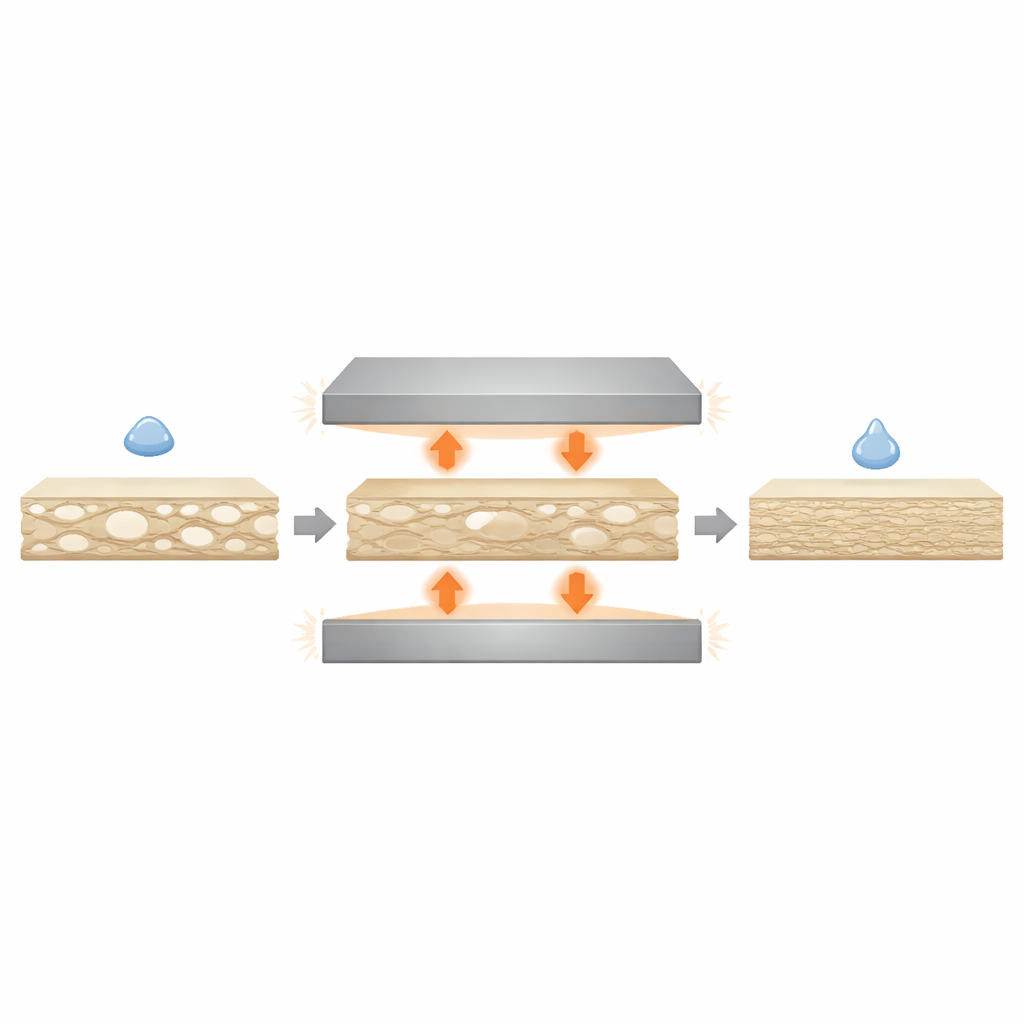
Measuring thickness, mass, and internal voids showed that pressure and heat do more than flatten the surface: they squeeze the nanofibrils into a denser, less porous structure. All films had similar thickness, but those subjected to double pressing reached the highest density and the lowest porosity, meaning there was less empty space inside. This structural tightening changed how water behaved on the surface. Every film remained inherently water‑loving, as expected for cellulose, yet double‑pressed films showed larger, more rounded water droplets, a sign that water penetrated more slowly. The study links this behavior directly to higher density and lower porosity: fewer internal channels and a smoother, more compact top layer leave water with fewer pathways to soak in.
Balancing stiffness and flexibility
The way the films were dried also shifted their mechanical behavior. Slowly cast films were less stiff but could stretch more before breaking, while all pressure‑assisted methods produced stiffer sheets that elongated less. Interestingly, the maximum strength at break was similar across methods, meaning the films could ultimately carry comparable loads even though their stiffness differed. This suggests manufacturers could tune drying conditions depending on whether flexibility or rigidity is more important, without sacrificing overall strength.
What this means for greener packaging
Overall, the study identifies double thermal pressing—specifically a two‑hour oven step at moderate temperature and low pressure—as a fast and efficient way to make cellulose nanofibril films with smooth surfaces, high density, and improved resistance to water ingress. For non‑experts, the key message is that how these plant‑based films are dried can make the difference between a wrinkled, leaky sheet and a sleek, high‑performance barrier. By fine‑tuning pressure, temperature, and time during drying, industry can move closer to replacing some plastic packaging and coatings with sustainable materials made from wood pulp, without compromising function or product quality.
Citation: Andrade, A., Vega-Reyes, J., Yáñez-Durán, G. et al. Effect of drying method on the surface properties of cellulose nanofibril films. Sci Rep 16, 9152 (2026). https://doi.org/10.1038/s41598-026-36984-3
Keywords: cellulose nanofibril films, drying methods, surface roughness, sustainable packaging, barrier materials