Clear Sky Science · en
Pure tone auditory thresholds and their association with cognition in the Canadian Longitudinal Study on Aging
Why hearing and thinking are linked
As people grow older, many notice that hearing conversations—especially in noisy places—gets harder. At the same time, concerns about memory lapses or slower thinking often arise. Because age‑related hearing loss has been flagged as the single biggest changeable risk factor for dementia, scientists want to know just how closely hearing and thinking abilities are connected, and whether simple measures of hearing can reliably flag who is most at risk.
Listening to thousands of older adults
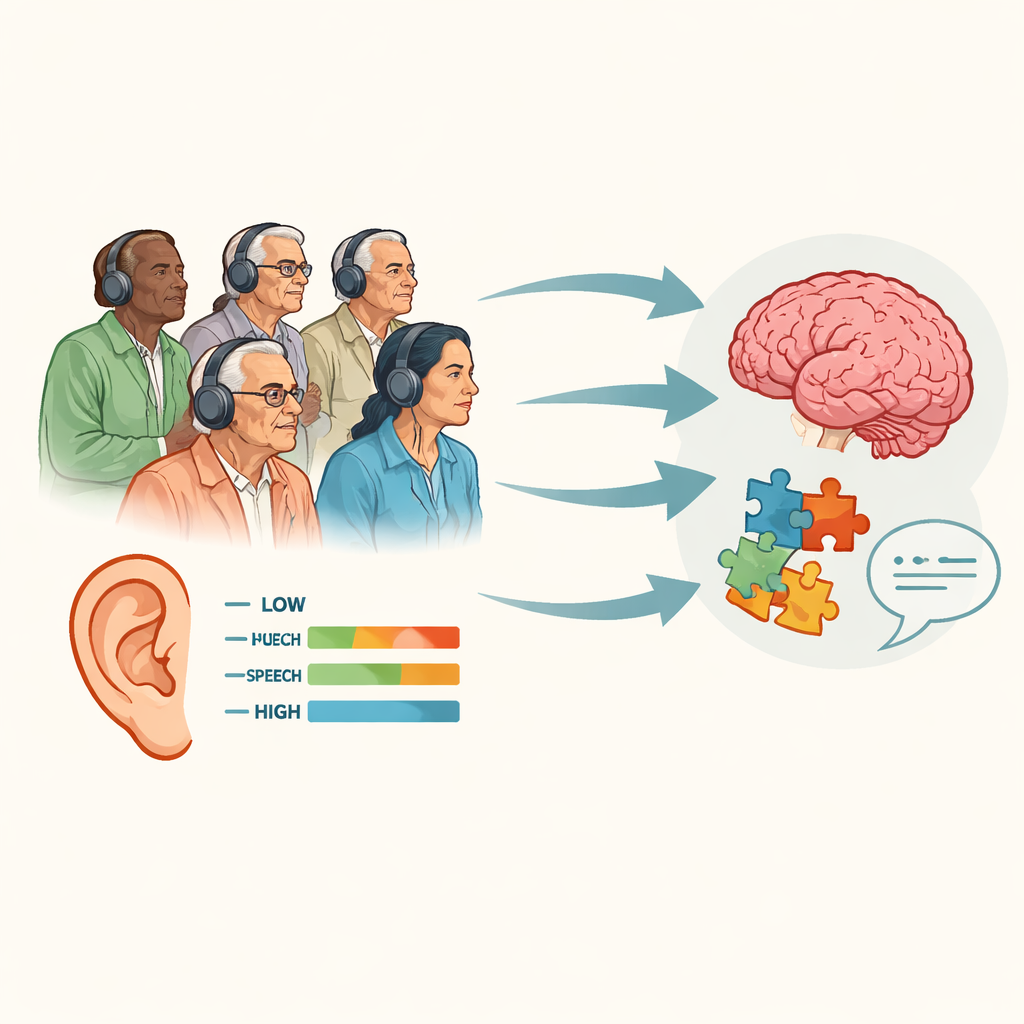
In this study, researchers tapped into the Canadian Longitudinal Study on Aging, a large project following more than 50,000 middle‑aged and older adults. They focused on 13,654 participants aged 60 and over who had completed both hearing and thinking tests. Hearing was measured with pure tones—simple beeps presented through headphones at different pitches, from low to high. From these results, the team created several versions of a single summary score, called a pure tone average, using different combinations of low, mid, and high frequencies and different ways of combining the two ears. Thinking abilities were captured with two composite scores: one for memory (recalling word lists) and one for “executive functions” such as flexible thinking, word fluency, and resisting distractions.
Testing many ways to measure hearing
Scientists around the world do not agree on which sound frequencies—or which ear—to use when summarizing hearing ability. Some averages emphasize low tones, others focus on pitches important for speech, and still others lean on higher pitches where age‑related hearing loss typically begins. The team calculated four main hearing scores: low‑frequency, speech‑focused, high‑frequency, and an overall average across all tested tones. They also repeated their analyses three times, once using the better ear, once using the worse ear, and once using the average of both ears. On top of this, they took into account age, sex, education, cardiovascular risk factors, symptoms of depression, and whether people used hearing aids—factors known to influence both hearing and cognition.
What the numbers revealed
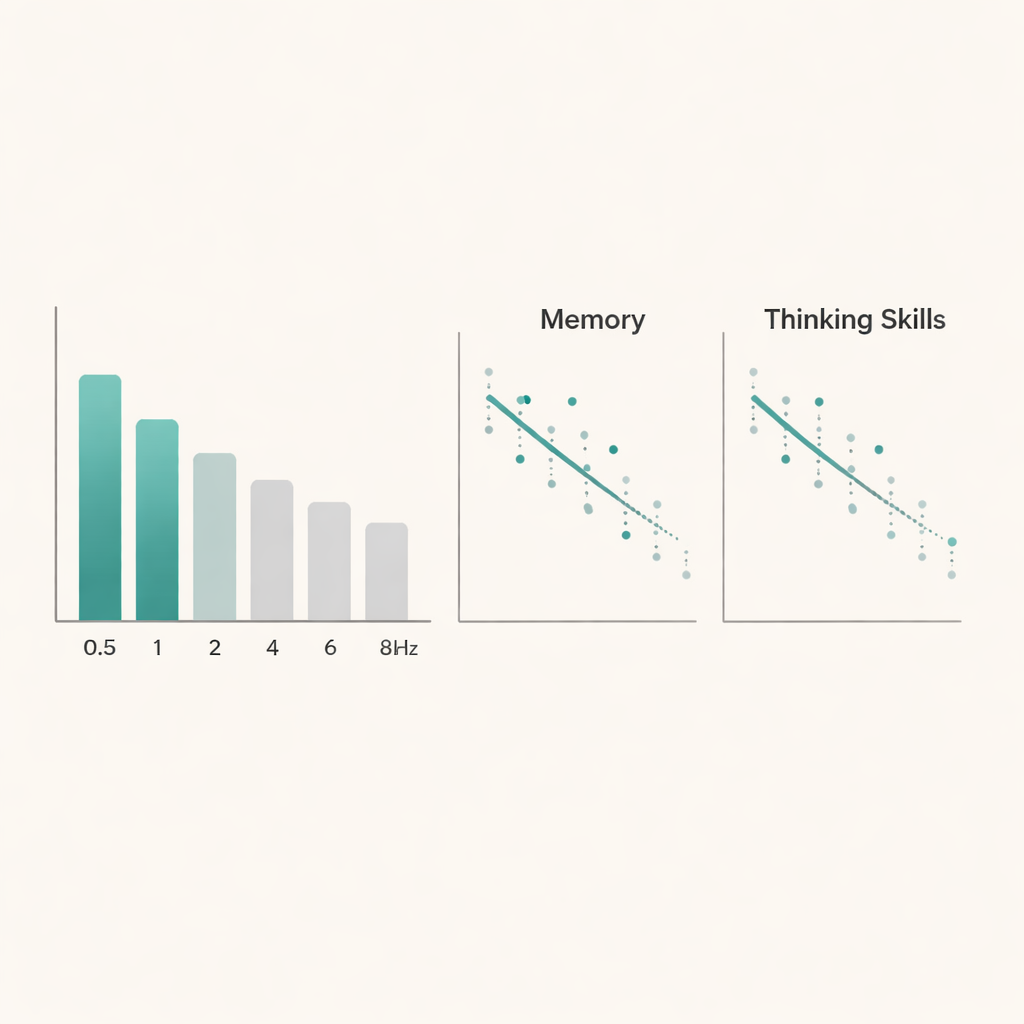
Across all versions of the hearing scores, poorer hearing was linked to slightly lower memory and executive function scores: people who heard less well tended to perform a bit worse on thinking tests. This link stayed statistically reliable even after adjusting for all the other health and lifestyle factors. However, it was consistently weak: once age, education, mood, and cardiovascular health were considered, hearing explained at most about 1% of the differences in thinking scores between individuals. The particular way hearing was summarized did not make much difference. Whether researchers used the better ear, the worse ear, or both ears together, the strength of the hearing–thinking link barely changed. Scores that focused only on the highest pitches showed the weakest relationships, while averages emphasizing lower and speech‑related frequencies were slightly more informative.
Zeroing in on the most informative tones
To see if a specific set of tones carried most of the useful information, the researchers ran stepwise regression analyses, letting a statistical model pick the frequencies that best predicted cognitive performance while controlling for the six major health factors. For memory, the most informative combination involved three relatively low pitches: 0.5, 1, and 2 kilohertz. For executive functions, the best pair was 0.5 and 3 kilohertz. Even these “optimal” combinations added only tiny improvements to their models, reinforcing the idea that while hearing matters, it is only one of many small influences on how well older adults perform on cognitive tests.
What this means for everyday life
The study supports the view that age‑related hearing loss and thinking abilities are connected, but not in a dramatic way. For the average older adult, worse hearing is associated with somewhat poorer memory and mental flexibility, yet this effect is modest compared with the impact of age, education, cardiovascular health, and depression. Importantly, the results suggest that researchers and clinicians do not need to agonize over exactly which ear or precise set of frequencies they use to summarize hearing: most reasonable choices capture essentially the same weak but reliable link. Together with other work showing that treating hearing loss can slow cognitive decline in some people, these findings argue for taking hearing health seriously in later life, while also recognizing that it is just one piece of a larger brain‑health puzzle.
Citation: Wang, Y.R., Bacon, BA., Champoux, F. et al. Pure tone auditory thresholds and their association with cognition in the Canadian Longitudinal Study on Aging. Sci Rep 16, 5808 (2026). https://doi.org/10.1038/s41598-026-36979-0
Keywords: age-related hearing loss, cognitive decline, dementia risk, pure tone audiometry, older adults