Clear Sky Science · en
Antibacterial potential of endophytic Streptomyces spp. isolated from peanut (Arachis hypogaea) roots: bioactiveprofiling and molecular docking studies
Hidden helpers in peanut roots
Doctors are running out of effective antibiotics as more bacteria learn to evade our best drugs. This study explores an unexpected ally in that fight: friendly microbes living quietly inside peanut roots. By examining these tiny partners, the researchers discovered natural chemicals that can outperform several standard antibiotics in the lab, hinting that everyday crops may hide powerful new medicines.
Why antibiotic resistance is so alarming
Antibiotic resistance already kills hundreds of thousands of people every year, and that number could soar into the tens of millions by mid-century. Many hospital infections are now caused by bacteria that shrug off multiple drugs. Because inventing brand‑new antibiotics is difficult and slow, scientists are turning back to nature, searching for organisms that have spent millions of years locked in microscopic arms races and have evolved their own chemical weapons.
Friendly tenants inside plants
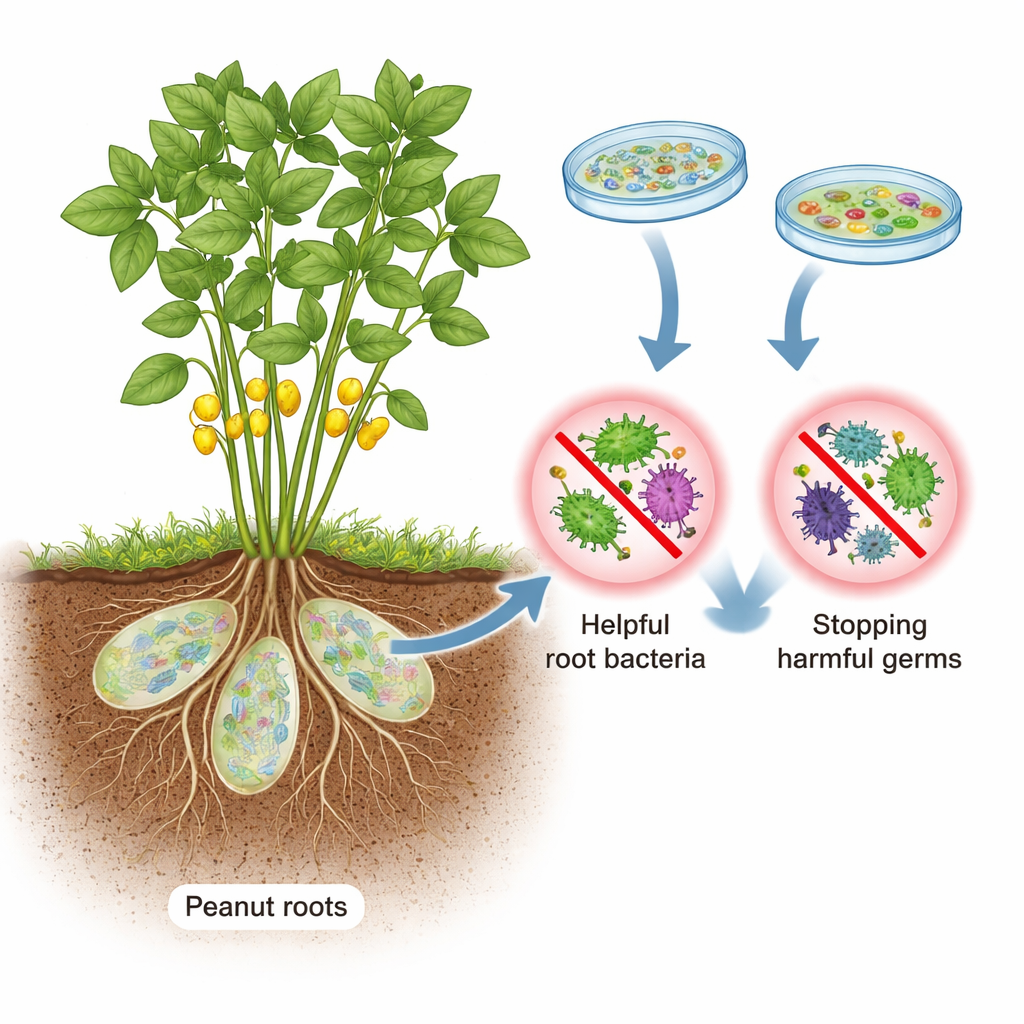
Plants are not as alone as they appear. Their tissues are home to “endophytes” – bacteria and fungi that live between plant cells without causing disease. Some of the most promising endophytes belong to the genus Streptomyces, already famous as the source of many of our existing antibiotics. In this work, scientists collected healthy peanut roots from fields in Egypt, carefully sterilized the outside so only internal microbes remained, and then grew whatever survived on special lab media. From sixteen root samples, they obtained eighteen different Streptomyces strains.
Finding the strongest defenders
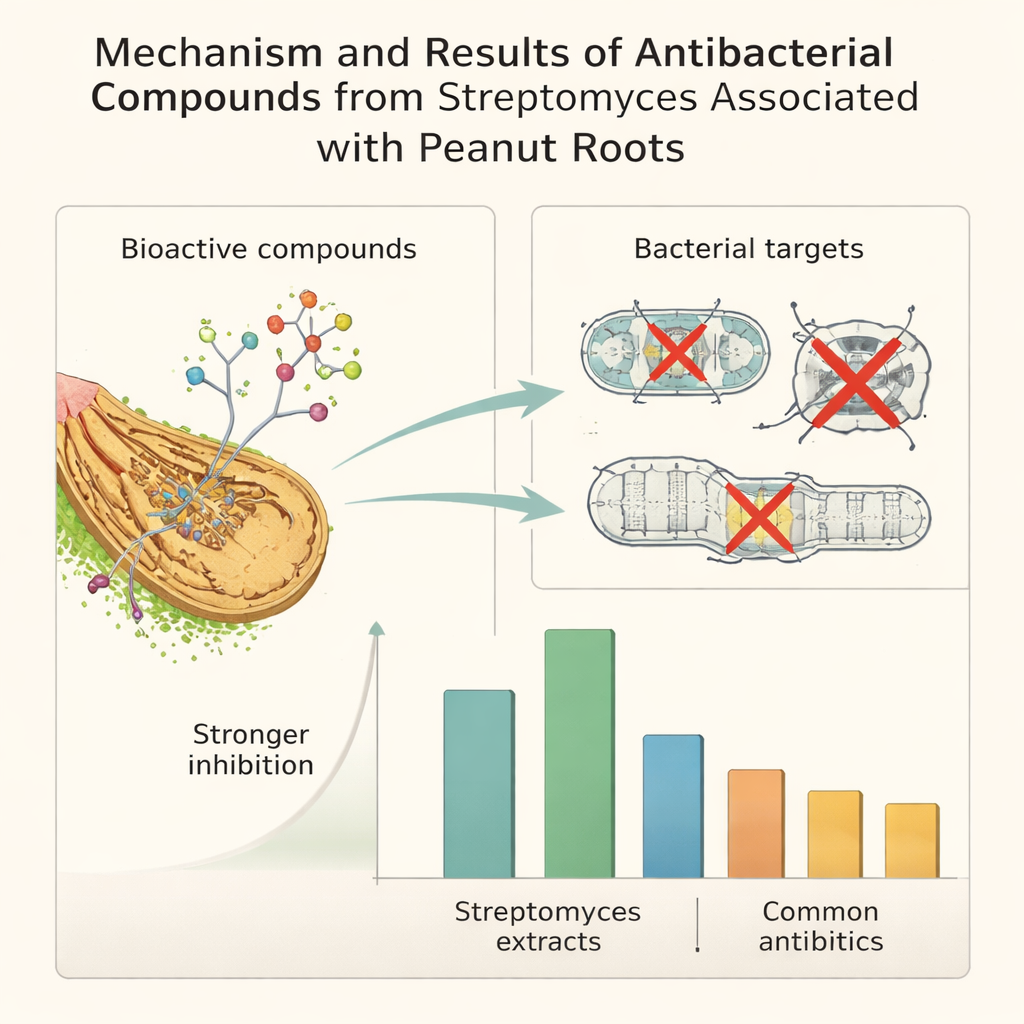
The team tested all eighteen strains against a panel of well‑known disease‑causing bacteria, including Staphylococcus aureus and Escherichia coli. Eight strains showed clear ability to halt growth of these pathogens, and two stood out in particular, named Streptomyces rochei RSA1 and Streptomyces sp. RSA2. When the researchers extracted the compounds these strains released into liquid culture and placed them on paper discs, the resulting clear “kill zones” on test plates were often larger than those produced by six common antibiotics. This suggests that peanut‑associated Streptomyces can generate especially potent antibacterial cocktails.
Peeking into the chemical toolbox
To understand what made these microbes so effective, the scientists analyzed the extracts using sensitive instruments that separate and weigh molecules. They found a mix of nine bioactive compounds, dominated by one sulfur‑containing substance called 2‑(butylthio) pyrimidine‑4,6‑dione, which accounted for over 96% of the material in both strains. Other ingredients included antioxidant‑like phenols, ring‑shaped molecules that can interfere with bacterial communication and biofilm formation, and small cyclic peptides known to damage or destabilize microbes. Additional infrared measurements confirmed the key chemical groups present in these mixtures, strengthening confidence in the identifications.
How the molecules may stop germs
The study went further than simply listing ingredients. Using computer‑based “docking” and molecular dynamics simulations, the researchers modeled how the main peanut‑derived compounds might latch onto crucial bacterial machinery, such as enzymes and the ribosomes that build proteins. The simulations showed strong and stable binding, with the RSA1 compounds in particular forming tight, energetically favorable complexes. These interactions could block DNA building blocks, disrupt protein production, and weaken bacterial membranes all at once. This multi‑pronged attack may explain why the crude extracts outperformed individual commercial antibiotics in lab tests.
What this means for future medicines
While these findings are still at an early, laboratory stage, they highlight peanut roots as a surprisingly rich source of candidates for new antibiotics. The work shows that endophytic Streptomyces can produce powerful, diverse molecules that hit bacteria in several ways, making it harder for resistance to develop. Before any treatment reaches patients, the individual compounds will need to be purified, tested for safety, and evaluated in animals and clinical trials. Even so, this study underscores a hopeful message: by looking more closely at the quiet partnerships between crops and their microscopic tenants, we may yet uncover the next generation of life‑saving drugs.
Citation: Mohamed, R.M., El Awady, M.E., Fahim, A.M. et al. Antibacterial potential of endophytic Streptomyces spp. isolated from peanut (Arachis hypogaea) roots: bioactiveprofiling and molecular docking studies. Sci Rep 16, 6351 (2026). https://doi.org/10.1038/s41598-026-36976-3
Keywords: antibiotic resistance, Streptomyces, endophytes, peanut roots, natural antibiotics