Clear Sky Science · en
Zero electromagnetic coupling of closely spaced identical helical resonators
Why tiny metal springs can ignore each other
When electronic devices cram antennas, filters, and resonant parts into ever-smaller spaces, those elements start to “talk” to each other in unwanted ways. This mutual interference can blur signals, shift working frequencies, and limit how compact our gadgets can be. This paper shows that by carefully twisting tiny metal helices—coiled wires that act like miniature radio resonators—it is possible to almost completely switch off that interaction, even when the helices sit much closer than a tenth of the wavelength of the radio waves they handle.
How close neighbors usually interfere
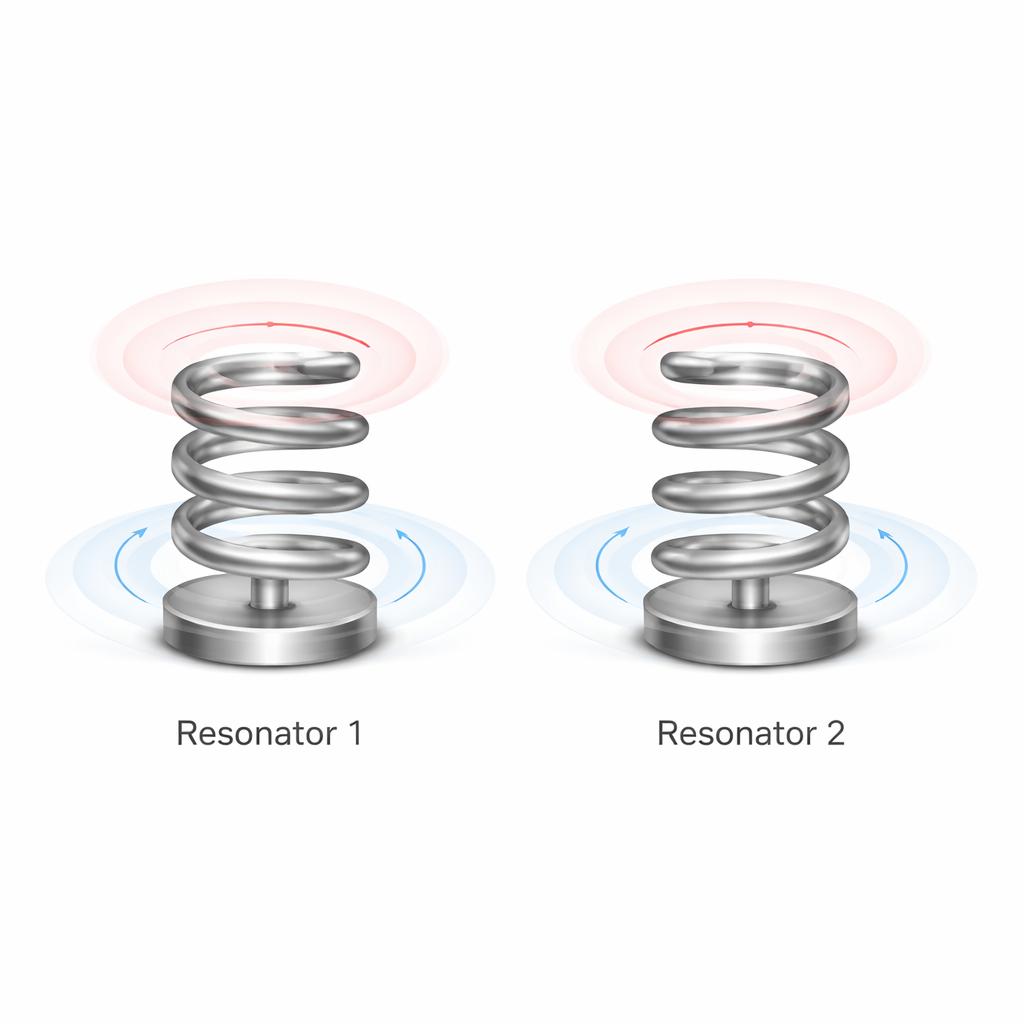
Any object that resonates with radio or microwave fields behaves a bit like a tuning fork: if you strike one, it can make a nearby fork ring too. In electronics, this happens through electric and magnetic fields leaking from one resonator to its neighbor. That "coupling" can be useful when we want waves to hop along an engineered structure, but it becomes a headache in dense antenna arrays or metamaterials, where unintended interactions distort performance. The authors focus on helical resonators—wire coils shaped like tiny springs—which are widely used and can be made much smaller than the wavelength they interact with. Conventionally, zero coupling is achieved by placing resonators far apart, so their fields barely overlap. Here, the striking claim is that almost the same effect can be engineered at extremely close spacings by exploiting geometry rather than distance.
Balancing electric and magnetic “conversations”
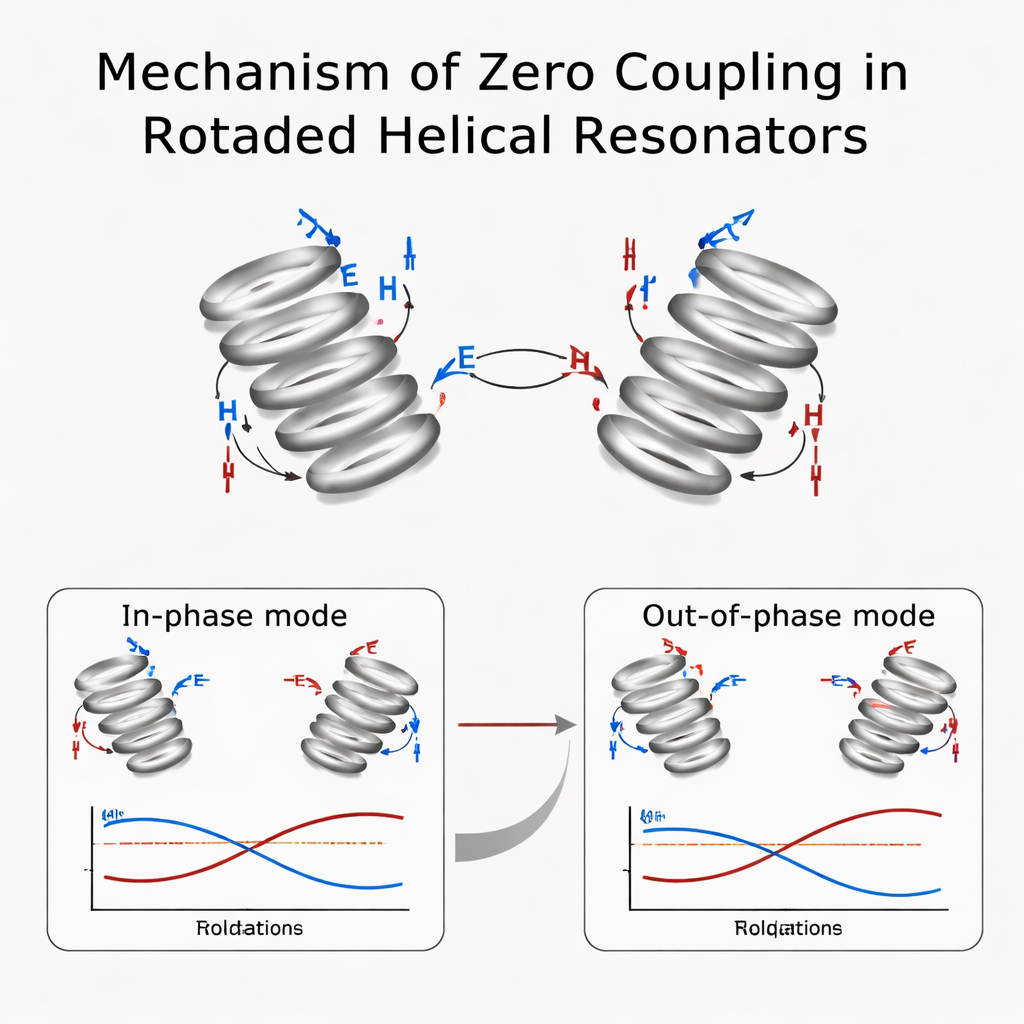
To understand and control these interactions, the team first treats each helix as an electrical circuit made of an inductor (storing magnetic energy), a capacitor (storing electric energy), and a resistor. When two such circuits are near each other, they interact magnetically (like two loop antennas) and electrically (through charges facing across the gap). The two kinds of coupling normally shift the shared resonances into two distinct modes: an in-phase mode, where both helices oscillate together, and an out-of-phase mode, where they swing oppositely. By calculating how these mode frequencies move as the helices are rotated about an axis through their centers, the researchers find special angles where the two frequencies merge. At these angles, the electric and magnetic couplings cancel each other so effectively that the net interaction is nearly zero, even though each contribution is still strong.
What detailed simulations and lab tests reveal
Using finite-element simulations, the authors compute the electromagnetic fields of pairs of four-turn copper helices placed side by side and then rotated. They map how the in-phase and out-of-phase resonances swap order and cross at particular tilt angles, signaling the near-zero coupling condition. They also examine higher-order resonances, which have more intricate field patterns, and discover additional crossing angles with more complex behavior. To confirm these predictions experimentally, they develop a fabrication method in which 3D-printed plastic molds are filled with a low-melting-point alloy called Field’s metal, producing highly repeatable helices encased in plastic. Measurements with a microwave network analyzer show resonance shifts that closely match the simulations, including the angles where the two main resonances become indistinguishable within experimental precision.
From isolated pairs to slow waves in chains
The study then scales up from a single pair to an infinite chain of identical helices arranged periodically. In such a chain, coupling determines how quickly energy can flow from one resonator to the next, which appears as the slope of a dispersion curve linking frequency and wavevector. By choosing a tilt angle that minimizes coupling between neighbors, the authors obtain very flat dispersion curves and correspondingly low “group velocity,” meaning that wave packets creep along the chain only very slowly. They also show how changing the sign and strength of coupling, merely by rotating the helices, can flip the ordering of modes and reshape how energy flows, while longer-range interactions between more distant neighbors keep the group velocity from reaching exactly zero.
Why this matters for future compact technologies
For non-specialists, the core message is that it is possible to design tiny resonant structures that sit almost shoulder-to-shoulder yet barely influence one another, simply by choosing the right orientation. This geometric trick could make it easier to build tightly packed antenna arrays, filters, and metamaterials that behave predictably, without the usual penalties from crowding. At the same time, the same principles can be used deliberately to slow down electromagnetic waves along engineered chains of helices, potentially enabling compact delay lines and signal-processing elements. Although this work focuses on a one-dimensional row of coils, the authors suggest that similar ideas could be extended to two- and three-dimensional arrays, opening the door to more flexible control over electromagnetic waves in future devices.
Citation: Gudge-Brooke, J., Clow, N., Hibbins, A.P. et al. Zero electromagnetic coupling of closely spaced identical helical resonators. Sci Rep 16, 7661 (2026). https://doi.org/10.1038/s41598-026-36975-4
Keywords: helical resonators, electromagnetic coupling, metamaterials, slow waves, microwave antennas