Clear Sky Science · en
Water use efficiency regulated by ecosystem type and soil plant water interactions in cold arid regions
Why water thriftiness in cold deserts matters
High mountain deserts may look barren, but they quietly control how much water and carbon move between land and air. In the cold, dry valleys on the northeastern edge of the Qinghai–Tibet Plateau, every drop of water must be used wisely by plants. This study asks a deceptively simple question: how do different kinds of vegetation and soils in this harsh region work together to help plants squeeze the most growth out of very limited water—what scientists call water‑use efficiency?
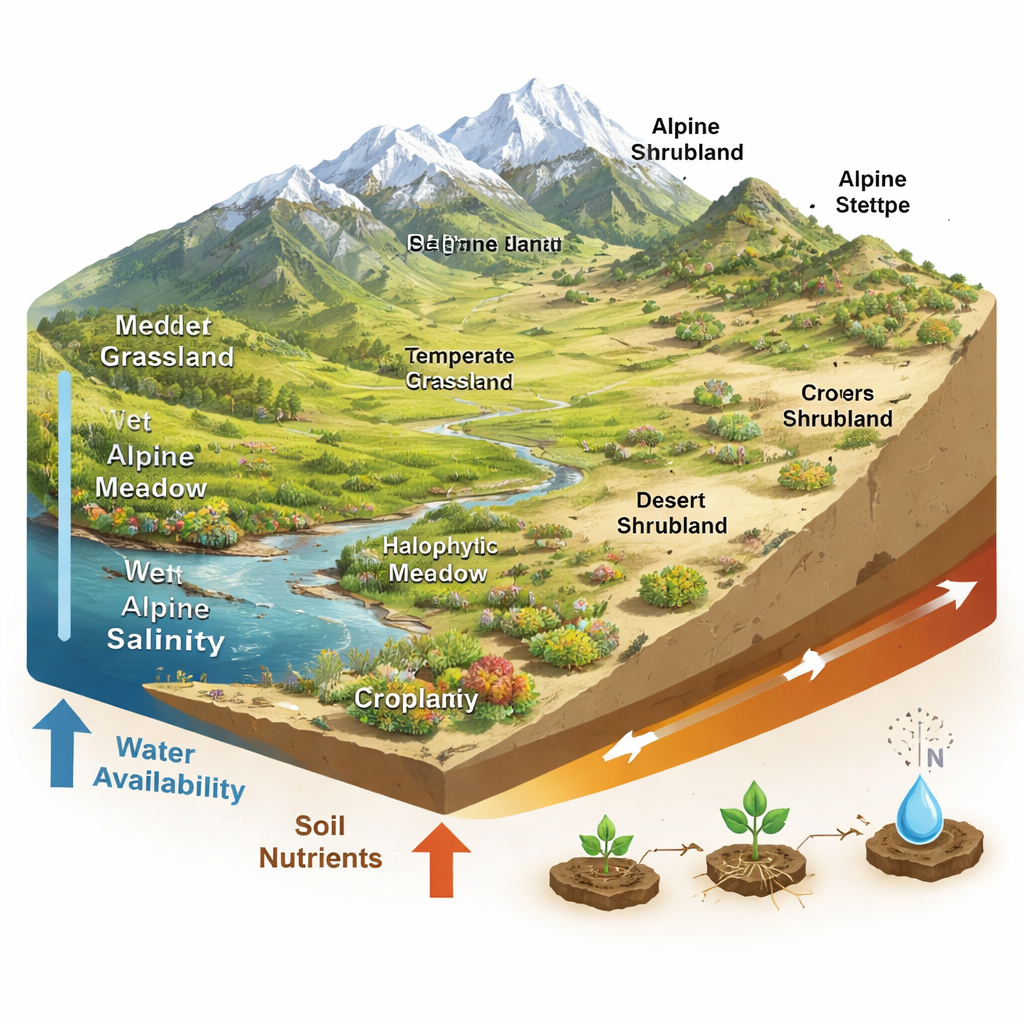
Different landscapes, different rules
The researchers compared seven types of ecosystems packed into one mountain basin: lush alpine meadows, alpine shrublands, alpine steppes, temperate grasslands, desert shrublands, salty halophytic meadows, and farmed croplands. Each comes with its own mix of rainfall, groundwater, and soil fertility. By collecting soil samples down to one meter, measuring soil moisture and salt, and analyzing leaves from 74 plant individuals, the team built a detailed picture of how water, nutrients and plant traits differ from place to place. These contrasts allowed them to see how the surrounding environment pushes plants toward different strategies for using water.
Rich topsoil as a life-support zone
Across all ecosystems, the upper 20 centimeters of soil emerged as the critical "life-support layer." Here, carbon, nitrogen, phosphorus, and water were strongly concentrated, then declined steadily with depth. Productive systems—alpine meadow, halophytic meadow, and cropland—held the richest stores of organic matter and nutrients, helped by dense vegetation and steady inputs of dead roots and leaves. In contrast, desert shrubland and alpine steppe, with sparse, low-growing plants, had poorer soils and far less organic material. Soil acidity changed little with depth and stayed weakly alkaline throughout, suggesting that shifts in fertility and water, rather than pH, are what really separate these ecosystems ecologically.
Water and salt: partners and enemies
Moisture and salt in the soil formed intricate vertical patterns that depended strongly on ecosystem type. In many places, the team saw a "dry top, salty middle" profile: as water evaporated upward from the surface, dissolved salts were left behind, concentrating in certain layers even while the soil itself dried out. This moisture‑deficit, salt‑accumulation pattern was clear in croplands, desert shrubland, and temperate grasslands, where irrigation, strong sun, and wind all help drive salts upward. In wetter systems such as alpine and halophytic meadows, water and salt sometimes increased together in deeper layers, a sign that shallow groundwater or seepage from higher slopes was feeding both. These distinct water–salt combinations create very different levels of stress for roots trying to draw in water.
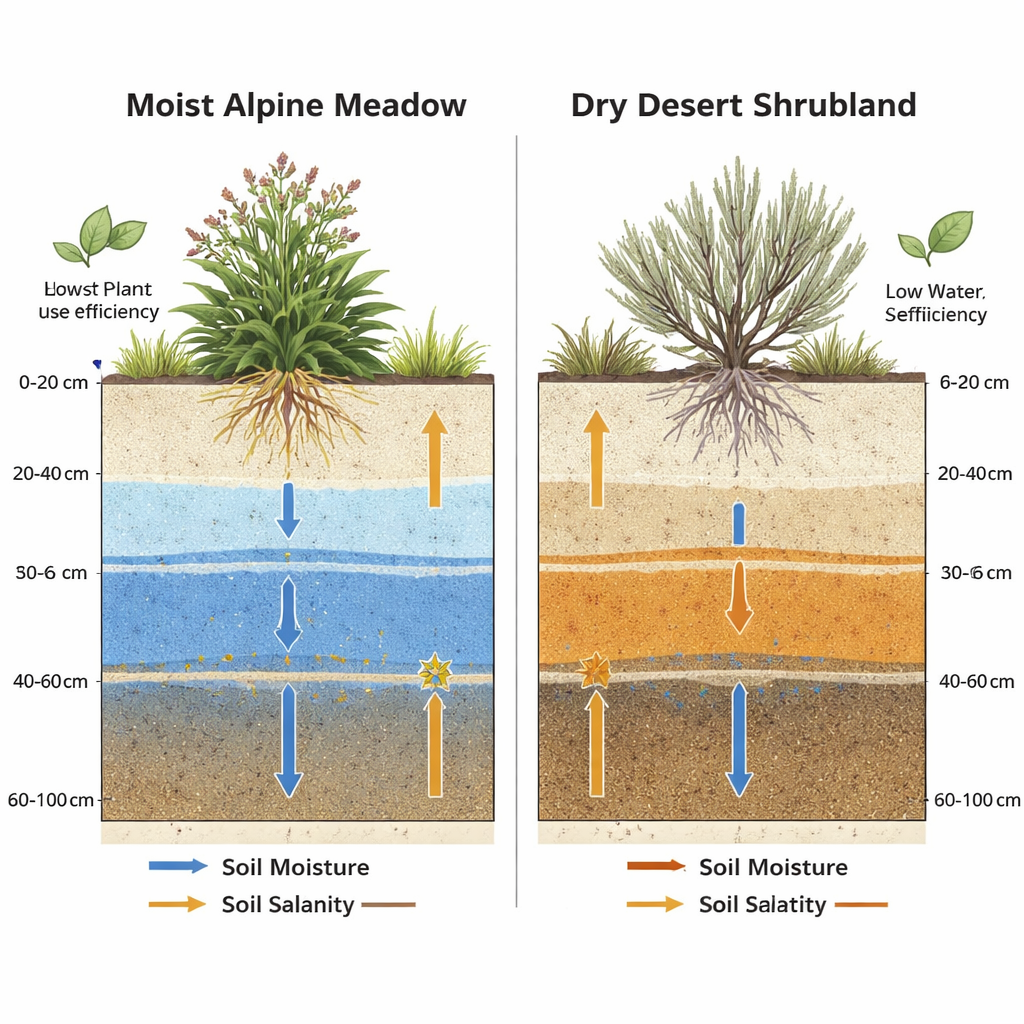
Leaf-level strategies for saving water
The scientists then linked these belowground patterns to leaf traits that control how plants take in carbon and lose water. In drier or salt‑stressed sites, plant water‑use efficiency was most strongly tied to traits that manage photosynthesis and leaf wetness—such as chlorophyll content, the balance between two types of chlorophyll, and how much water the leaves could physically hold. Under these tough conditions, plants seem to maximize each unit of water by fine‑tuning how light is captured and how tightly stomata (the pores on leaves) are opened. In relatively well‑watered and fertile systems, by contrast, efficiency depended more on how much nitrogen and carbon leaves contained, and on the balance between nitrogen and phosphorus. Here, plants appeared to focus on running their internal "engines"—enzymes and metabolic pathways—as effectively as possible rather than simply holding onto water.
What this means for fragile mountain regions
Together, the results show that water‑use efficiency in cold, arid mountains is not fixed; it emerges from a three‑way negotiation between soil, water and plant biology that changes from one ecosystem to the next. Where water is scarce or salty, plants lean on traits that help them conserve and carefully spend each drop. Where water and nutrients are more plentiful, they shift toward traits that boost growth and metabolism. For land managers and restoration projects on the Qinghai–Tibet Plateau and similar regions, this means that improving vegetation health is not just about adding water or fertilizer. It also requires understanding how each ecosystem’s particular mix of soil depth, moisture and salt sets the stage for different, locally adapted plant strategies for using water wisely.
Citation: He, Q., Cao, G., Han, G. et al. Water use efficiency regulated by ecosystem type and soil plant water interactions in cold arid regions. Sci Rep 16, 5894 (2026). https://doi.org/10.1038/s41598-026-36971-8
Keywords: water-use efficiency, cold arid ecosystems, Qinghai–Tibet Plateau, soil moisture and salinity, plant functional traits